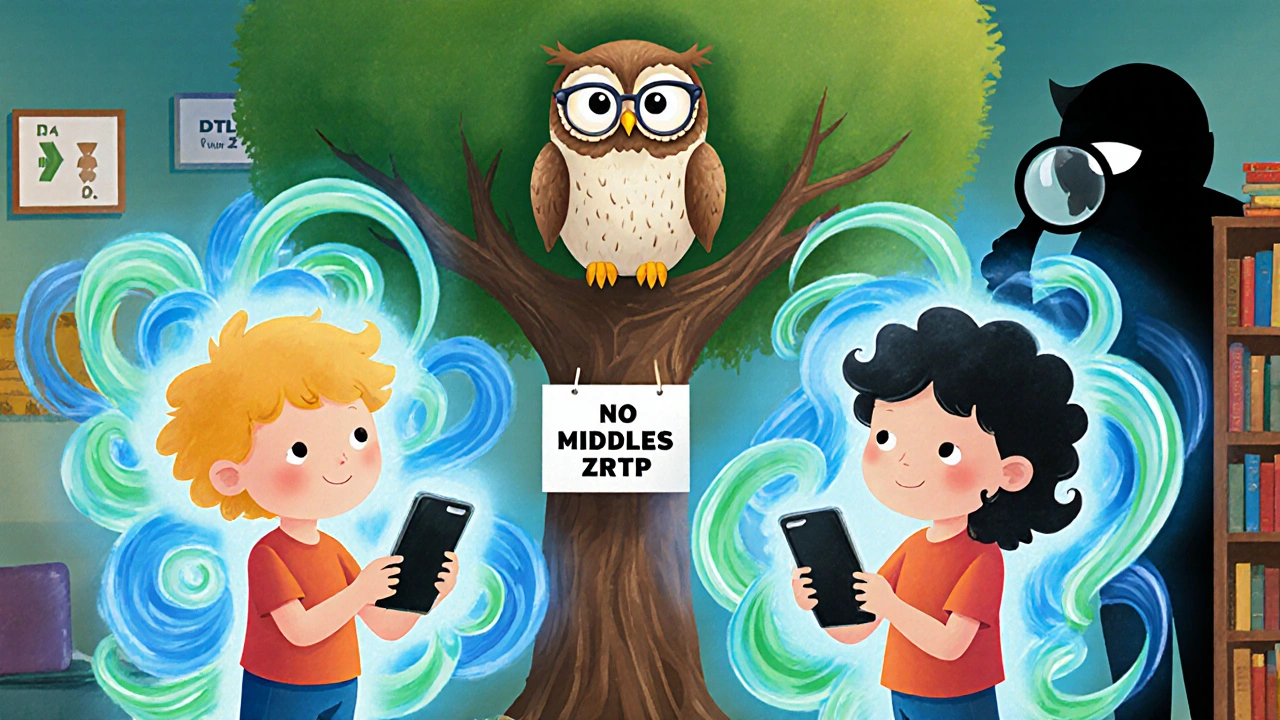
ZRTP: Secure VoIP Encryption Explained
When you make a VoIP call, your voice travels over the internet—and unless it’s encrypted, anyone with access to the network can listen in. ZRTP, a protocol that establishes end-to-end encryption for voice calls between two endpoints without relying on central servers. Also known as Zimmermann Real-time Transport Protocol, it’s one of the few methods that keeps your calls truly private, even if your provider is compromised. Unlike TLS-based encryption that depends on your VoIP provider’s infrastructure, ZRTP generates keys directly between your phone and the person you’re calling. That means no middleman can intercept or store your conversation.
ZRTP works alongside SIP and RTP, the standard protocols that handle call setup and voice data. It doesn’t need pre-shared secrets or certificates. Instead, it uses a simple key agreement called Diffie-Hellman, where both devices exchange public values over the network and independently calculate the same secret key. You’ll see a short string of numbers on both screens during setup—this is the short authentication string. If the numbers match, you know no one’s tampering with the call. It’s like shaking hands over the internet to confirm you’re talking to the right person.
This matters because VoIP calls are vulnerable in ways traditional phone lines aren’t. Hackers can capture traffic on public Wi-Fi, exploit misconfigured firewalls, or even trick your router into rerouting calls. ZRTP fixes that. It’s used in apps like Signal, RedPhone, and some business-grade SIP phones from AudioCodes and Snom. If you’re handling sensitive conversations—lawyers with clients, doctors with patients, or small businesses talking to suppliers—ZRTP isn’t optional. It’s the baseline.
But ZRTP isn’t magic. It only works if both sides support it. If your phone uses ZRTP but your contact’s system doesn’t, the call falls back to unencrypted RTP. That’s why you need to check your device settings. Many VoIP phones let you enable ZRTP under Security or Advanced Settings. You’ll also want to pair it with a strong firewall and proper VLAN setup to keep voice traffic isolated from data. And while ZRTP protects the call itself, it doesn’t secure voicemails or call logs stored on servers. For full privacy, you need to think about the whole chain.
What you’ll find below are real-world guides on how ZRTP fits into larger VoIP security setups. From configuring SIP phones to understand how DSCP markings and VLANs help ZRTP work smoothly, to comparing hardware that supports it out of the box. You’ll also see how encryption ties into compliance, call recording rules, and even how Webhook security can be strengthened when voice traffic is encrypted at the source. This isn’t theory. These are the steps businesses and remote teams take every day to keep their calls private—and avoid costly breaches.