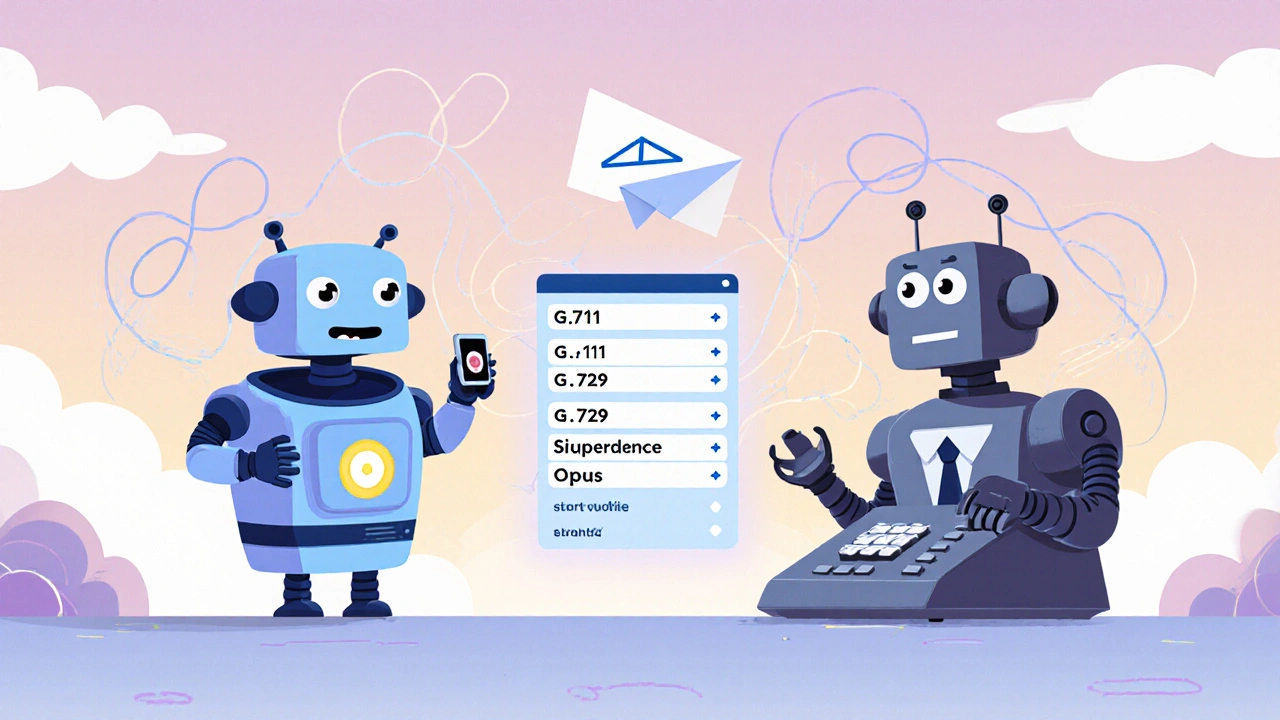
G.711 vs Opus: Which Audio Codec Wins for VoIP Calls?
When it comes to VoIP call quality, the audio codec, a method for compressing and decompressing voice data to send over the internet. Also known as voice encoder-decoder, it’s the hidden engine behind every call you make. Two codecs dominate the scene: G.711, a legacy, uncompressed standard used since the 1980s for phone networks, and Opus, a modern, open-source codec designed for the internet era with adaptive bitrate and low latency. Choosing between them isn’t about which is "better"—it’s about which fits your network, your budget, and your need for crystal-clear calls.
G.711 delivers studio-quality sound because it doesn’t compress voice data much—it’s basically digital phone line audio. That’s great if you have plenty of bandwidth and zero tolerance for any distortion. But it eats up 64 Kbps per call, which adds up fast when you’ve got 50 agents on a system. Opus, on the other hand, adjusts dynamically. It can drop down to 6 Kbps on a weak connection and still sound natural, or ramp up to 510 Kbps for CD-quality audio on a fast network. It handles background noise better, adapts to packet loss without dropping out, and works great for mobile and remote workers. You won’t find G.711 in Zoom or Teams—but you’ll find Opus everywhere. That’s not an accident. Companies using Opus report fewer complaints about robotic voices, dropped syllables, and laggy conversations.
Still, G.711 hasn’t disappeared. Many legacy PBX systems, call centers with strict compliance rules, and hardware phones still rely on it because it’s predictable. If you’re integrating with old equipment or need to meet specific regulatory standards for call recording, G.711 might be your only option. But if you’re building a new system, upgrading hardware, or managing a hybrid workforce, Opus is the smarter play. It’s not just about saving bandwidth—it’s about making sure your customers hear you clearly, even on shaky Wi-Fi. The posts below break down real-world tests, setup tips, and how these codecs interact with DSCP marking, jitter buffers, and network prioritization. You’ll see which one actually improves agent efficiency, reduces support tickets, and cuts your monthly bill. No theory. Just what works today.