Recording calls on remote VoIP systems isn’t just about catching mistakes or training agents anymore. If you’re running a business with distributed teams, you’re already collecting voice data-and if you don’t handle it right, you’re risking fines, lawsuits, or worse. In 2025, failing to record calls properly under regulations like GDPR, HIPAA, or FINRA can cost companies millions. This isn’t optional. It’s operational.
Why Recording Remote VoIP Calls Is Non-Negotiable
Companies with remote teams record calls for three reasons: compliance, quality control, and legal protection. But only one of those is mandatory. The other two are bonuses. If you’re in finance, healthcare, or customer service, you’re legally required to record. The SEC’s Rule 17a-4 forces broker-dealers to archive 100% of business communications for six years. HIPAA demands recordings of patient-related calls be kept for at least six years, with strict access controls. Even outside regulated industries, lawsuits over verbal agreements are rising. LexisNexis found that 31% of tech firms and 27% of retailers now record calls after being sued over disputed terms.Cloud-based VoIP platforms like Vonage, RingCentral, and 8x8 make this easy-but only if configured correctly. You can’t just flip a switch. You need a system that understands jurisdiction, encryption, retention, and consent.
What Regulations Actually Require
Regulations don’t say “record everything.” They say: record appropriately, store securely, and be transparent.- GDPR (EU/UK): You need a lawful basis for processing personal data in calls. Consent is one option-but “legitimate interest” is often better for business calls. You can’t just say “calls may be recorded for quality.” You must tell callers exactly why, and where the data goes. The UK’s ICO made this clear in 2022.
- PCI-DSS: Never record full credit card numbers. You must either block the middle 6 digits (digits 7-12) or use DTMF masking to mute tones when numbers are entered. Automated redaction tools now do this in real time.
- FINRA (US Financial): All business calls must be recorded and stored for six years. The first two years must be instantly accessible. No exceptions.
- State Laws (US): 39 states allow one-party consent. 11 states-including California, Florida, and Washington-require all parties to know. Michigan’s law is still in flux after a 2021 court ruling. If your remote team works in any of those 11, you must disclose before the call starts.
- Germany & Ireland: Germany treats unauthorized recording as a criminal offense. Ireland requires detailed, written explanations of why you’re recording to get valid consent.
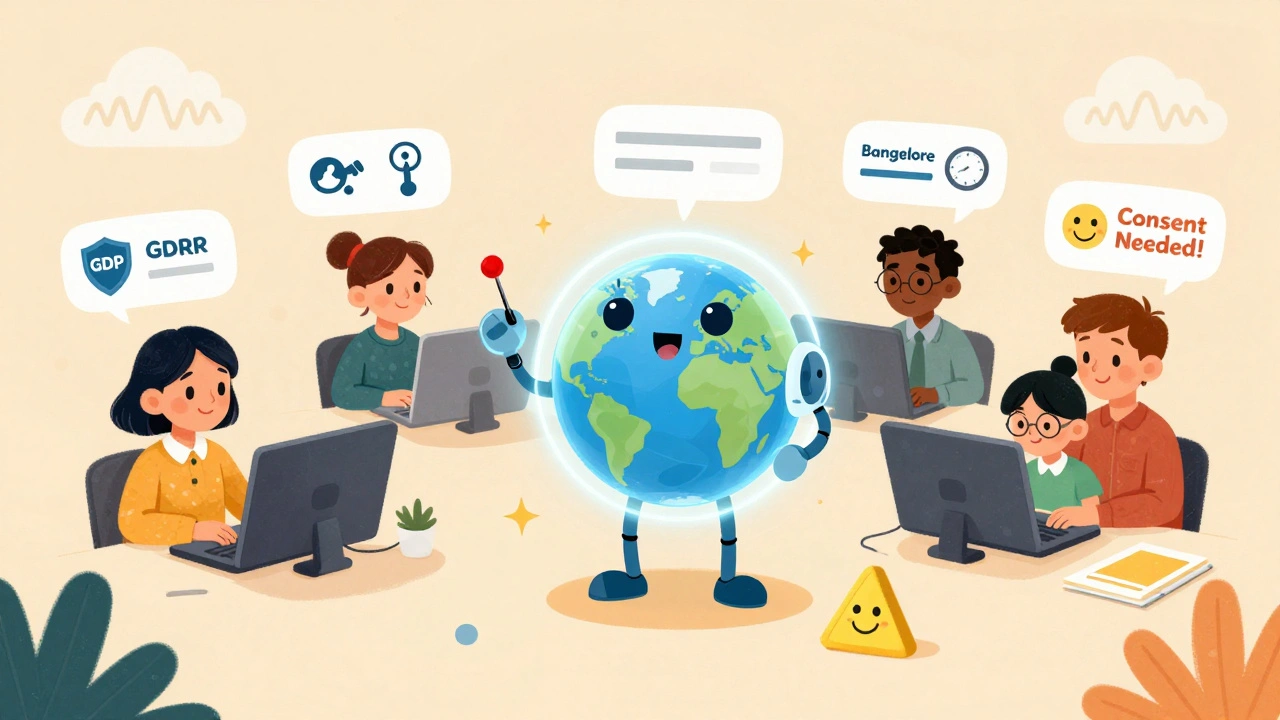
There are now 74 distinct regulatory frameworks globally for call recording, according to the International Compliance Association. That means if your team works from Berlin, Bangalore, and Boston, you need a system that adapts to each location’s rules automatically.
Technical Requirements for Compliant Recording
A VoIP recording system isn’t just a button you press. It’s a data pipeline with strict rules.- Encryption: Data at rest must use AES-256. Data in transit needs TLS 1.2 or higher. No exceptions.
- Storage: You need about 1GB of storage per 24 hours of recording at standard quality. For a team of 50 agents recording 8 hours a day, that’s 400GB daily. Plan for scalability.
- Audio Quality: Recordings must maintain a Mean Opinion Score (MOS) of at least 3.5. Below that, and the audio isn’t usable in disputes or audits.
- Bandwidth: Each concurrent recording needs at least 100 kbps. If your remote worker is on a shaky connection, the recording may drop or glitch. Packet loss over 5% corrupts files.
- Access Control: Role-based permissions with at least four tiers. Admins, supervisors, auditors, and regular users all need different levels of access. Multi-factor authentication is mandatory for admin accounts.
- Retention: Set rules by jurisdiction. Financial records: 6 years. Healthcare: 6-7 years. General business: 1-2 years unless required otherwise.
Most modern platforms handle this automatically. But you still need to configure them. A default setting might keep everything forever-which violates GDPR’s storage limitation principle.

Consent and Disclosure: The Biggest Pitfall
The #1 mistake companies make? Assuming a one-size-fits-all disclosure works everywhere.Some systems play a pre-recorded message: “This call may be recorded for quality purposes.” That’s outdated. The FCC ruled in September 2024 that callers must be able to opt out by voice command, not just press a number. If your system doesn’t support “Say ‘stop’ to opt out,” you’re non-compliant in the U.S.
And in two-party consent states like California, if the message plays too late-after the caller has started speaking-you’re breaking the law. Latency over 200ms can delay the message enough to invalidate consent. That’s why some companies use SIP trunking with local gateways to ensure timing accuracy.
For international teams, automated disclosure must be multilingual and jurisdiction-aware. A German employee shouldn’t hear an English message. An Irish caller needs a specific reason listed, not a generic one.
Archiving: It’s Not Just Storage
Archiving isn’t uploading files to Dropbox. It’s creating an immutable, tamper-proof record.SEC and FINRA require that recordings can’t be altered or deleted. That means:
- Write-once, read-many (WORM) storage
- Blockchain-based audit trails (JPMorgan is already piloting this with Hyperledger Fabric)
- Hash verification to prove a recording hasn’t changed since it was saved
Most cloud providers offer this. But you need to confirm it’s enabled. Don’t assume. Ask your vendor: “Is my archive WORM-compliant? Can I prove a file hasn’t been modified?”
Also, don’t store recordings in the same place as your CRM unless it’s encrypted and access-controlled. Mixing customer data with call logs without proper segmentation violates GDPR’s data minimization rule.
Integration: Making Recording Work With Your Tools
Recording is useless if no one can find it. The best systems sync with:- CRM platforms: Salesforce, HubSpot, Zoho-recordings attach to the right contact or deal
- Quality assurance tools: Calabrio, NICE, Verint-automatically flag low MOS scores or missed compliance cues
- Compliance dashboards: Real-time alerts when a call in Florida isn’t disclosed properly
These integrations use REST APIs with OAuth 2.0. Make sure your provider supports them. If your recording system can’t talk to your CRM, you’re doing manual work-and that’s where errors creep in.

Implementation Checklist: 5 Steps to Get It Right
Here’s how to roll out compliant recording without chaos:- Map your jurisdictions: List every country and state your remote workers operate in. Note consent laws and retention rules.
- Assess your infrastructure: Do you have enough bandwidth? Can your cloud storage handle 6 years of recordings? Test with 10% of your team first.
- Design disclosure: Build automated, location-aware, multilingual disclosures. Include voice opt-out. Test latency.
- Train your team: Mandatory quarterly training. Include real examples: “What if a customer in Washington says ‘I didn’t know you were recording’?”
- Run audits: Randomly sample 10% of recordings monthly. Check for missing disclosures, unredacted card numbers, or unencrypted files.
Most companies skip step 5. That’s how they get caught.
What’s Changing in 2025 and Beyond
The rules keep evolving. In February 2025, the European Data Protection Board said AI-generated summaries of calls count as new data processing-meaning you need a separate legal basis for them. That’s going to break a lot of “smart transcription” tools.Meanwhile, the EU’s DORA regulation now extends recording requirements to third-party tech vendors. If your call center uses a cloud provider outside the EU, that provider must also comply.
AI-powered redaction is becoming standard. Vonage’s system now auto-blurs card numbers, names, and addresses in real time. That’s cutting manual review time by 85%, according to IDC.
By 2027, IDC predicts 92% of enterprise voice communications will include compliant recording. The companies that wait will be the ones paying fines.
Final Thought: Compliance Isn’t a Project. It’s a Habit.
You don’t “set up” compliance and forget it. You build it into every decision: which vendor you pick, how you train staff, how you audit logs. Remote teams make this harder-but also more necessary. A call recorded in Tokyo and listened to in Chicago must follow both Japanese and U.S. rules. That’s the new normal.Don’t wait for a lawsuit or audit to force your hand. Start mapping your jurisdictions today. Test your disclosure system. Confirm your storage is immutable. Train your team. The cost of doing it right is a fraction of the cost of getting it wrong.
Is it legal to record VoIP calls with remote employees?
Yes-but only if you follow the laws in every location where your employees and customers are. In the U.S., 11 states require all parties to consent. In Germany and Ireland, recording without explicit consent can lead to criminal penalties. You must disclose the purpose clearly and give callers a way to opt out. If your team is spread across multiple countries, you need a system that auto-adjusts based on location.
Do I need to record every call?
It depends on your industry. Financial firms under FINRA must record 100% of business calls. Healthcare providers under HIPAA must record calls involving patient information. For other businesses, recording all calls isn’t legally required-but it’s the safest approach. If you only record some calls, regulators may assume you’re selectively recording to hide mistakes. Full recording removes that risk.
How long should I keep VoIP call recordings?
Retention periods vary. Financial records: 6 years (FINRA/SEC). Healthcare records: 6-7 years (HIPAA). General business: 1-2 years unless a law says otherwise. GDPR requires you to keep data only as long as needed for the stated purpose. Don’t auto-store everything forever. Set automated deletion rules by jurisdiction.
Can I use free VoIP tools like Zoom or Google Meet to record calls?
Technically, yes-but you shouldn’t. Free tools don’t offer WORM storage, granular access controls, automated redaction, or jurisdiction-specific disclosure. They also lack audit trails and compliance certifications (like SOC 2, ISO 27001). If you’re in a regulated industry, using them puts you at risk. Enterprise VoIP platforms like Vonage or RingCentral are built for compliance. Free tools are built for convenience.
What happens if I don’t record calls?
You risk fines, legal liability, and reputational damage. The SEC has fined firms over $100 million for failing to record broker-dealer calls. GDPR violations can cost up to 4% of global revenue. Without recordings, you can’t prove you followed procedures, resolved disputes fairly, or protected customer data. In court, silence is treated as evidence of negligence.
Can AI help with call recording compliance?
Yes-significantly. AI can auto-redact credit card numbers, flag calls where consent wasn’t properly obtained, transcribe audio for search, and even detect emotional tone that might indicate compliance risks. Vonage’s AI tools reduce manual review by 85%. But AI summaries count as new data processing under GDPR, so you still need a legal basis for them. AI doesn’t replace compliance-it automates it.
How do I know if my VoIP provider is compliant?
Ask for their compliance documentation: SOC 2 Type II, ISO 27001, HIPAA BAA, and FINRA-ready architecture. Check if they offer jurisdiction-specific disclosure, automated redaction, WORM storage, and role-based access. If they can’t show you audit logs or encryption details, walk away. Don’t trust marketing claims. Demand proof.
What’s the biggest mistake companies make with VoIP recording?
Assuming one setting works everywhere. A disclosure that’s fine in Texas may be illegal in California. A retention policy that meets U.S. standards may violate GDPR. Most companies deploy a single system globally without adjusting for local laws. That’s why 67% of organizations struggle with remote worker compliance. The fix? A platform that auto-detects location and applies rules dynamically.