
Imagine a DeFi protocol that doesn’t rely on strangers to keep its token tradable. No more paying out huge rewards just to keep liquidity alive. No more watching half your trading volume vanish when incentives stop. That’s the promise of protocol-owned liquidity-or POL. Instead of renting liquidity from external providers, the protocol itself owns it. And it’s changing how DeFi survives market crashes.
What Exactly Is Protocol-Owned Liquidity?
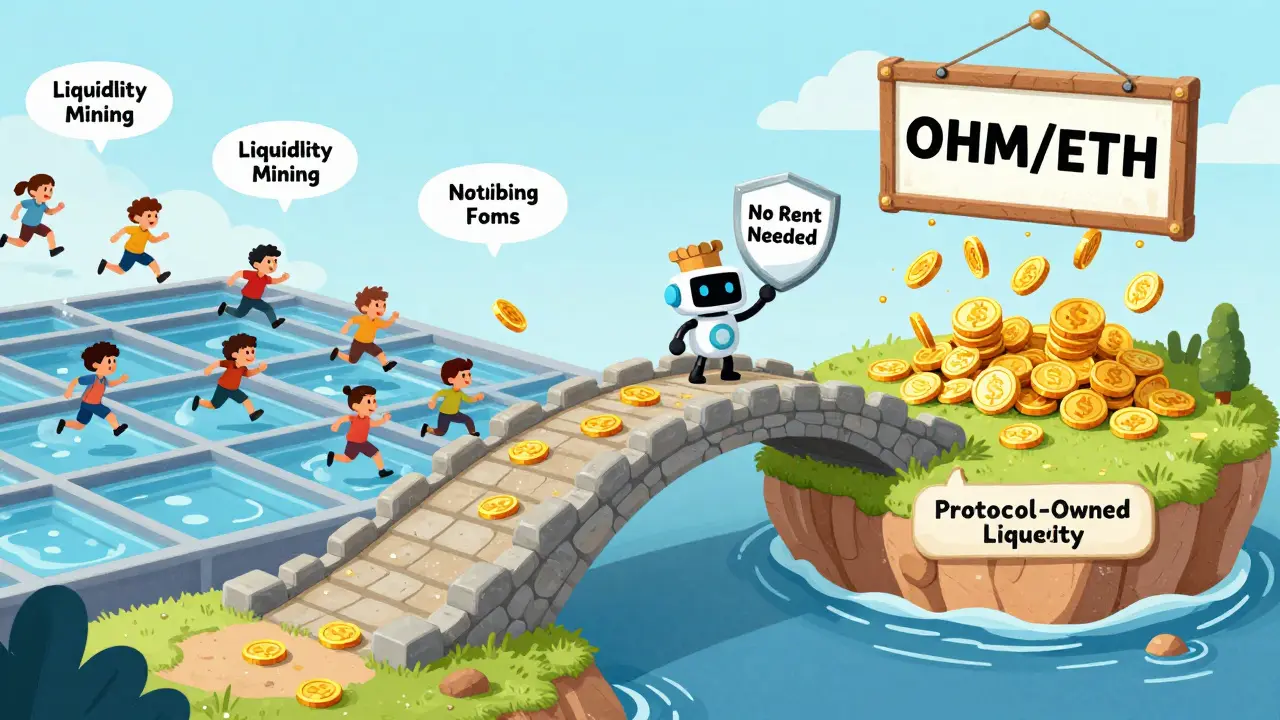
Protocol-owned liquidity means the project’s treasury holds the actual LP (liquidity provider) tokens in major DEXs like Uniswap or Curve. These LP tokens represent a share of a trading pair-say, OHM/wETH. When someone trades OHM for ETH, the protocol earns a cut of the fees. And because it owns the liquidity, it keeps 100% of those fees. No middlemen. No rent.
This isn’t theoretical. Olympus DAO did it first in 2021. Instead of giving away OHM tokens to liquidity miners, it started buying LP tokens directly from users through a bonding mechanism. Users would deposit ETH or USDC, and in return, they’d get OHM tokens at a 5-10% discount. Those OHM tokens were locked for a few days, preventing instant dumps. The protocol used that cash to buy more LP tokens. Over time, it owned nearly all of its own liquidity.
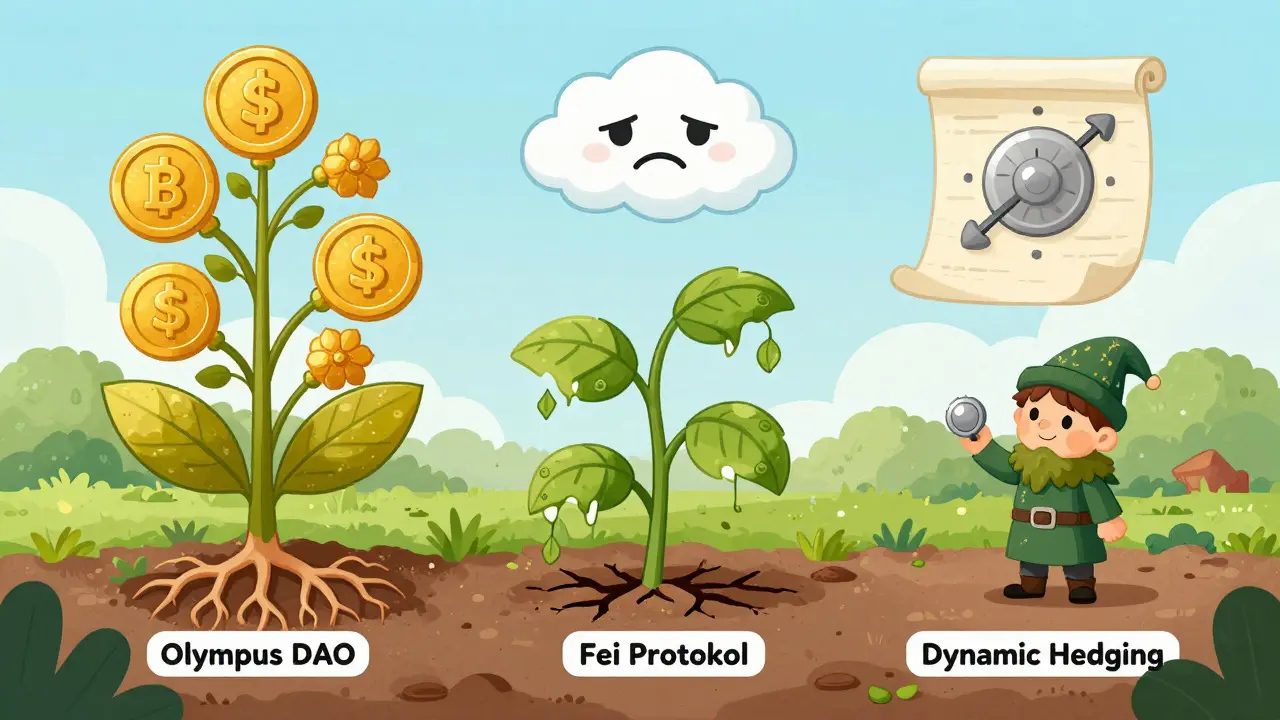
Other protocols followed. Frax Finance uses a hybrid model where part of its treasury backs its stablecoin with real assets, and part is locked in liquidity. Fei Protocol tried it too-but failed when its ETH/FEI pool got crushed during a price crash. The difference? Olympus had enough revenue to keep buying. Fei didn’t.
How POL Beats Traditional Liquidity Mining
Before POL, every DeFi project was stuck in a race to the bottom. To attract liquidity, you had to pay more than your competitors. SushiSwap once paid out $10 billion in token rewards just to keep its pools funded. When it cut rewards, liquidity dropped by 80% in three months. That’s not sustainability. That’s a Ponzi.
POL breaks that cycle. Once a protocol owns its liquidity, it doesn’t need to pay rewards. The fees from trading keep the engine running. Olympus DAO made $120 million in trading fees in 2022 alone-money that went straight back into the treasury. That’s not a giveaway. That’s a revenue stream.
And during crashes? POL protocols hold up. When the market crashed in May 2022, most DeFi protocols lost 50-70% of their liquidity. Olympus DAO kept 93% of its liquidity intact. Why? Because the liquidity wasn’t rented-it was owned. The users who provided it were paid once, upfront, and then left. The protocol didn’t need to keep bribing them.
The Downside: Capital Lock-Up and Impermanent Loss
POL isn’t magic. It’s expensive. Olympus DAO started with $50 million in treasury capital just to get going. Most early-stage projects don’t have that kind of cash. If you’re a new token with $2 million in treasury, you can’t afford to lock 70% of it into illiquid LP positions.
Then there’s impermanent loss. If the price of your token drops sharply, the value of your LP position drops even more. During the May 2021 ETH crash, Fei Protocol lost 40% of its treasury value because its main pool was ETH/FEI. Olympus DAO avoided this by diversifying-its liquidity is spread across OHM/wETH, OHM/DAI, and OHM/USDC. Stablecoin pairs reduce volatility. But they also reduce fee income.
And here’s the real trade-off: capital efficiency. POL protocols tie up 30-70% of their treasury in LP tokens. That’s money that can’t be used to fund development, marketing, or partnerships. Hasu from Flashbots pointed out that POL projects spend 55-75% of their treasury on liquidity. Traditional projects? Just 20-40%. That means POL protocols might grow slower. But they grow steadier.
How to Implement POL the Right Way
If you’re thinking about building POL into your protocol, here’s how to avoid the mistakes others made:
- Start small. Don’t lock up 80% of your treasury on day one. Olympus started with 10-15%. Wait until you have consistent trading volume before scaling up.
- Use bonding, not direct buys. Direct purchases require huge upfront cash. Bonding lets users help fund the liquidity themselves. Offer 5-8% discounts with 2-5 day vesting periods. Too short? Arbitrage bots will eat you alive. Too long? Users get frustrated.
- Diversify your pairs. Don’t put all your liquidity in one pair. Use a stablecoin (DAI, USDC) and a major asset (ETH). That way, if ETH crashes, your DAI pair keeps generating fees.
- Rebalance automatically. Use tools like Olympus Pro or Bond Protocol’s open-source framework to adjust liquidity based on price swings. If OHM drops 10%, shift more into OHM/DAI to stabilize the pool.
- Track your volume-to-liquidity ratio. Aim for 20-30x daily trading volume compared to your total liquidity. If you have $10 million in liquidity and only $150k in daily volume, you’re way overcapitalized. You’re wasting money.
Who’s Winning and Who’s Failing
Look at the data. As of September 2023, $12.7 billion in DeFi TVL was tied to POL. That’s 18% of the entire DeFi market. And it’s growing fast-from $800 million in January 2022 to over $12 billion in under two years.
Winners:
- Olympus DAO: Owns nearly 100% of its OHM liquidity. Maintained $300M in liquidity during the 2022 bear market. Generated $120M in fees in 2022.
- Frax Finance: Uses a fractional-reserve model. 75% of its liquidity is backed by real assets. Its POL system works alongside its lending protocol, creating a self-funding loop.
Failures:
- Fei Protocol: Concentrated too much in ETH/FEI. Lost 40% of treasury value during the ETH crash. Merged with Rari Capital in 2022.
- Tokemak v1: Tried to build a POL infrastructure for others. Needed $200 million in community funding just to get started. The model collapsed under its own weight.
The lesson? POL works if you have revenue. It fails if you’re just hoping users will stick around.
The Future: Dynamic Hedging and Regulation
By 2026, most major DeFi protocols will use POL-but not the way they do today. The next evolution? Dynamic hedging. Imagine your protocol automatically buying ETH perpetual futures when OHM’s price drops too fast. That offsets impermanent loss in real time. Mechanism Institute predicts 80% of top DeFi protocols will use this by 2026.
But there’s a dark side: regulation. The SEC’s 2023 framework warned that POL could be seen as “sufficient centralization of control.” If the protocol owns all the liquidity, controls the bonding curve, and dictates token supply, is it still decentralized? Coinbase’s legal team flagged this as a potential security risk. That means future POL protocols might need to open up governance more-or risk getting shut down.
Is POL Right for You?
Ask yourself these questions:
- Do you have a steady revenue stream (fees, subscriptions, staking rewards)?
- Can you afford to lock up 30-50% of your treasury for 12+ months?
- Do you have a team that understands AMMs, bonding curves, and rebalancing?
- Are you building for long-term stability-or short-term hype?
If you answered yes to the first two, POL could be your biggest advantage. If you’re a new token with no revenue and no treasury, skip it. Stick with liquidity mining until you can afford to own your own liquidity.
POL isn’t about making your token go up faster. It’s about making sure it doesn’t crash when the market turns. And in DeFi, that’s worth more than any 10x pump.
What’s the difference between protocol-owned liquidity and traditional liquidity mining?
Traditional liquidity mining pays users with token rewards to provide liquidity. The protocol doesn’t own the LP tokens-it’s renting them. When rewards stop, liquidity often vanishes. Protocol-owned liquidity means the protocol buys and holds the LP tokens itself using treasury funds. It keeps all trading fees and doesn’t need to pay ongoing rewards, making liquidity more stable.
Why do some POL projects fail?
Most fail because they lack sufficient treasury capital or revenue. If a protocol can’t afford to lock up 30-70% of its treasury into illiquid LP positions, it risks running out of cash for development or emergencies. Projects like Fei Protocol failed because they concentrated too much liquidity in volatile pairs (ETH/FEI) and didn’t hedge against price drops.
How does bonding work in POL?
Bonding lets users deposit stablecoins or ETH into the protocol’s treasury in exchange for native tokens at a discount-usually 5-10%. Those tokens are locked for a short time (1-5 days) to prevent instant dumping. The protocol uses the deposited funds to buy LP tokens on DEXs. This way, users help fund the protocol’s liquidity without needing the treasury to spend its own cash upfront.
Can POL reduce token volatility?
Yes. By owning liquidity, protocols reduce slippage and create deeper order books. Olympus DAO’s OHM token saw 40% lower volatility and 65% less slippage on large trades compared to similar tokens using liquidity mining. This stability attracts long-term holders and reduces panic selling.
Is POL regulated?
Regulators are watching. The SEC’s 2023 framework suggested that if a protocol controls all liquidity, sets bonding rules, and manages treasury assets centrally, it could be seen as a centralized entity-potentially making the token a security. Projects using POL need to ensure governance is transparent and decentralized to avoid regulatory risk.
What tools can help implement POL?
Open-source tools like Bond Protocol and Olympus Pro offer white-label bonding systems used by over 80 protocols. Mechanism Institute’s POL Risk Assessment Toolkit helps calculate impermanent loss exposure and optimal liquidity allocation. Most teams use these instead of building from scratch.
How much of a treasury should go into POL?
Start with 10-15%. Once trading volume stabilizes and you’re generating consistent fees, increase to 30-40%. Never exceed 70% unless you have a proven revenue model. Olympus DAO now holds about 45% of its treasury in LP tokens. That’s the sweet spot for most mature protocols.