
Why Bundling Works Better Than Discounts Alone
Most sellers think raising prices or running sales is the way to boost sales. But the real secret? Selling more items per order. That’s where bundling comes in. Instead of pushing one product, you group two or three that naturally go together-like a phone case and screen protector, or a moisturizer and serum. Customers don’t feel like they’re being upsold. They feel like they’re getting a smarter, easier solution.
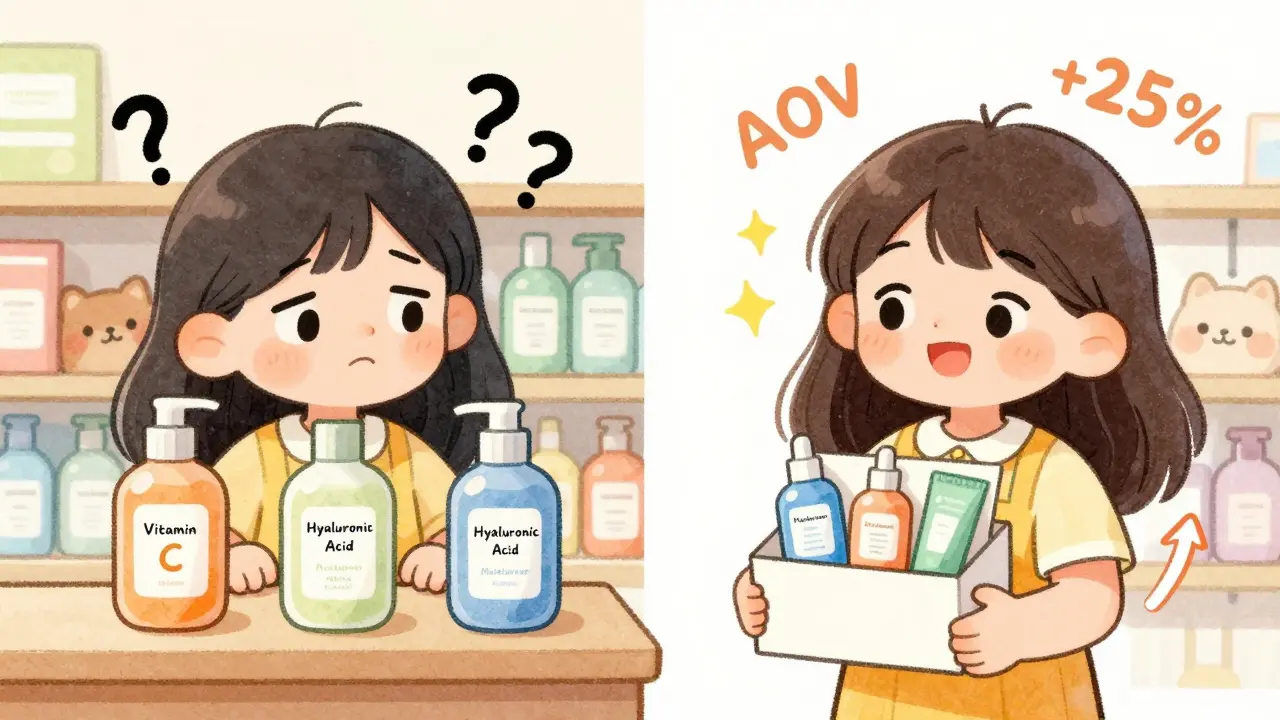
Amazon, Shopify, and Walmart sellers who use bundling see their average order value (AOV) jump by 12% to 25%. Why? Because people hate making too many choices. A well-made bundle removes the guesswork. You’re not just selling products-you’re solving a problem. A new mom doesn’t need to hunt for electrolytes, a postpartum guide, and a hydration bottle. Give her all three in one package, and she buys faster-and spends more.
How to Pick the Right Products to Bundle
Not every pair of products belongs together. Randomly sticking items into a bundle often backfires. The key is finding items that customers already buy together. Look at your sales data. Which products show up in the same cart? Use Google Analytics or your marketplace’s reports. You want products with a correlation of at least 0.65-meaning they’re frequently purchased as a pair.
For example, if you sell skincare, check if people who buy vitamin C serum also buy hyaluronic acid. If they do, bundle them. Same with tech: phone chargers and cables. Pet owners who buy flea treatment also buy grooming wipes. These aren’t guesses. They’re patterns in your own data.
Start with 3 items max. Bundles with three products convert 18% better than two-item bundles, according to Sarasa Analytics. More than five? Customers get overwhelmed. Keep it simple. And never bundle items that don’t logically connect. A coffee maker and a yoga mat? No. A coffee maker and a reusable filter? Yes.
Virtual vs. Physical Bundles: What’s Right for You
You have two main options: virtual bundles and physical bundles. Virtual bundles are easier. You don’t need to ship anything together. You just create a new listing in your seller dashboard-like on Amazon or Etsy-that shows three products as one. The customer gets them shipped separately, but they pay one price. This takes under an hour to set up and costs nothing extra in inventory.
Physical bundles mean you actually package the items together. You need to keep them in stock as a set. This works great for gift sets, starter kits, or seasonal bundles. But it adds complexity. You have to track inventory for the bundle as its own SKU. If one item runs out, the whole bundle is out of stock.
Most sellers start with virtual bundles. They’re low-risk, fast to test, and give you data. Once you see what’s working, you can move to physical bundles for your top performers. If you’re on Amazon, make sure your bundle follows their rules: the combined value must be at least 30% higher than the individual items’ prices, and you can’t bundle counterfeit or restricted products.
Price It Right: The Sweet Spot for Profit and Perception
Discounting too much kills your margins. Discounting too little makes the bundle feel pointless. The magic range? 15% to 20% off the total of buying items separately. That’s enough to feel like a deal, but not so much that you’re giving away profit.
Here’s how to calculate it: Add up the individual prices of your three items. Multiply that total by 0.85 (for a 15% discount) or 0.80 (for 20%). That’s your bundle price. Use a margin calculator to double-check you’re still making at least 30% profit after shipping and fees.
Some sellers make the mistake of pricing bundles below cost. They think “more volume = more profit.” But if you’re losing money on each bundle, you’re just selling more at a loss. One Shopify merchant lost $8,000 in three months because they bundled a $12 item with a $15 item and sold the combo for $20. They didn’t account for shipping or platform fees.
Instead of deep discounts, highlight the value. Say “You Save $15” instead of “50% Off.” People respond better to absolute savings than percentages. And always show the original price crossed out next to the bundle price. Visual contrast works.
Make Your Bundles Feel Personal
Generic bundles are forgettable. Personalized bundles win. If you know a customer bought a yoga mat last month, show them a bundle with a yoga towel and a foam roller. If they bought a baby onesie, suggest a matching burp cloth and diaper cream. Personalization boosts conversion by 22%, according to SITE123’s 2024 study.
You don’t need fancy AI to do this. Shopify and WooCommerce let you set up automated bundles based on past purchases. Use their built-in tools. If you’re on Amazon, use their “Frequently Bought Together” data as inspiration. Even better-look at your customer reviews. What do people say they wish they’d bought with their item? That’s your next bundle idea.
For example, a seller of reusable water bottles noticed customers often left reviews saying, “I wish this came with a carabiner.” So they created a bundle: bottle + carabiner + cleaning brush. Sales jumped 30% in two weeks. It wasn’t a discount. It was a solution.
If you’re overwhelmed by writing product descriptions for each bundle, tools like sellygenie.com can generate clear, compelling listings in seconds instead of spending 10-15 minutes on each one.
Test, Measure, and Improve
Don’t set it and forget it. Run A/B tests. Create three versions of your bundle: one with a countdown timer, one with “100+ sold this week” social proof, and one with just the price. Run them for two weeks. See which one converts best.
Track three things:
- Conversion rate-how many people who see the bundle actually buy it. Well-made bundles lift this by 8-12%.
- AOV increase-compare the average order value before and after launching the bundle.
- Return rate-do people send back the bundle? If returns go up, your bundle doesn’t solve a real problem.
One home goods store tested two versions of a candle bundle: one with three scents, one with two. The two-scent version had higher sales and lower returns. Why? Customers felt less overwhelmed. Simplicity won.
What Not to Bundle (And Why It Fails)
Bundling fails when you force it. You can’t bundle a luxury handbag with a $5 keychain and call it a gift set. Customers see through it. High-end brands see only a 5% AOV lift from bundling because their buyers don’t want deals-they want exclusivity.
Industrial parts, medical devices, and custom equipment also don’t work. These aren’t impulse buys. Buyers need exact specs. Bundling them confuses the buyer and increases returns.
Even in categories where bundling works, avoid overdoing it. If every product you sell has a bundle, it feels desperate. Customers start expecting discounts. Brands that rely on 30%+ discounts see their profit margins shrink by 12% or more. The goal isn’t to sell cheap. It’s to sell smarter.

Where Bundling Is Working Right Now
Some categories are natural winners for bundling:
- Beauty-serums, masks, and cleansers sold as routines. AOV up 25%.
- Home goods-coasters + drinkware + napkins for entertaining. AOV up 22%.
- Tech accessories-cases, chargers, screen protectors. AOV up 18%.
- Subscription boxes-monthly bundles with recurring items. Customer retention jumps 35%.
On the flip side, avoid bundling in commodity markets like printer paper or basic batteries. There’s no perceived value. People buy those on price alone.
Future of Bundling: What’s Coming Next
By 2026, most marketplaces will have built-in AI bundling tools. Shopify already launched one in early 2024 that suggests bundles based on your sales history. Amazon now requires virtual bundles to have a 30% unique value proposition-meaning you can’t just slap three items together. You have to explain why they belong.
Emerging trends include “choose-your-own” bundles. Customers pick 3 out of 5 items. This increases AOV by 15% because it gives them control. Another is predictive bundling-AI notices you buy coffee filters every 45 days, so it suggests a bundle with 3 months’ supply at a discount before you even think about it.
The winners won’t be the ones with the biggest discounts. They’ll be the ones who bundle based on real customer needs. The mom who needs postpartum care. The student who needs a dorm essentials kit. The pet owner who needs grooming tools. Solve the problem. The sales will follow.
Common Mistakes and How to Fix Them
Here’s what goes wrong-and how to fix it:
- Mistake: Bundling items that don’t naturally go together. Fix: Use your sales data, not your gut.
- Mistake: Pricing bundles too low. Fix: Always calculate your true profit after fees and shipping.
- Mistake: Not testing different versions. Fix: Run A/B tests for at least two weeks.
- Mistake: Ignoring returns. Fix: If returns spike, the bundle isn’t solving a real problem.
- Mistake: Using the same bundle forever. Fix: Refresh bundles every 60-90 days. Rotate items based on season or trends.
Start small. Pick one product. Find its natural partner. Build a simple bundle. Test it. Measure it. Then scale. You don’t need a team. You don’t need a budget. You just need to pay attention to what your customers already do-and give them a better way to do it.