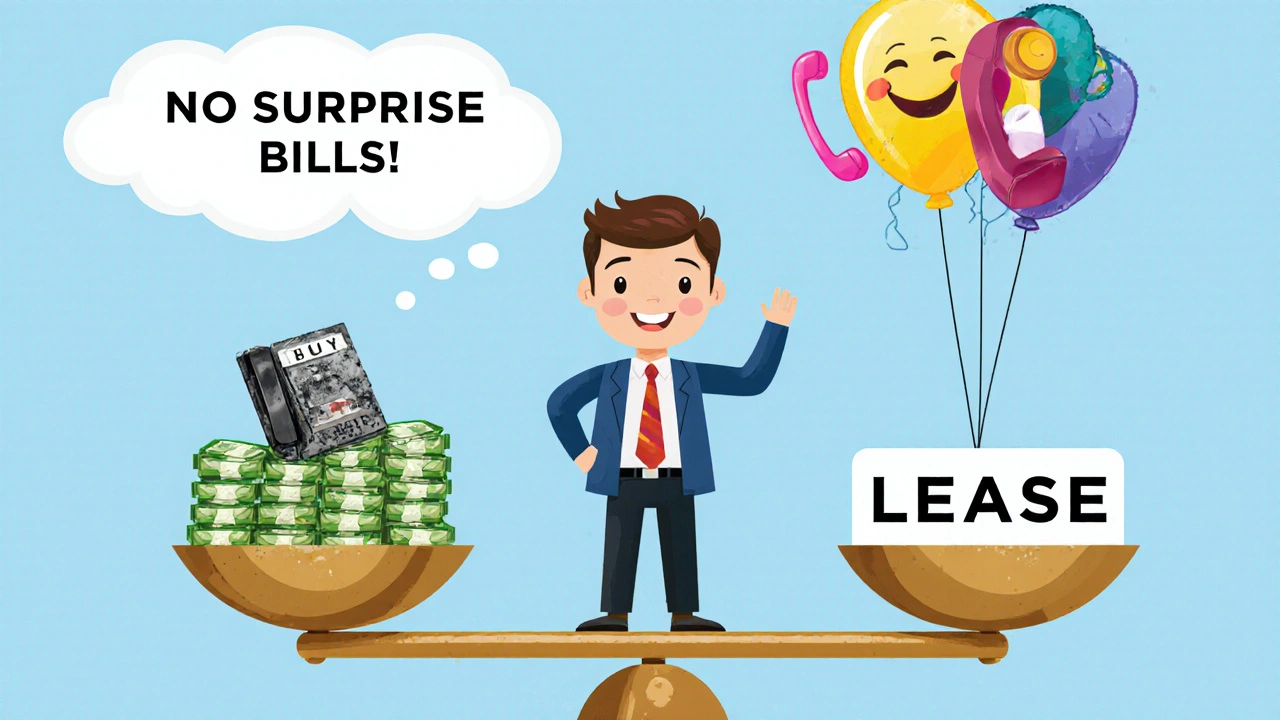
When you’re setting up a VoIP system for your business, the first question isn’t about which phone model to pick-it’s whether to lease or buy the hardware. This decision doesn’t just affect your balance sheet; it shapes your entire financial rhythm for the next few years. Many small businesses think buying is cheaper because they see a $250 price tag on a desk phone. But what they don’t see are the hidden costs that come with ownership. And leasing? It’s not just a monthly bill-it’s a strategic tool that can free up cash for growth, but only if you understand what you’re really paying for.
What You Pay Upfront: Cash Flow vs Capital
Leasing VoIP hardware means almost no upfront cost. For a 10-user setup, you might pay $0 to $500 total to get started. That’s it. Monthly payments range from $15 to $35 per phone, depending on the model and service bundle. This turns a big, scary expense into a predictable, manageable line item on your operating budget. If your business is tight on cash right now-maybe you’re hiring, launching a new product, or just trying to keep inventory stocked-leasing keeps your capital where it belongs: in the business. Buying, on the other hand, requires you to pay full price upfront. A single enterprise-grade VoIP phone costs between $100 and $400. For a 10-user office, that’s $1,000 to $4,000 out the door before you even plug anything in. That’s not just a line item-it’s a capital expenditure. It shows up on your balance sheet as an asset, not an expense. And if you’re a small business with under $500,000 in annual revenue, that kind of outlay can stall other priorities. According to CCT Telecomm’s 2023 analysis, 78% of small businesses who leased maintained healthier cash reserves than those who bought.Total Cost of Ownership: The Real Math
Here’s where people get fooled. Buying looks cheaper on paper. But look at the full picture. Let’s say you buy a $250 VoIP phone. Sounds good. But over three years, you’ll likely spend $50-$75 on maintenance-repairing a broken screen, replacing a faulty headset jack, or upgrading firmware that’s no longer supported. Then there’s storage: you need space for spare phones, backup power supplies, and cables. That’s 2-5 square feet per 10 devices. And when the phone dies? You can’t just call someone and get a new one. You’ve got to find a replacement, which gets harder every year as models get discontinued. E-waste disposal costs $15-$30 per device, and you’re legally responsible for it. Now, lease the same phone. At $25/month, you pay $900 over three years. That’s $650 more than buying. But here’s the catch: that $900 includes repairs, replacements, software updates, and a new phone every 24-36 months. No extra costs. No surprise bills. No hunting for parts. And if your business grows from 10 to 15 users? Your provider swaps out the old phones for new ones-no extra charge. You don’t have to worry about obsolescence.Who Benefits Most from Leasing?
Leasing is the smart move if your business:- Has fewer than 25 employees
- Experiences rapid growth (20%+ quarterly headcount changes)
- Has remote or hybrid teams that need frequent equipment swaps
- Lacks dedicated IT staff
- Wants predictable monthly expenses
When Buying Makes More Sense
Buying is better if you:- Plan to use the equipment for 4+ years
- Have an in-house IT team that can handle maintenance
- Need custom configurations (like specialized call routing or integrations)
- Own your office space long-term
- Want complete control over firmware and settings
Tax Implications: The Hidden Advantage
This is where leasing really shines-and most businesses overlook it. Lease payments are treated as operating expenses. That means you can deduct 100% of your monthly payment from your taxable income every quarter. For a business paying $300/month in lease fees, that’s $3,600 in deductions per year. No depreciation schedules. No IRS forms. Just a line on your P&L. Buying? You can use Section 179 to deduct the full cost in year one-but only if you have enough taxable income to absorb it. If you’re a small business with low profits, you might not get the full benefit. And even if you do, you still have to track depreciation, asset disposal, and maintenance costs for tax purposes. Leasing simplifies everything.Support, Upgrades, and the Real Cost of Downtime
When your phone stops working, how long are you down? With leasing, your provider handles everything. If a phone fails, they ship a replacement within 24-48 hours. Most include 24/7 support with 4-hour response times for critical issues. You don’t need to know SIP protocols or PoE switches. The provider sets it all up. Installation takes 1-3 days. Buying? You’re on your own after the warranty expires (usually 12 months). Replacement parts for discontinued models are hard to find. You might need to hire a technician at $75-$150/hour to reconfigure your network. Deployment takes 5-10 business days. And if your IT person is on vacation? Your calls drop. Downtime costs money-often more than the phone itself.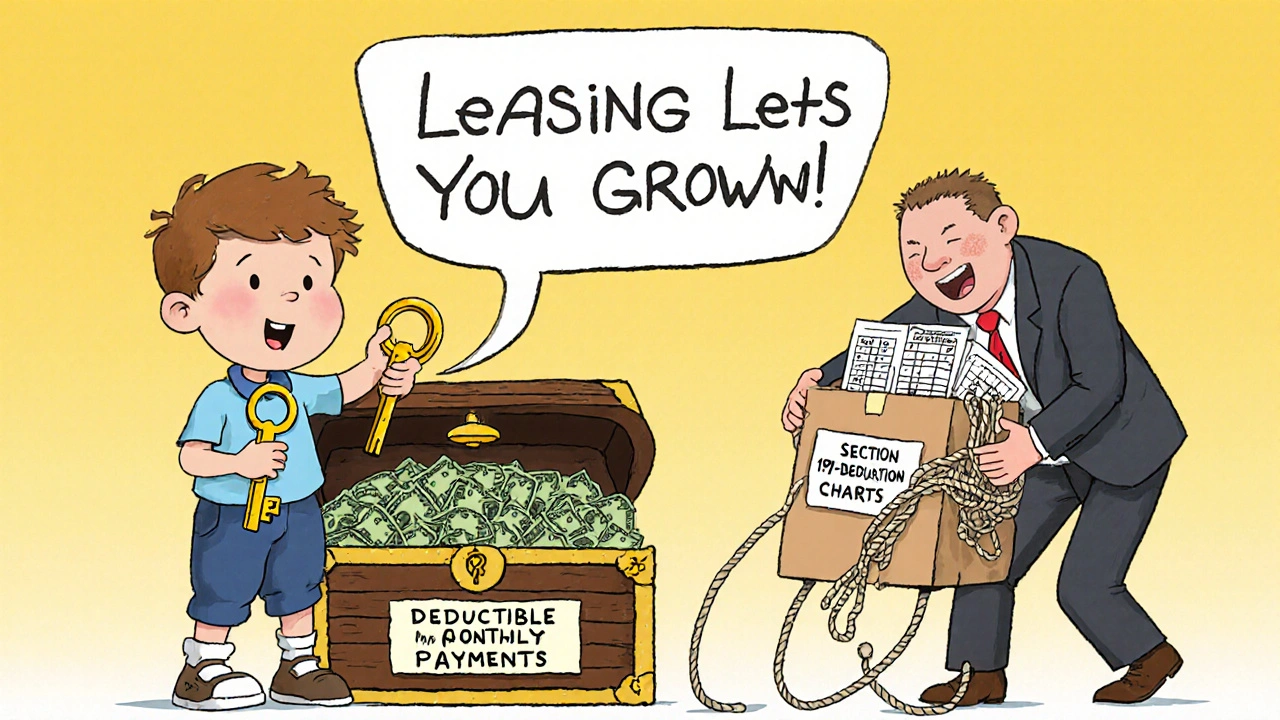
Hybrid Models Are the New Standard
The smartest businesses aren’t choosing one or the other. They’re blending both. Matrix-NDI’s 2024 data shows 41% of mid-sized companies now purchase their PBX servers and core infrastructure-things that last 5+ years-and lease the phones, headsets, and video endpoints. Why? Because the core system is stable. The endpoint devices change fast. Some providers now offer “lease-to-own” options. CadyBT launched one in May 2024: 70% of your monthly lease payments go toward buying the equipment outright after 36 months. That gives you the cash flow benefits now-and ownership later.What Users Really Say
On Capterra, leased VoIP systems average 4.3/5. Users love “predictable billing” and “no repair headaches.” But 33% of negative reviews mention “contract lock-in penalties.” Read the fine print. Some leases charge $200+ to cancel early. Purchased systems score slightly higher at 4.5/5. People love “owning their gear” and “no more monthly bills.” But 41% of negative reviews cite “unexpected repair costs after warranty.” One user wrote: “I bought 15 phones. Two died in year two. No one sells the parts anymore. Had to buy a whole new system.”What You Should Do Next
Here’s how to decide:- Calculate your 3-year cash flow. Can you afford $3,000 upfront? If not, lease.
- Estimate maintenance costs. Add $60 per device per year. Does that push your buying cost above the lease total? If yes, lease.
- Check your IT capacity. Do you have someone who can fix SIP issues? If not, lease.
- Ask about lease-to-own. If you want ownership eventually, this option reduces long-term cost.
- Don’t forget taxes. Lease payments = immediate tax savings. Buying = complex depreciation.
Is it cheaper to lease or buy VoIP hardware?
Buying has a lower upfront cost, but leasing often wins on total cost of ownership over 3-5 years because it includes repairs, upgrades, and replacements. For example, a $250 phone leased at $25/month costs $900 over 3 years-but you get new equipment every 2-3 years with no extra fees. Buying costs $250 plus $75 in maintenance, but you’re stuck with aging hardware and no support after warranty expires.
Can I write off VoIP hardware on my taxes?
Yes, but differently. If you lease, your monthly payments are 100% tax-deductible as operating expenses. If you buy, you can use Section 179 to deduct the full cost in year one-but only if your business has enough taxable income. Many small businesses benefit more from the steady quarterly deductions of leasing than from a one-time capital deduction.
What happens if I need more phones next month?
With leasing, your provider ships new phones within days-pre-configured and ready to use. You just plug them in. With buying, you need to research, order, set up, and train staff on new devices. That takes time, money, and IT resources. Leasing scales with your business. Buying doesn’t.
Are there hidden fees with VoIP leasing?
Yes. Watch out for early termination fees (often $150-$300), mandatory service bundles, and automatic renewal clauses. Always read the contract. Some providers charge extra for shipping replacements or for phones that are damaged. Make sure the lease includes unlimited repairs and replacements.
Should I lease or buy if I’m planning to move offices in 2 years?
Lease. If you buy, you’re stuck moving heavy equipment, dealing with reconfiguration, and possibly losing value if you sell later. Leasing lets you return the phones when you move. Your provider can even ship new ones to your new location. No hassle, no cost.