
When you hold a governance token in a blockchain project, you’re not just owning an asset-you’re holding a vote. But what happens when no one shows up to vote? Or when only a handful of wallets control most of the power? That’s where quorum, delegation, and incentives become the real backbone of decentralized governance.
Most people think governance in crypto means clicking "yes" or "no" on a proposal. It’s not that simple. If only 5% of token holders participate, does that decision really reflect the community? That’s the quorum problem. If you don’t have time to read through 20 complex proposals every month, can you still have a say? That’s where delegation comes in. And if voting doesn’t pay off, why would anyone bother? That’s the incentive gap.
What Quorum Really Means (And Why It Breaks)
Quorum isn’t just a technical term-it’s the minimum number of votes needed for a decision to count. Think of it like a town hall meeting. If only three people show up out of 1,000 residents, and they pass a rule that affects everyone, is that fair? In many DAOs, the answer is no.
MakerDAO requires a 10% quorum for proposals to pass. That means at least 10% of all MKR tokens in circulation must vote. If they don’t hit that number, the proposal dies-even if 95% of voters say yes. This isn’t about rigging votes. It’s about preventing a small group from hijacking the system. A 1% quorum? Anyone with a few million dollars could push through anything. A 50% quorum? Most proposals fail because nobody cares enough to vote.
Polkadot uses a different model: 30% quorum for referendums. But here’s the catch-there’s no penalty for not voting. So even with a high threshold, turnout is often below 20%. That means decisions get made by a tiny fraction of the community. The system looks democratic on paper. In practice? It’s fragile.
Delegation: The Secret Weapon for Mass Participation
Most token holders aren’t experts. They’re everyday people who bought a few tokens, maybe held them for a while, and now have a vote they don’t know how to use. That’s where delegation saves the system.
Delegation lets you hand your voting power to someone else-someone you trust. Maybe it’s a community leader who reads every proposal. Maybe it’s a dev team that’s been building the protocol for years. Or maybe it’s a bot that follows clear rules, like "vote yes on upgrades that improve scalability."
Uniswap’s governance allows direct delegation. If you hold UNI tokens, you can assign your vote to any wallet address. That wallet then votes on your behalf. No need to log in. No need to understand gas fees. You just set it once and forget it. And if you change your mind? You can reassign it anytime.
This isn’t just convenient-it’s essential. Without delegation, governance becomes a club for the tech-savvy. With it, even someone who owns 0.1 UNI can have their voice heard. And that’s how you scale democracy.
Some DAOs go further. In Aragon, delegates can even sub-delegate. So if you delegate to Alice, and Alice delegates to Bob, your vote flows through both layers. It creates a chain of trust. But it also creates risk. If Alice is compromised, your vote gets hijacked. That’s why transparency matters. The best systems let you see who your delegate voted for-and why.

Incentives: Why People Actually Show Up
Here’s the hard truth: most people won’t vote unless there’s something in it for them.
Token holders aren’t volunteers. They’re stakeholders. And if voting doesn’t give them value, they’ll ignore it. That’s why many DAOs are starting to tie voting to rewards.
Curve Finance gives CRV token holders liquidity mining rewards for participating in governance. If you vote on a proposal, you earn extra CRV. Not a huge amount-but enough to make you check your wallet once a month. It’s not charity. It’s alignment. You get paid to protect the system you’re invested in.
Compound does something similar. They don’t pay directly for voting, but they give out COMP tokens to users who actively engage. That includes proposing ideas, debating in forums, and yes-voting. Over time, those who participate become more influential. It’s a feedback loop: the more you show up, the more power you earn.
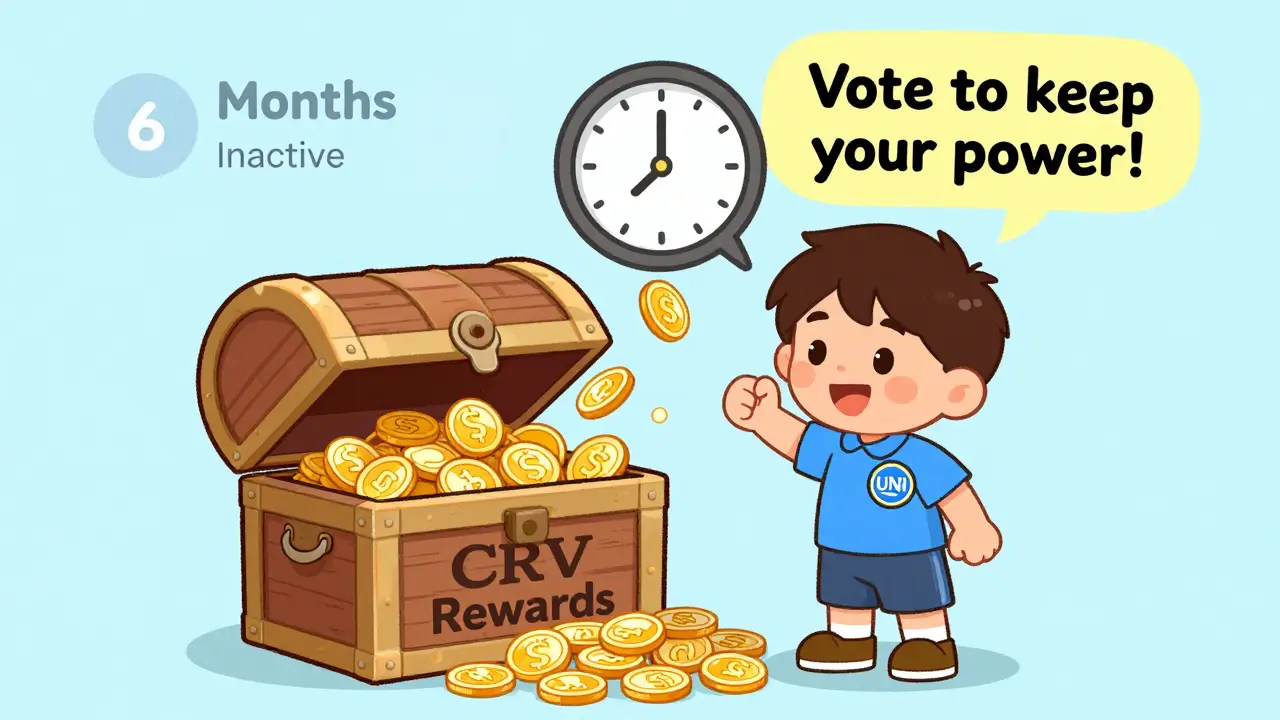
But here’s the trap: if you reward only the top voters, you reinforce inequality. The rich get richer. The active get more influence. That’s why some projects are testing penalties. In the upcoming Ethereum Improvement Proposal (EIP-4345), there’s talk of slashing voting rights for inactive holders. Not a fine. Not a tax. Just a slow reduction in your vote weight if you don’t engage for six months.
It’s radical. But it works. In a system where power equals participation, apathy is the enemy.
The Hidden Cost of Low Participation
When quorum isn’t met, proposals stall. When delegation is ignored, power concentrates. When incentives are missing, governance becomes a ghost town.
The result? Forks. Not the good kind. The kind where a group of frustrated users split off to build a new chain because they lost faith in the original one. That’s what happened with Ethereum Classic after the DAO hack. And it’s why some projects now bake participation into their core design.
Look at Snapshot. It’s not on-chain. It’s off-chain. But it’s used by hundreds of DAOs because it’s fast, cheap, and lets anyone vote-even if they don’t hold tokens. It’s not perfect. But it’s a workaround for systems that are too slow or too expensive to vote on-chain.
The truth? No system is flawless. But the ones that last are the ones that make participation easy, rewarding, and meaningful.
What Works Today (And What Doesn’t)
Let’s cut through the noise. Here’s what real governance looks like in 2026:
- Good: Quorum set at 10-20%, delegation enabled by default, voting rewards tied to participation, transparent delegate histories.
- Bad: Quorum too high (50%+), no delegation, no incentives, votes locked for 30 days, no public voting records.
- Emerging: Voting power decay for inactivity, delegated voting bots, reputation-based weight (not just token count), and off-chain polling integrated with on-chain execution.
MakerDAO still leads in structure. Uniswap leads in accessibility. Curve leads in incentives. But none of them are done. The best systems are still being built.
How to Get Involved-Even If You’re New
You don’t need to be a coder. You don’t need to own millions. You just need to care enough to act.
- Find a DAO you use. Maybe it’s a DeFi protocol you trade on. Or a NFT project you collect from.
- Check their governance page. Look for delegation options. Most have a simple slider or button.
- Delegate to someone you trust. Or vote yourself on one proposal this month.
- Look for rewards. If voting gives you tokens, do it. It’s not gambling-it’s participation.
- Speak up. Comment on forums. Ask questions. Even a simple "Why does this matter?" can spark change.
Governance isn’t about power. It’s about responsibility. And every vote, no matter how small, adds up.
What happens if a DAO doesn’t meet quorum?
If a proposal doesn’t reach the required quorum-say, 10% of total tokens voted-it automatically fails, even if most voters approved it. This prevents small groups from making binding decisions. The proposal can be resubmitted later with better outreach or revised terms.
Can I delegate my vote to multiple people?
No, most systems only allow one delegate at a time. But you can change your delegate anytime. Some advanced systems, like Aragon, let you delegate different votes to different people-for example, one delegate for treasury proposals and another for protocol upgrades. But this is rare and requires technical setup.
Do I lose my tokens if I don’t vote?
No, you never lose your tokens for not voting. But some DAOs reduce your voting power over time if you’re inactive. For example, if you haven’t voted in six months, your vote weight might drop by 5% per month. This encourages ongoing engagement without punishing ownership.
Are governance tokens the same as utility tokens?
No. Utility tokens give you access to a service-like paying for storage or computing power. Governance tokens give you voting rights. Some tokens do both. UNI and MKR, for example, can be used for fees and governance. But not all utility tokens have voting power. Always check the project’s documentation.
Can I vote anonymously in DAOs?
Most on-chain votes are public. Your wallet address and vote are recorded on the blockchain forever. Some DAOs use off-chain voting (like Snapshot) for privacy, but even then, your address is usually visible. True anonymity is rare and often discouraged because it makes accountability harder. Transparency is a core principle of decentralized governance.