Most crypto projects fail not because of bad code, but because their token economics don’t make sense. People don’t act out of loyalty. They act out of self-interest. If your token rewards short-term selling over long-term holding, people will sell. If your liquidity pools pay high yields with no penalties for pulling out, liquidity will vanish overnight. This isn’t a bug - it’s a feature of human behavior. And that’s exactly why game theory is the missing piece in most token designs.
Why Game Theory Isn’t Just for Economists
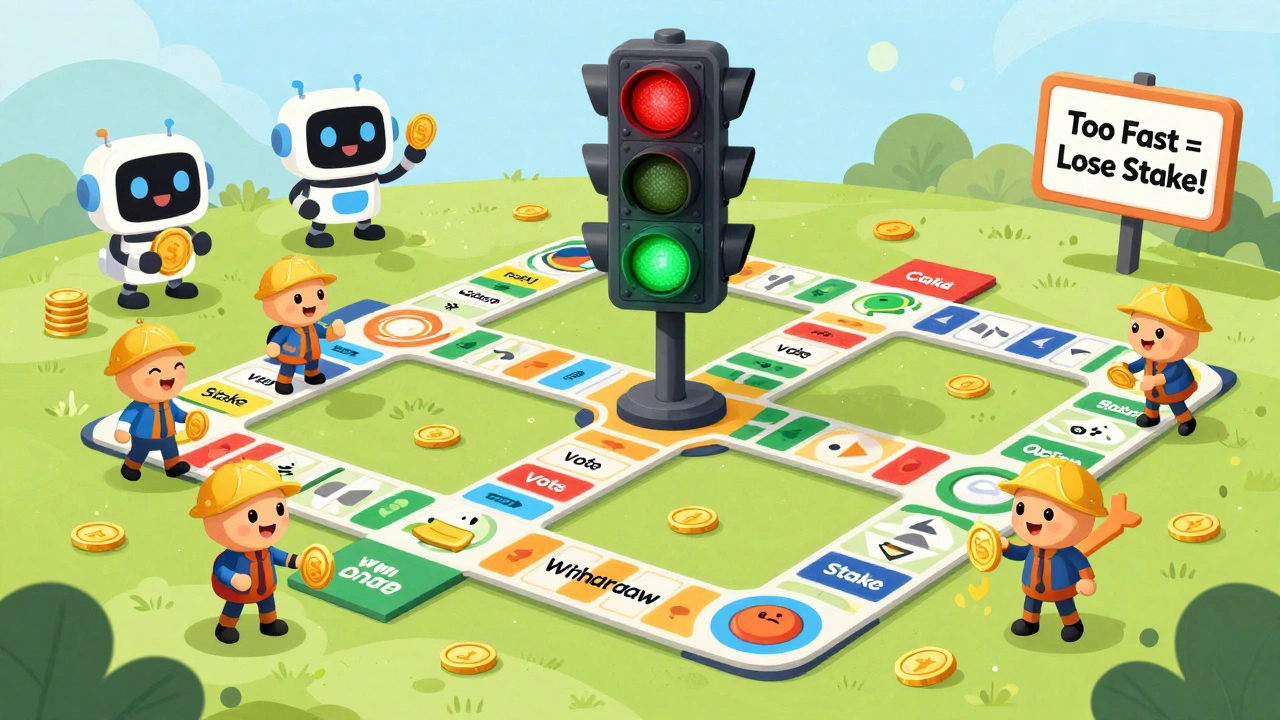
Game theory isn’t about predicting the future. It’s about designing systems where the future you want becomes the easiest path for people to take. Think of it like traffic lights. They don’t force you to stop. They make running a red light riskier than stopping. The same principle applies to blockchain networks. Satoshi Nakamoto didn’t invent blockchain from scratch. He built it on a simple insight: if miners are rewarded for securing the network, and cheating costs more than it’s worth, then the network stays secure - even with strangers running the software. That’s game theory in action. Bitcoin’s Proof-of-Work turned mining into a high-stakes competition where the only winning move is to play fair. Today, every major blockchain uses game theory, whether they admit it or not. Ethereum’s staking system, Compound’s liquidity mining, even decentralized governance votes - all rely on carefully balanced incentives. The difference between a thriving ecosystem and a dead one often comes down to whether someone modeled the incentives before launch.The Three Games That Shape Token Economies
Not all incentives work the same way. Different behaviors need different game models. Three patterns show up again and again in successful token designs:- The Prisoner’s Dilemma - This is the classic “cooperate or betray” scenario. In DeFi, it’s about liquidity. If everyone leaves their tokens in a pool, the protocol stays liquid and rewards grow. But if one person pulls out early, they get a quick profit while others suffer. The fix? Withdrawal fees. Projects like Uniswap v3 charge 0.3-1% for early exits, making it cheaper to stay than to flee. The fee isn’t a punishment - it’s a nudge.
- Coordination Games - These happen when everyone wins by doing the same thing. Think token distribution. If 10,000 people stake for 90 days, they all get 1.5x rewards. But if only a few do it, the bonus disappears. The trick is making the reward visible and predictable. Ethereum 2.0 does this by clearly showing staking APY based on total locked ETH. When users see others locking up, they follow.
- Voting Games - Governance tokens give holders power. But if only whales vote, the system becomes a dictatorship. The solution? Weighted voting with penalties. Some protocols require voters to lock their tokens for the duration of the vote. Others slash voting rights if a user votes yes on a proposal that later gets exploited. This turns voting from a freebie into a responsibility.
How Real Projects Use Game Theory (And Where They Fail)
Let’s look at what works - and what doesn’t. Ethereum’s staking system is one of the best examples. To become a validator, you need 32 ETH. If you misbehave - say, you double-sign a block - you lose 0.5 ETH. If you go offline for too long, your stake slowly erodes. The math is simple: the cost of attacking is $100,000+, while the reward is zero. That’s not luck. That’s design. Compound’s COMP token rewards liquidity providers. But here’s the catch: the rewards decay over time. When too many people join, the payout drops. That’s intentional. It prevents a gold rush where everyone rushes in, takes the yield, and leaves. The system self-corrects. Users reported earning 14.3% APY at first - then watched it drop 62% after six months. That wasn’t a bug. That was the game theory working. But not all projects get it right. The Poly Network hack in 2021 stole $600 million. Why? Because two cross-chain bridges had different rules. The attacker exploited a gap no one modeled. No one asked: “What happens if someone tries to move tokens between these two systems?” Game theory isn’t just about single-player behavior. It’s about how systems interact. Even worse are projects that overcomplicate incentives. One DeFi protocol offered tiered rewards based on token holding duration, voting participation, referral codes, and liquidity depth. The result? Only 12% of users understood how to maximize their returns. The rest gave up. Game theory only works if people can understand it.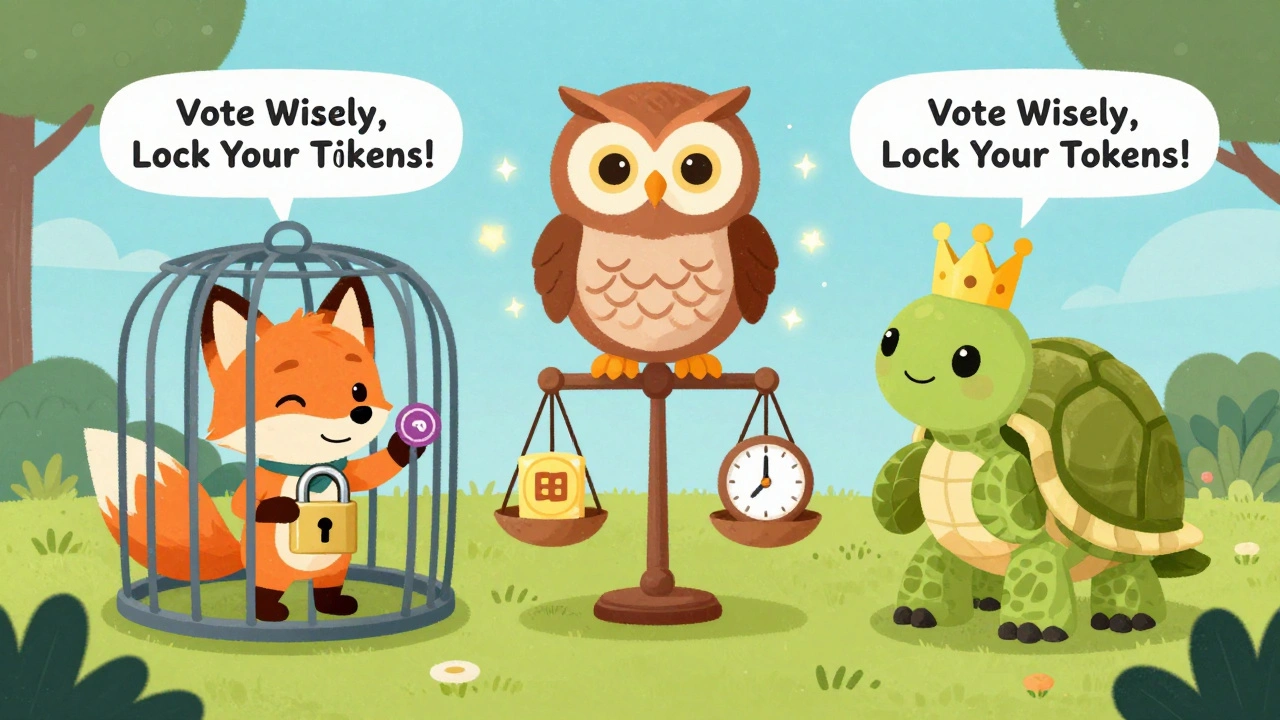
The Hidden Costs of Getting It Right
Building a game-theoretic token economy isn’t easy. It takes time, expertise, and testing. Teams now hire dedicated game theory specialists - people with backgrounds in economics, cryptography, and behavioral psychology. Their salary? $150,000-$220,000 a year. Why? Because a bad incentive structure can cost millions. The design process usually follows four steps:- Map user actions - What can people do? Stake? Sell? Vote? Withdraw? List every possible move.
- Model payoffs - For each action, what’s the reward or penalty? Use a 2x2 matrix: cooperate vs. defect. Calculate the Nash equilibrium - the point where no one benefits from changing their strategy.
- Test with simulations - Run 10,000 virtual scenarios. What happens if 20% of users panic-sell? What if a whale dumps 10% of the supply? Tools like TDeFi’s framework help simulate these outcomes.
- Iterate and monitor - Launch with adjustable parameters. Track behavior. If people start exploiting a loophole, tweak the fee, reward, or penalty. Ethereum’s EIP-1559 burned base fees to reduce miner extractable value - and it took months of tweaking to get right.
The Big Risk: People Aren’t Rational
Game theory assumes people act logically. But markets aren’t logical. They’re emotional. During the Terra/Luna collapse in May 2022, game theory models failed. They assumed users would weigh costs and benefits. Instead, panic hit. People sold everything - even if it meant losing everything. No reward structure could stop that. Dr. David Wagner from UC Berkeley warns: “Over-reliance on rational actor models creates blind spots.” When prices swing 30% in a day, fear overrides math. That’s why the best designs include buffers - like gradual reward decay, or cooldown periods before large withdrawals. The solution isn’t to abandon game theory. It’s to layer it with behavioral insights. Add social proof. Show users how others are acting. Use countdown timers for rewards. Make the consequences visible. People don’t just respond to numbers. They respond to stories.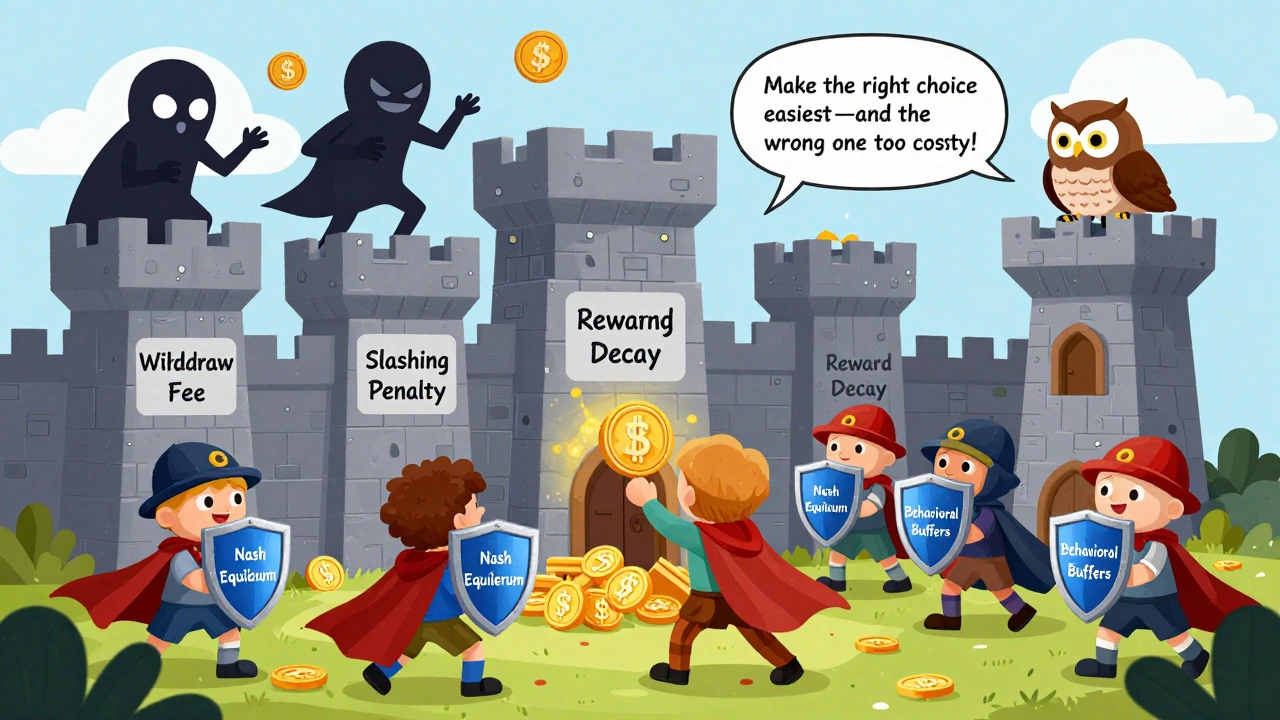
What the Future Looks Like
By 2026, Gartner predicts 90% of major token launches will include formal game theory modeling. That’s up from 65% in 2023. Why? Because the market is learning. Ethereum’s upcoming Dencun upgrade will lower the staking requirement from 32 ETH to 1 ETH. That’s a massive shift in game theory. More people can join. But now, the risk of Sybil attacks rises. The system must adapt - maybe by adding reputation scores or requiring staking history to vote. New tools are emerging. Adaptive game theory models use machine learning to adjust rewards in real time. One experiment showed a 41% improvement in attack resistance during stress tests. That’s not science fiction. It’s happening now. Regulators are watching too. The SEC noted in early 2023 that projects with strong incentive modeling may get more favorable treatment. Why? Because they’re less likely to be manipulated.Final Takeaway: Incentives Are the Real Smart Contract
Code is important. But incentives are what make code work. A token that looks good on paper can collapse in days if users have a reason to leave. A token that seems simple can last for years if it makes doing the right thing the easiest, most profitable choice. Game theory doesn’t guarantee success. But it gives you the best odds. It turns chaos into structure. It turns exploitation into cooperation. It turns a group of strangers into a functioning economy. If you’re designing a token, ask yourself: What’s the easiest way for someone to break this? Then make that path cost more than it’s worth. Don’t build a token. Build a game - and make sure the players want to win together.What is game theory in token design?
Game theory in token design applies strategic decision-making models to cryptocurrency ecosystems. It shapes incentives so that users’ self-interested actions - like staking, providing liquidity, or voting - naturally align with the network’s security and growth. Instead of relying on trust, it uses economic penalties and rewards to guide behavior.
How does game theory reduce exploits in crypto?
It makes attacks economically irrational. For example, Ethereum’s staking system requires 32 ETH to become a validator. If a validator tries to cheat, they lose 0.5-5% of their stake - worth tens of thousands of dollars. The cost of attacking is higher than any possible gain. This discourages malicious behavior before it starts.
What are common game theory models used in tokenomics?
Three main models are used: the Prisoner’s Dilemma (for liquidity provision), coordination games (for token distribution and staking), and voting games (for governance). Each is tailored to the type of behavior you want to encourage. For example, withdrawal fees turn liquidity provision into a coordination game where staying in the pool benefits everyone.
Can game theory prevent rug pulls?
Not directly, but it makes them harder to pull off. A well-designed system locks up liquidity, imposes penalties for early exits, and ties governance power to long-term holding. Rug pulls often rely on sudden, unanticipated withdrawals. Game theory builds in delays, fees, and reputation systems that slow down or expose bad actors before they can escape.
Why do some game theory-based tokens still fail?
Because human behavior isn’t always rational. During market crashes, fear overrides math. Some designs are too complex for users to understand. Others ignore behavioral economics - like how people react to loss aversion or social pressure. The best systems combine game theory with clear communication, visual feedback, and adaptive parameters.
Do I need a team of economists to design a token?
You don’t need a full team, but you need at least one person who understands incentive design. Many successful projects partner with specialized firms like BlackTokenomics or TDeFi. You can also use open-source frameworks and simulation tools. The key is not to guess - model, test, and iterate before launch.