
When you’re on a VoIP call and your client’s voice cuts in and out like a bad radio signal, it’s not because your internet is slow. It’s because of latency, jitter, and upstream constraints - and the type of internet connection you’re using makes all the difference. DSL and fiber might both claim to deliver internet, but when it comes to clear, reliable voice calls, they’re not even in the same race.
Why Bandwidth Doesn’t Matter as Much as You Think
Most people assume that if their internet speed is high - say, 100 Mbps or more - their VoIP calls will sound great. That’s a myth. A 300 Mbps wireless connection can sound worse than a stable 25 Mbps wired one. Why? Because VoIP doesn’t need a lot of bandwidth. A single HD voice call uses about 100 Kbps. Even 10 simultaneous calls barely touch 1 Mbps. So if your DSL plan gives you 10 Mbps upload, why do calls still drop or echo? The real problem isn’t how much data you can send. It’s how quickly and consistently it gets there. Latency is the delay between when you speak and when the other person hears it. Jitter is the variation in that delay. Upstream bandwidth is how much data you can send back to the server - and for VoIP, that’s just as important as download speed.Latency: The Silent Killer of Call Quality
Latency under 100ms is ideal for VoIP. Above 150ms, people start noticing the lag. Above 200ms, conversations become frustrating. You say “hello,” wait a beat, and they answer before you’ve finished your sentence. It feels like talking through a tunnel. Fiber connections typically have latency between 5ms and 40ms. That’s because light travels through glass fibers at nearly two-thirds the speed of light. DSL, on the other hand, uses copper wires and electrical signals. Those signals degrade over distance. If you live more than 5,000 feet from the central office, your latency jumps. At 18,000 feet - the max range for many DSL networks - latency can spike to 70ms or higher. That’s not just noticeable. It’s unusable for professional calls. One business in Exeter switched from AT&T DSL to Verizon Fios fiber. Their average latency dropped from 48ms to 29ms. The result? Customer complaints about echo and delays fell by 73% in just three months.Jitter: When Timing Gets Unpredictable
Jitter is the inconsistency in packet arrival times. Think of it like driving on a highway where the speed limit keeps changing randomly. Sometimes you’re going 70 mph. Other times you’re crawling at 20. Your VoIP call sounds choppy because voice packets arrive unevenly. Fiber networks rarely show jitter above 5-10ms. DSL? It’s common to see 20-40ms. Why? DSL routers often have oversized buffers that fill up during peak hours. When that happens, packets sit and wait - then burst out all at once. This is called bufferbloat. A 2023 study by Splynx found 78% of DSL routers had serious bufferbloat issues. Only 32% of fiber routers did. One IT manager in Bristol monitored his office network for three months. On DSL, jitter averaged 37ms during business hours. After switching to fiber, it dropped to 8ms. “The difference wasn’t just technical,” he said. “Our sales team could finally talk to clients without saying ‘wait, say that again.’”Upstream Bandwidth: The Forgotten Bottleneck
VoIP sends your voice data upward - to the cloud, to the other person. That’s upstream. Most people don’t realize that DSL is built backwards. It’s designed for downloading videos, not sending voice. Typical DSL upload speeds? 3-10 Mbps. Fiber? Symmetrical. 1 Gbps up, 1 Gbps down. If you’re running a small business with five employees all on VoIP calls at once, you’re using about 500 Kbps upload. Sounds easy. But what if someone starts streaming a video? Or uploading a file? On DSL, that’s enough to choke your upstream pipe. Your calls start breaking up. On fiber? You’ve got 1,000 times more headroom. A 2024 Gartner survey found that 68% of businesses using fiber reported “excellent” VoIP quality. Only 42% of DSL users said the same. The gap wasn’t about speed. It was about reliability under load.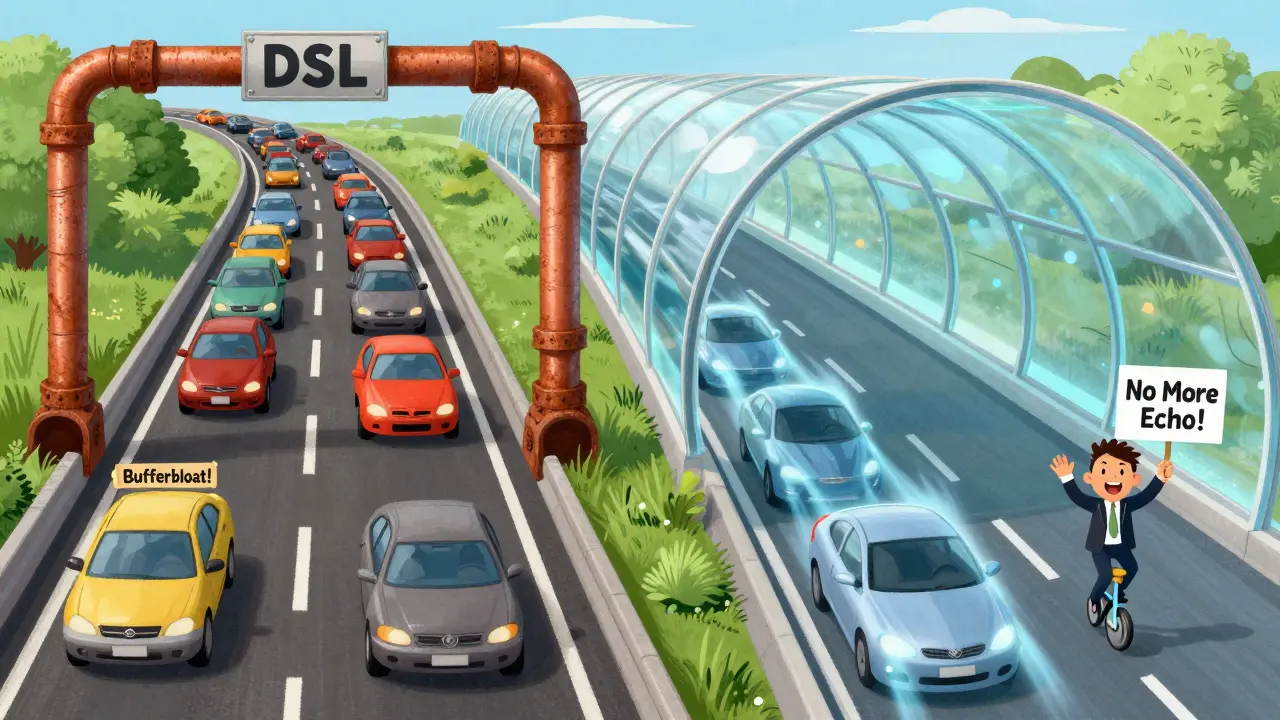
Bufferbloat and Network Congestion: Why DSL Fails When It Matters
Imagine your internet connection as a highway. During rush hour, traffic slows. On fiber, cars keep moving smoothly. On DSL, the highway gets clogged. Cars pile up in giant parking lots (buffers), then suddenly lurch forward in waves. That’s bufferbloat. DSL routers were built for older, slower networks. They still use outdated queue systems that don’t manage congestion well. Fiber routers, especially newer ones, use Smart Queue Management (SQM) by default. Tools like cake or fq_codel keep traffic flowing evenly. IT professionals spend 35% more time troubleshooting VoIP issues on DSL than on fiber, according to a 2025 Spiceworks survey. Why? Because DSL needs constant tweaking. Fiber? Set it and forget it.Cost vs. Performance: Is DSL Still Worth It?
Yes, DSL is cheaper. AT&T’s basic DSL plan costs $35/month as of January 2025. Fiber starts at $60. That’s a real difference for a home office on a tight budget. But here’s the catch: if you’re using VoIP for business, every dropped call costs money. Lost sales. Damaged reputation. A single 30-second call glitch during a client demo can cost more than the monthly price difference over a year. Fiber isn’t just faster. It’s more predictable. It doesn’t slow down at night. It doesn’t get worse when your neighbor starts streaming. It doesn’t need constant monitoring. For any business that relies on phone calls - sales, support, consulting - fiber isn’t a luxury. It’s a requirement.Real-World Impact: What Users Are Saying
On Reddit’s r/VoIP, a January 2025 thread had 147 comments. 82% of users said their call quality improved dramatically after switching from DSL to fiber. Common phrases: “no more echo,” “calls don’t drop anymore,” “my team actually enjoys video calls now.” Trustpilot reviews for Vonage show a clear split: 4.2/5 stars from fiber users. 3.1/5 from DSL users. The negative reviews? “Choppy audio,” “frequent dropouts during peak hours,” “can’t use conference calls.” One user wrote: “We used to have 3-4 complaints a week about call quality. After switching to fiber? Zero in the last six months.”
What About Rural Areas? Is DSL the Only Option?
In rural parts of the UK and US, fiber isn’t available. That’s a real problem. But even here, there are options. Fixed wireless or satellite internet with QoS settings can outperform DSL if properly configured. Some providers now offer LTE/5G business plans with dedicated upload bandwidth - better than DSL’s inconsistent performance. The FCC’s Rural Digital Opportunity Fund is pouring $9.2 billion into fiber expansion through 2026. By 2027, analysts predict fiber will cover 85% of business locations. DSL will be a relic - only surviving where no other option exists.What You Should Do Right Now
If you’re using DSL for VoIP:- Check your upload speed. If it’s under 10 Mbps, you’re at risk.
- Run a jitter test using PingPlotter or a similar tool. If it’s over 30ms, your calls are unstable.
- Look for bufferbloat. Use the Bufferbloat.net test. If your latency spikes during a download, your router is the problem.
- Enable QoS on your router. Prioritize VoIP traffic (SIP/RTP ports). This helps - but it’s a band-aid, not a fix.
- Ask your provider if fiber is available. Even if it’s not advertised, it might be coming to your street.
- Choose fiber. Period.
- Make sure it’s symmetrical. No point in paying for 1 Gbps download if upload is capped at 50 Mbps.
- Use a business-grade router with SQM enabled. Avoid consumer routers with default settings.
- Test before you commit. Run a 10-minute VoIP call while downloading a large file. If the call stutters, walk away.
The Future Is Fiber - And It’s Already Here
In 2024, 87% of new business VoIP installations used fiber. By 2026, that number will hit 82%. DSL is shrinking. It’s not just outdated. It’s becoming unreliable for modern communication needs. VoIP is no longer just about making calls. It’s about video conferencing, screen sharing, AI-powered transcription, and real-time collaboration. These features need consistent, low-latency connections. DSL can’t deliver that. Fiber can. The question isn’t whether you can afford fiber. It’s whether you can afford to keep using DSL.Is DSL good enough for VoIP at home?
DSL can work for a single home user with a short distance to the central office and minimal internet use. But if you have video calls, multiple devices, or work from home regularly, you’ll notice echo, delays, and dropped calls - especially during evenings. Fiber is a better long-term solution even for home offices.
How do I test my VoIP connection quality?
Use PingPlotter or a free tool like Speedtest.net’s jitter test. Look for latency under 100ms, jitter under 30ms, and upload speed above 10 Mbps. Run the test while someone else downloads a file. If latency spikes above 150ms or jitter jumps over 40ms, your connection isn’t reliable for VoIP.
Does Wi-Fi affect VoIP quality on fiber?
Yes. Even on fiber, wireless connections add jitter and latency. For VoIP, always use a wired Ethernet connection. If you must use Wi-Fi, get a modern router with QoS and put your VoIP phone or adapter on the 5GHz band. Avoid using VoIP over public Wi-Fi or mesh systems with multiple hops.
Can I improve DSL for VoIP without switching?
You can try enabling SQM (Smart Queue Management) on your router using firmware like OpenWrt, or switch to a router that supports fq_codel. Prioritize VoIP traffic with QoS. Limit bandwidth-heavy activities during calls. But these are temporary fixes. DSL’s physical limitations can’t be overcome - only replaced.
What’s the minimum internet speed for VoIP?
You don’t need much speed - 100 Kbps per call is enough. But you need stable latency under 100ms, jitter under 30ms, and upload bandwidth that doesn’t get choked. A 10 Mbps upload with low jitter is better than a 100 Mbps connection with high latency. Speed doesn’t fix poor network design.
Will 5G home internet replace DSL for VoIP?
In some rural areas, yes. 5G home internet often offers better upload speeds and lower latency than DSL. But performance depends on tower proximity and network congestion. Fiber still wins in consistency and reliability. If 5G is your only option, choose a plan with guaranteed upload speeds and use a wired connection for VoIP.