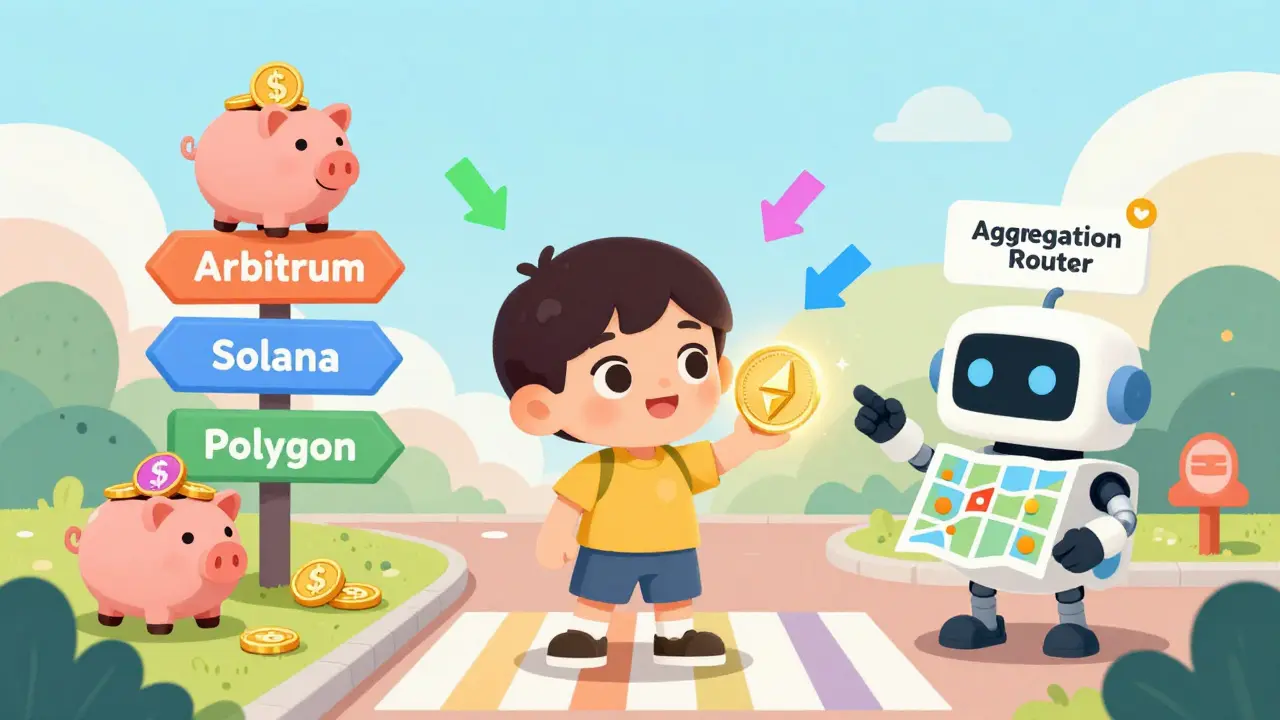
Imagine you want to trade ETH for USDC, but your ETH is on Ethereum, and the best price is on Arbitrum. You can’t just click ‘swap’ - you have to bridge your assets, wait 10-20 minutes, pay gas on two chains, and hope no one exploits the price gap while you wait. That’s cross-chain liquidity fragmentation in action. It’s not a bug - it’s the default state of DeFi today.
Every major blockchain - Ethereum, Solana, Polygon, Base, Optimism - has its own set of liquidity pools. A USDC token on Ethereum is not the same as USDC on Solana, even if they both claim to be the same asset. They live in different smart contracts, with different rules, different fees, and different users. This creates a world where capital is stuck in silos, and traders pay the price in slippage, delays, and missed opportunities.
Why Liquidity Fragmentation Hurts Everyone
It’s easy to think fragmentation only affects traders. But it hits everyone. Let’s break it down:
- For traders: Large orders get split across chains, leading to massive slippage. A $500,000 trade on a thin pool might move the price by 5% - that’s $25,000 lost before you even finish.
- For liquidity providers: You deposit ETH-USDC on Ethereum, but the same pair on Polygon has 3x the volume. Your capital earns less, and you’re exposed to impermanent loss from price drift between chains.
- For developers: Building a cross-chain DApp means integrating with 5+ different bridges, each with their own security model, failure modes, and API quirks. It’s like building a car with parts from 10 different manufacturers.
- For institutions: Hedge funds and market makers can’t efficiently allocate capital because they’re forced to manage liquidity separately on each chain. That means lower returns and higher operational risk.
The result? Price discovery breaks down. If USDC trades at $1.001 on Ethereum and $0.998 on Solana, arbitrage bots can’t act fast enough to fix it - because bridging takes too long. That $0.003 gap isn’t just noise - it’s a sign the market isn’t working.
How Aggregation Solutions Are Fixing This
The fix isn’t to merge blockchains. It’s to connect them - smartly. That’s where liquidity aggregation comes in. These aren’t just bridges. They’re routers. Think of them as Google Maps for DeFi: you tell them where you want to go (swap ETH for USDC), and they find the fastest, cheapest path - even if it means crossing three chains.
Here’s how the top solutions work:
Chainlink CCIP: The Industry Standard for Messaging
Chainlink’s Cross-Chain Interoperability Protocol (CCIP) isn’t a swap tool - it’s the plumbing. It lets any smart contract on one chain send a message to another, securely. That means a DApp on Avalanche can ask for liquidity from a pool on Ethereum without needing to build a custom bridge. CCIP uses decentralized oracle networks to verify state across chains, making it one of the most secure options for institutional-grade applications.
Polygon AggLayer: Aggregating Liquidity Under One Roof
Polygon’s AggLayer doesn’t move assets - it hides the movement. It sits on top of Ethereum, Polygon, and other Layer 2s, creating a unified order book. When you swap on AggLayer, you’re not trading on one chain - you’re trading against the combined liquidity of all connected chains. The protocol handles routing, bridging, and settlement behind the scenes. No more juggling wallets. No more manual bridging. Just one interface.
LayerZero: Trustless Messaging, No Middlemen
LayerZero uses an ultra-light client model. Instead of relying on a central validator, it splits verification between two independent nodes: an oracle (reads chain state) and a relayer (executes the transaction). This means no single point of failure. It’s the backbone for protocols like deBridge and Wormhole, letting them move assets faster and cheaper than legacy bridges.
deBridge and Wormhole: Intent-Driven Trading
deBridge and Wormhole let users define intents - not just trades. Instead of saying ‘swap 1 ETH for USDC,’ you say ‘I want the best price for ETH on any chain.’ The protocol then finds the optimal route: maybe it burns ETH on Ethereum, mints native ETH on Solana, and swaps it for USDC there. All in one transaction. No wrapping. No locked assets. Just native liquidity, wherever it’s deepest.
RenVM: Trustless Cross-Chain Swaps
RenVM uses a decentralized network of nodes (called Darknodes) to lock assets on one chain and mint equivalent tokens on another - without custody. It’s one of the few solutions that avoids wrapped tokens entirely. When you swap BTC for ETH via RenVM, you’re not getting a ‘wBTC’ - you’re getting real, native ETH on the destination chain.

The Two Models: Lock-and-Mint vs. Burn-and-Mint
Not all cross-chain solutions are created equal. There are two core models:
- Lock-and-Mint: You lock your native asset (say, USDC) on Chain A. A wrapped version (wUSDC) is minted on Chain B. This is what most bridges do. But wrapped tokens are fragile - they rely on custodians, oracles, and smart contracts. If one fails, the whole thing unravels.
- Burn-and-Mint: You burn your USDC on Chain A. A new, native USDC is issued on Chain B. No wrapping. No custody. Just pure, native liquidity. This is the future - and protocols like deBridge and Wormhole are pushing it.
The shift from wrapped to native assets is critical. Wrapped tokens are the source of most cross-chain hacks. Native assets eliminate that risk. And as more protocols adopt burn-and-mint, fragmentation shrinks - because now, USDC is truly USDC, no matter where you are.

What’s Still Broken
Even with all this progress, the system isn’t perfect.
- Finality delays: Ethereum finalizes in 15 seconds. Solana in 2.5. Polkadot takes 60. Aggregators have to wait for the slowest chain - that’s where delays creep in.
- Impermanent loss: When liquidity is spread across chains, price drift between them can cause LPs to lose money faster than on a single chain. Bots exploit these gaps in milliseconds.
- Fragmented user experience: You still need to manage multiple wallets, gas tokens, and approvals. Aggregators help, but they don’t fix the underlying wallet chaos.
These aren’t dealbreakers - they’re engineering challenges. And they’re being solved. LayerZero’s lightweight oracles cut finality delays. New LP protocols now auto-rebalance across chains. Wallets like Phantom and MetaMask are starting to support multi-chain transactions in one click.
The Future: One Global Liquidity Pool
The endgame isn’t 100 blockchains. It’s one liquidity layer.
By 2026, we’ll see:
- Every major stablecoin - USDC, DAI, USDT - issued natively on 5+ chains.
- DEX aggregators routing trades across 10+ chains automatically.
- DeFi protocols like Aave and Uniswap offering cross-chain lending and swaps as standard.
- Institutional capital flowing in because they can now manage risk across chains like they do across stock exchanges.
That’s the real win. Not just better trades - but a DeFi economy that behaves like Wall Street. Unified. Efficient. Transparent.
The days of hopping between chains like a digital nomad are ending. The future belongs to protocols that make fragmentation invisible. And that’s not just innovation - it’s evolution.