
When you move from Ethereum’s mainnet to a Layer 2 solution like Arbitrum, Optimism, or Starknet, you expect cheaper transactions. But what you actually pay isn’t just a simple discount. It’s a mix of gas, data blobs, batch efficiency, and network congestion - all changing in real time. If you’re building on L2s, running a dApp, or just sending frequent transactions, guessing your costs can cost you. Here’s how to actually plan for them.
Why L2 Fees Are Not What They Seem
Many think L2s are just "Ethereum but cheaper." That’s true - but only if you understand what’s behind the numbers. On Ethereum L1, a simple transfer costs $2-$5. A complex swap or NFT mint? $10-$30. On L2s, those same actions drop to $0.01-$0.10. But that $0.05 fee isn’t magic. It’s the result of dozens of technical decisions working together. The real cost driver isn’t computation. It’s data. Up to 95% of an L2 transaction’s cost comes from storing transaction data on Ethereum’s main chain. Even though the actual processing happens off-chain, the L2 must publish a compressed summary - called calldata - to Ethereum so everyone can verify it later. That’s where EIP-4844 changed everything.EIP-4844 and the Blob Revolution
Before March 2024, L2s used regular calldata to post transaction data on Ethereum. It was expensive. Starknet’s data shows average fees were $6.80 per transaction. After EIP-4844 introduced blob transactions, that dropped to $0.04. A 95% drop. Blobs are special data containers designed for L2s. They’re cheaper to store because they’re not part of Ethereum’s state. They’re temporary, only kept for 18 days, and don’t bloat the blockchain. This means L2s can now post way more data for way less. Starknet’s engineers reported that blob usage alone reduced their users’ costs by 95-99% compared to pre-upgrade levels. But blobs aren’t a free lunch. Their availability depends on Ethereum block space. During high congestion - like during a meme coin surge in December 2024 - blob prices spiked. Some L2 users saw fees jump to $1.20 temporarily. That’s still cheaper than L1, but it shows why you can’t ignore Ethereum’s state.Gas vs. Data: The Two Cost Pillars
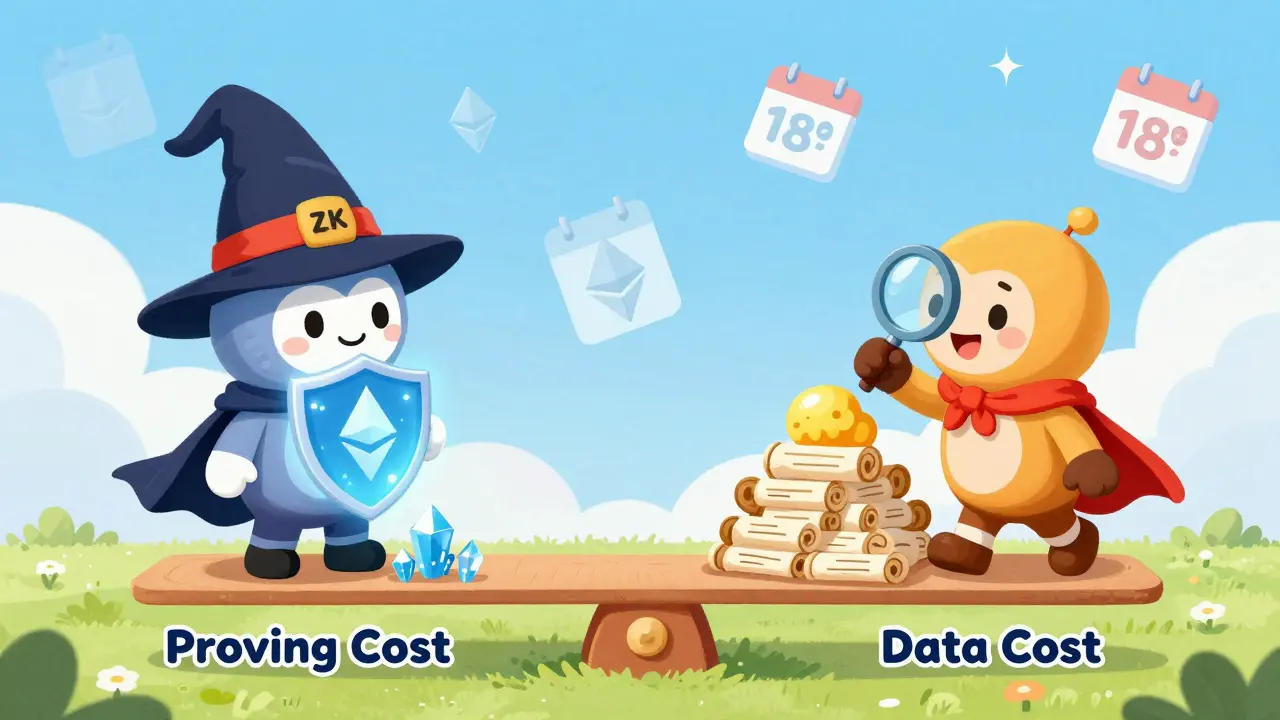
L2 fees break down into two main parts:- Gas fees: Pay for computation. This includes executing smart contracts, validating proofs, or running logic. ZK-Rollups like Starknet and zkSync pay more here because they generate cryptographic proofs for every batch. Optimistic Rollups like Arbitrum and Optimism pay less - they assume transactions are valid and only check if someone challenges them.
- Data fees: Pay for posting transaction data on Ethereum. This is where blobs help. ZK-Rollups compress data better, so they pay less here. Optimistic Rollups need to post more data for fraud proofs, so their data costs are higher.
| Cost Type | ZK-Rollups (Starknet, zkSync) | Optimistic Rollups (Arbitrum, Optimism) |
|---|---|---|
| Proving Costs | $10,500/month | $4,000/month |
| Data Storage Costs | $1,200/month | $8,500/month |
| Total Monthly Cost | $11,700 | $12,500 |
Notice something? ZK-Rollups spend more on proving but far less on data. Optimistic Rollups do the opposite. For high-frequency, low-value transactions (like gaming or payments), Optimistic Rollups are often cheaper. For high-value, low-frequency actions (like DeFi swaps or asset transfers), ZK-Rollups win because of faster finality and lower data overhead.
Throughput Planning: Batching, Compression, and Block Size
You can’t just look at per-transaction fees. You need to think about volume. L2s bundle hundreds or thousands of transactions into a single batch. The more you batch, the lower the cost per transaction. Starknet’s v0.13.0 upgrade in late 2024 increased block size, cutting fees by up to 25%. Their SHARP system also improved resource efficiency by 18% through better layout algorithms. Developers who batch transactions manually - say, combining 10 NFT mints into one call - can cut costs by 30% or more. One Starknet GitHub contributor documented this in December 2024: switching from individual transactions to batched ones dropped their daily fee from $15 to $10.50. That’s $1,600 saved per month at scale. For enterprises like Immutable X, which handles 1.2 million NFT transactions daily, the math is brutal. On Ethereum L1, that would cost $18.8 million per day. On their L2, it’s $3,600. That’s a 99.98% reduction. But they didn’t get there by accident. They spent months optimizing calldata, choosing the right batch size, and timing their uploads to avoid blob congestion.Volition: Choose Your Own Cost Path
Starknet introduced Volition - a feature letting users pick where their data is stored. You can choose:- On-chain: Data posted to Ethereum. Higher cost, maximum security.
- Off-chain: Data stored in decentralized storage like IPFS or Celestia. Cheaper, but you sacrifice some verification guarantees.
When L2s Get Expensive (And How to Avoid It)
L2s are cheaper - but they’re not immune to Ethereum’s volatility. When L1 gas spikes, L2s feel it. Why? Because they still need to post data on Ethereum. During the December 2024 meme coin frenzy, Arbitrum fees jumped from $0.05 to $1.20 in under 24 hours. That’s still cheaper than L1’s $25, but it’s a shock if you’re budgeting for $0.10. The fix? Use tools like Blocknative’s gas estimation API. It gives 99% confidence in Ethereum’s gas price for the next 5 blocks. L2 operators use this to delay transactions during spikes or adjust fees dynamically. One DeFi protocol reduced its user fees by 17% in Q4 2024 just by shifting 30% of transactions to off-peak hours. Also, don’t forget bridging costs. Moving funds from L1 to L2 isn’t free. You pay L1 gas to lock your ETH. If you only make 2-3 transactions a month, that bridge fee might eat your savings. Bitwave’s analysis says infrequent users often don’t benefit from L2s. You need volume to make it worth it.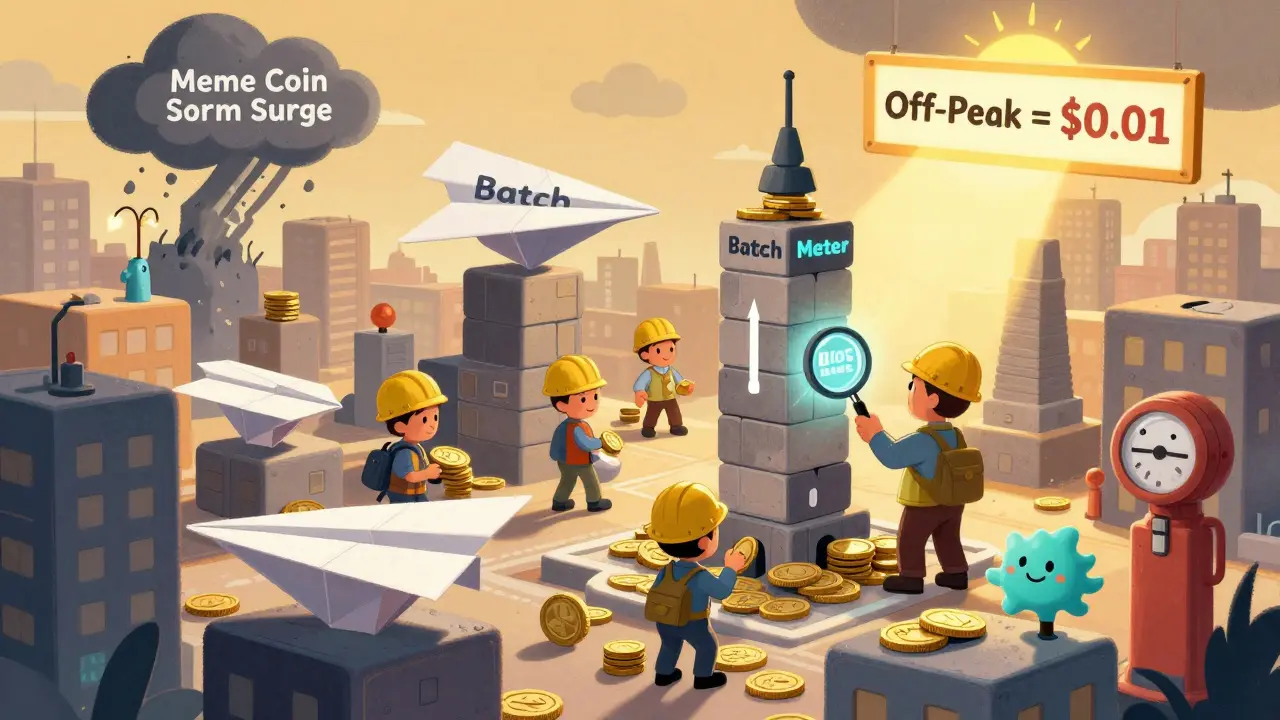
What’s Next: The Road to What’s Next: The Road to $0.01 Transactions
.01 Transactions
By Q4 2025, analysts at Messari predict average L2 transaction costs will fall below $0.01. Here’s why:
- Pectra upgrade (Q3 2025): Ethereum will double blob capacity from 6 to 12 per block. That could halve data costs again.
- SHARP v2 (Q2 2025): Starknet’s next proof system will cut proving costs by 35%.
- Dynamic fee models: Research from Columbia University shows smart fee algorithms can reduce operator costs by 18-22% by adjusting batch size based on real-time congestion.
What You Need to Know to Get Started
If you’re new to L2 cost planning:- Understand EIP-4844. It’s not optional anymore - it’s the baseline.
- Use a gas estimator. Blocknative, Dune Analytics, or L2Beat’s fee tracker can show real-time costs.
- Batch your transactions. Don’t send 10 separate swaps. Send one batch.
- Know your L2 type. ZK-Rollups? Better for high-value. Optimistic? Better for high-volume.
- Track Ethereum congestion. Use ETH Gas Station or similar tools to avoid peak times.
- For enterprises: Budget 15-20% of your blockchain spend on cost optimization tools. ROI takes 3-6 months, but it’s worth it.
There’s no one-size-fits-all cost model. But with the right tools and awareness, you can predict your fees within 10% accuracy. That’s enough to build profitable apps, avoid budget overruns, and keep users happy.
Why are L2 transaction fees so much lower than Ethereum L1?
L2s reduce costs by moving computation off-chain and batching thousands of transactions into one proof or fraud challenge posted on Ethereum. The real savings come from EIP-4844 blob transactions, which cut data storage costs by up to 95%. On L1, every transaction is processed and stored individually. On L2, only a compressed summary is posted - making fees 10-100x cheaper.
Do I need to use blobs to benefit from L2s?
Yes - if you’re using a modern L2 built after March 2024. EIP-4844 is now the standard. Older L2s without blob support are being phased out. Even if your L2 doesn’t force you to use blobs, it’s likely already leveraging them behind the scenes to keep your fees low. Avoid any L2 that doesn’t support EIP-4844.
Which is cheaper: ZK-Rollups or Optimistic Rollups?
It depends. ZK-Rollups have higher proving costs but lower data costs. Optimistic Rollups have lower proving costs but higher data costs. For small, frequent transactions (like gaming or payments), Optimistic Rollups are often cheaper. For large, infrequent transfers (like DeFi swaps), ZK-Rollups win because they use less data and offer faster finality. Starknet and zkSync are ZK examples; Arbitrum and Optimism are Optimistic.
Why do L2 fees spike sometimes?
L2s rely on Ethereum to store their transaction data. When Ethereum gas prices spike - like during NFT mints or meme coin surges - the cost to post blobs and calldata rises. This pushes L2 fees up temporarily. During December 2024, Arbitrum fees jumped to $1.20 during peak congestion. The fix is timing: avoid peak hours, use dynamic fee tools, or batch transactions.
Is it worth switching to L2 if I only make a few transactions a month?
Probably not. Bridging funds from Ethereum L1 to an L2 costs L1 gas - often $5-$15. If you only make 2-3 transactions a month at $0.05 each, you’re spending more on bridging than you save on fees. L2s make sense for users making 10+ transactions monthly or enterprises processing thousands. For light users, stick with L1 or wait until fees drop further.
What tools should I use to estimate L2 costs?
Use Blocknative’s gas estimation API for real-time Ethereum gas predictions. For L2-specific fees, check L2Beat’s fee tracker or Starknet’s fee calculator. Developers should integrate these into their apps. For enterprises, tools like Dune Analytics or custom dashboards that monitor blob prices, batch sizes, and congestion trends are essential.
Can I reduce L2 costs by optimizing my smart contracts?
Absolutely. Every byte of calldata you save cuts your cost. Use packed storage, avoid unnecessary data logging, and combine multiple operations into one transaction. One developer reduced fees by 30% just by batching 10 NFT mints into a single call. Also, avoid writing large strings or arrays to storage - compress them first. Optimization matters more on L2 than you think.