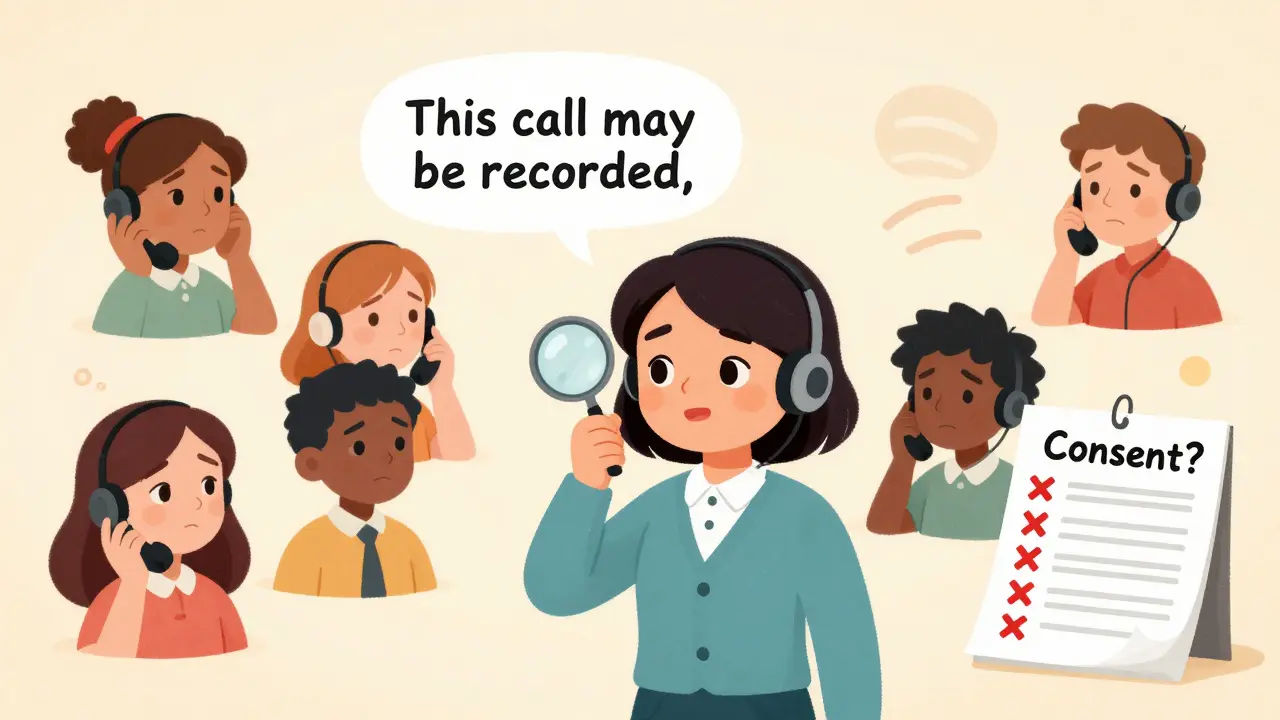
When you record a customer call, you're not just saving a conversation-you're handling sensitive personal data. And in 2026, the rules around who can record, how long you can keep it, and how you play it back have gotten tighter than ever. One wrong move, and you could face fines of $10,000 or more-or even criminal charges. This isn't theoretical. In 2024, a mid-sized retail chain in Pennsylvania was hit with a $15,000 penalty because their automated system played a consent notice, but the agent didn't confirm the customer understood. That’s the reality today.
Consent Isn't Optional-It's the First Rule
You can't just hit record and hope for the best. The law doesn't care if you think it's common practice. In 39 U.S. states, you only need one person's consent to record-usually, that's you. But in 11 states plus Washington D.C., everyone on the call must know and agree. That includes California, Florida, Illinois, Massachusetts, Pennsylvania, Washington, Connecticut, Delaware, Maryland, Montana, and New Hampshire.
Here’s the catch: saying "this call may be recorded" isn't enough anymore. In California, the Attorney General’s 2024 guidance made it clear: if the recording contains health or financial data, you need affirmative opt-in. That means the customer has to actively say "yes" or click "agree." Just letting them stay on the line after hearing the notice? That’s not consent under CCPA.
And if you're in the EU? GDPR wipes out implied consent entirely. You need a clear, unambiguous yes-no vague language, no buried checkboxes. Even if your business is based in the U.S., if you talk to someone in Germany or France, GDPR applies. Violate it, and you could be fined up to 4% of your global revenue.
Storage Isn't Just About Space-It's About Security
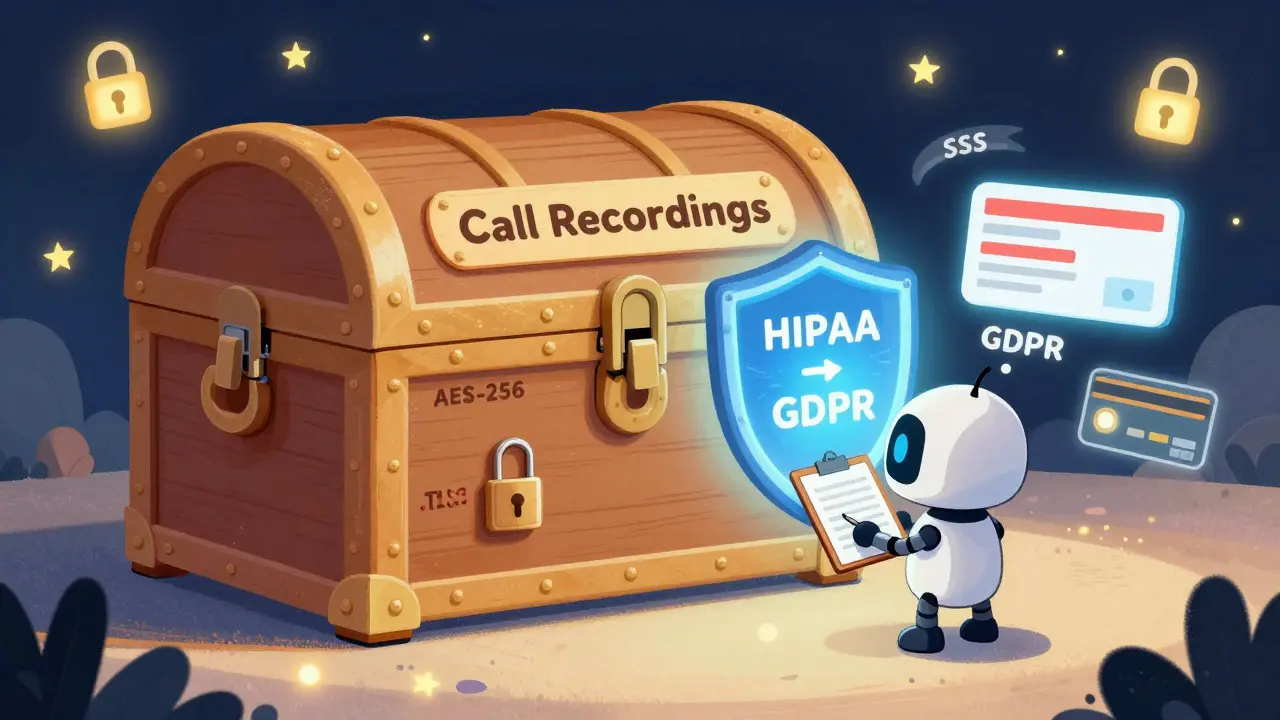
Storing recordings isn't like saving a file on your desktop. You need encryption that meets real standards. NIST 800-175B is the baseline. That means AES-256 encryption for data at rest and TLS 1.3 for data in transit. Anything less, and you're at risk.
Here’s what that looks like in practice:
- A 10-minute call, compressed, takes about 10MB. A contact center handling 1 million minutes per month? That’s 10TB of storage every 30 days.
- You need secure access controls. Not just passwords-role-based permissions. Only the person who needs to hear it should be able to access it.
- For healthcare? HIPAA requires Business Associate Agreements (BAAs) with your recording provider. You also need audit trails showing exactly who accessed each file, when, and why.
And it’s getting harder. NIST just updated its guidelines in October 2024, saying that by 2027, any recording containing Personally Identifiable Information (PII) must use quantum-resistant encryption. That’s not a suggestion. It’s a requirement for federal contractors-and many private companies are adopting it early to avoid future compliance headaches.
Retention Rules Vary by Industry-And State
How long should you keep recordings? There’s no single answer. It depends on who you are and where you operate.
- Financial services: FINRA requires records to be kept for at least 3 years. Some firms keep them longer for internal audits.
- Healthcare: HIPAA mandates 6 years. But in California, if a patient requests deletion under CCPA, you must erase it within 30 days-even if the 6-year clock hasn’t run out.
- General retail: No federal rule. But many keep recordings for 12 to 24 months for training and dispute resolution.
- Multi-state operations: This is where things break. If you serve customers in Illinois (where recordings must be kept for 5 years) and Texas (where there’s no retention law), you have to follow the strictest rule across all states. That means 5 years, even if you’re only required to keep it 1 year in most places.
Automated retention policies are no longer a luxury. Systems that don’t auto-delete recordings after the legal window closes are a ticking time bomb. One company in Florida was fined $8,000 last year because their system kept recordings from 2019-even though their policy said 2 years.
Playback: It’s Not Just About Listening
Playing back a recording isn’t just for training. It’s for legal defense, quality checks, and compliance audits. But if you can’t prove who accessed it or why, you’re vulnerable.
Here’s what a compliant playback system needs:
- Full audit logs: Who played it? When? For what reason? (Training? Dispute? Legal review?)
- Redaction tools: You can’t play back a recording with a customer’s SSN or credit card number. Systems must let you mute or remove sensitive parts before playback.
- Access controls: A call center supervisor shouldn’t be able to listen to every recording. Only those with a legitimate business need.
- AI-powered monitoring: Some platforms now flag recordings where consent wasn’t properly obtained-before anyone even listens. Sprinklr’s Real-Time Compliance Guard, for example, catches 94% of violations during live calls.
And here’s the twist: AI is changing the game. If your system analyzes voice tone, detects emotion, or identifies stress levels, you’re now handling biometric data. Fourteen states have passed laws treating voice patterns as biometrics. That means extra consent. That means extra security. And that means extra risk if you skip it.
What Happens When You Get It Wrong?
Fines aren’t the worst of it. In Illinois, illegally recording a call is a Class 4 felony. That’s not a slap on the wrist-it’s jail time. In California, each violation can cost $2,500. Multiply that by 500 calls recorded without consent? That’s $1.25 million in penalties.
But the real damage is reputational. Customers don’t forget when they feel watched. A 2024 G2 Crowd survey found that 31% of customers said they’d stop doing business with a company after learning their calls were recorded without clear consent. That’s more than the cost of fines.
And the lawsuits? They’re rising. In 2024, 23% of contact center managers reported being targeted by class-action suits over recording practices. Most were based on failure to obtain proper consent-not technical failures.
How to Get It Right in 2026
You don’t need to be a lawyer to stay compliant. But you do need a system that does the heavy lifting for you.
- Use a VoIP provider with built-in compliance. Platforms like CloudTalk, Sprinklr, and Ringly.io handle state-specific consent prompts, retention schedules, and audit trails out of the box.
- Train your agents. A simple 10-minute module on consent rules for each state you serve can cut violations by 60%.
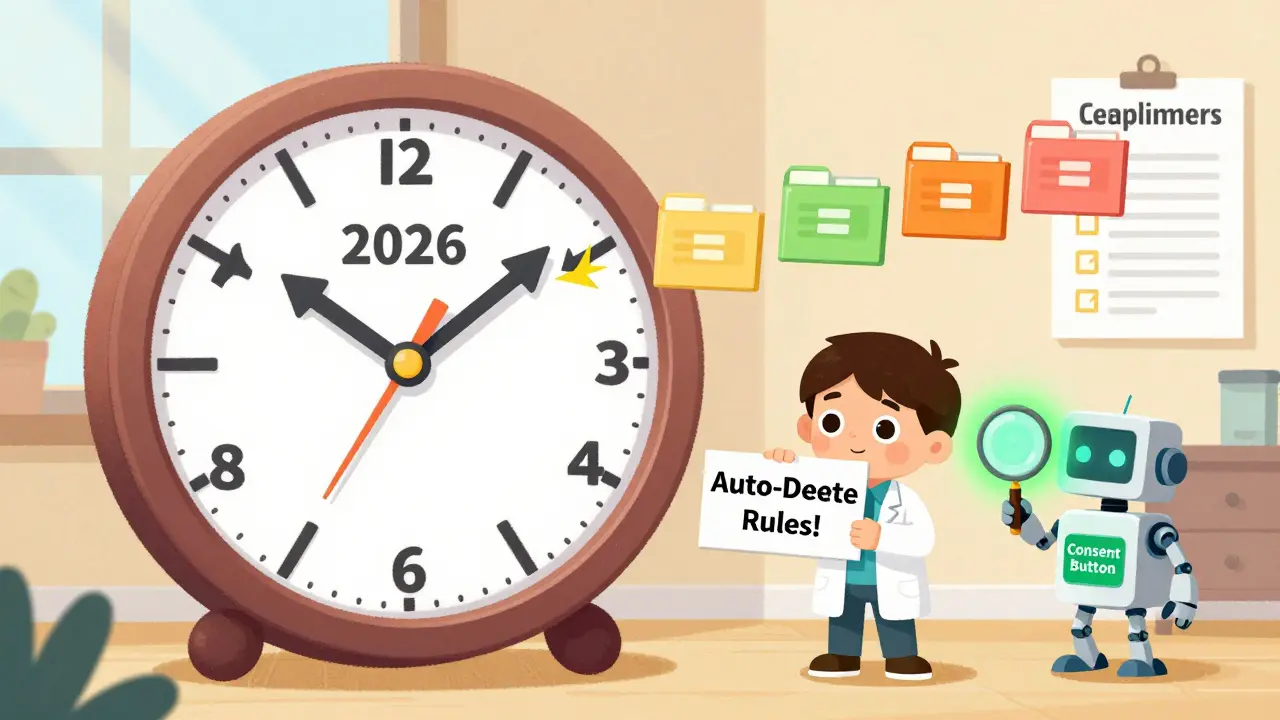
- Automate deletion. Set up rules that purge recordings after the minimum legal retention period.
- Test your system. Run monthly audits. Play back random recordings. Can you prove consent? Can you prove access? Can you prove deletion?
- Know your state. If you operate in more than one state, map out which ones require two-party consent. Update your scripts quarterly.
And if you're using AI voice agents? The FCC’s September 2024 update says you need written consent for outbound calls-not just verbal. That means a digital form, a checkbox, an email confirmation. No more "by staying on the line, you consent."
What’s Coming Next
The next 12 months will bring even more changes. Seventeen states passed laws in late 2024 requiring businesses to disclose when AI is on the call. The EU’s AI Act, effective February 2025, bans emotion recognition tech without explicit consent. And by 2026, 75% of contact centers will use AI to monitor compliance in real time.
The future isn’t about avoiding recording. It’s about recording smarter. With transparency. With security. With respect for the law-and the people on the other end of the line.
Do I need consent to record a call if I’m in a one-party state?
Yes. Even in one-party states, you must notify the other party. Silence or continued conversation doesn’t count as consent under most modern laws. Some states, like California and Illinois, require explicit consent for any recording containing sensitive data-health, financial, or biometric information-regardless of state law.
How long should I keep call recordings?
It depends on your industry and location. Financial services must keep recordings for at least 3 years under FINRA. Healthcare providers need 6 years under HIPAA. Retailers typically keep them 12-24 months. But if you serve customers in California, you must delete recordings upon request-even if the legal retention period hasn’t expired. Always follow the strictest rule across all jurisdictions.
Can I use free VoIP services to record calls?
Technically, yes-but you’re risking compliance. Most free or low-cost VoIP services don’t offer encryption that meets NIST 800-175B, don’t provide audit logs, and can’t auto-delete recordings per legal requirements. If you’re in healthcare, finance, or operate across state lines, using a non-compliant system could expose you to fines or lawsuits. Enterprise-grade systems start at $25/user/month for basic compliance add-ons.
What if my customer says "I don’t care if you record this"?
It doesn’t matter. Consent must be obtained through a clear, documented process-not a casual remark. If your system doesn’t capture affirmative consent (like a click, a verbal "yes," or a signed form), you’re still in violation. Courts and regulators don’t accept informal statements as legal consent.
Do I need consent for internal calls between employees?
Generally, no-if both parties are employees and the recording is for internal training or quality assurance. But if the call includes customer data, even in passing, you should still notify participants. Many companies apply consent rules to all internal recordings as a best practice to avoid accidental violations.