When you send ETH from Ethereum to a Layer 2 like Arbitrum or Optimism, you’re not just sending money-you’re crossing a digital border. The bridge between these chains isn’t a simple tunnel. It’s a complex, high-stakes system that locks your assets on one side and unlocks them on the other. If it fails, your money could vanish. But if it works right, you get transactions that are 100x cheaper and 10x faster than on Ethereum itself. Understanding how this works isn’t just for developers. If you’re using DeFi, NFTs, or even just holding crypto, you need to know what’s happening when you bridge.
Why Bridge at All?
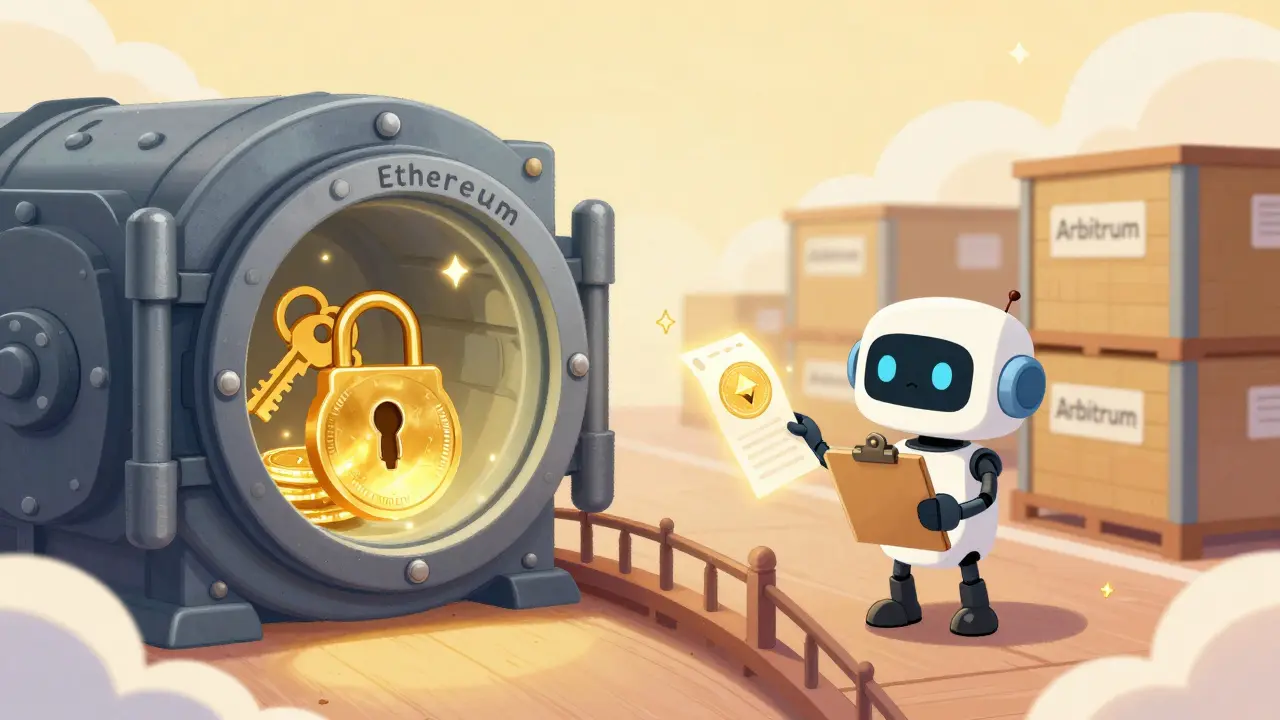
Ethereum’s main chain is slow and expensive. Right now, sending a simple token transfer can cost $5-$20 in gas fees. On Layer 2, that same transfer costs pennies. But you can’t just hop over without a bridge. Layer 2 networks don’t have their own security. They borrow Ethereum’s. That’s why every asset you use on Arbitrum, zkSync, or Base started as ETH or ERC-20 tokens on Ethereum. The bridge is the only way in.Think of it like this: Ethereum is the vault. Layer 2 is the fast-moving warehouse next door. You lock your valuables in the vault, and the warehouse gives you a receipt. You trade those receipts around the warehouse-buying, selling, swapping-without ever touching the vault. When you want your stuff back, you return the receipt. The vault checks it, opens, and gives you your original items. That’s bridging.
How Bridging Actually Works
The process is simple in theory but packed with technical precision in practice. Here’s how it breaks down:- You send ETH or a token (like USDC) from your wallet to a bridge contract on Ethereum (Layer 1).
- That contract locks your tokens in a smart contract. They’re frozen until you claim them back.
- On the Layer 2 side, a corresponding amount is minted as a wrapped version-like ETH on Arbitrum or USDC on zkSync.
- You now have assets on Layer 2. You can swap, stake, or trade at low cost and high speed.
- When you’re done, you send a withdrawal request back through the bridge. The Layer 2 network proves the transaction was valid and submits it to Ethereum.
- Ethereum verifies the proof. If everything checks out, your original tokens are unlocked and sent back to your wallet.
This back-and-forth relies on two key ideas: finality and proof. Finality means once Ethereum confirms the withdrawal, it’s permanent. Proof means the Layer 2 network doesn’t just say, “Trust me,” it shows mathematically that every transaction was valid.
The Two Types of Proofs: Optimistic vs. Zero-Knowledge
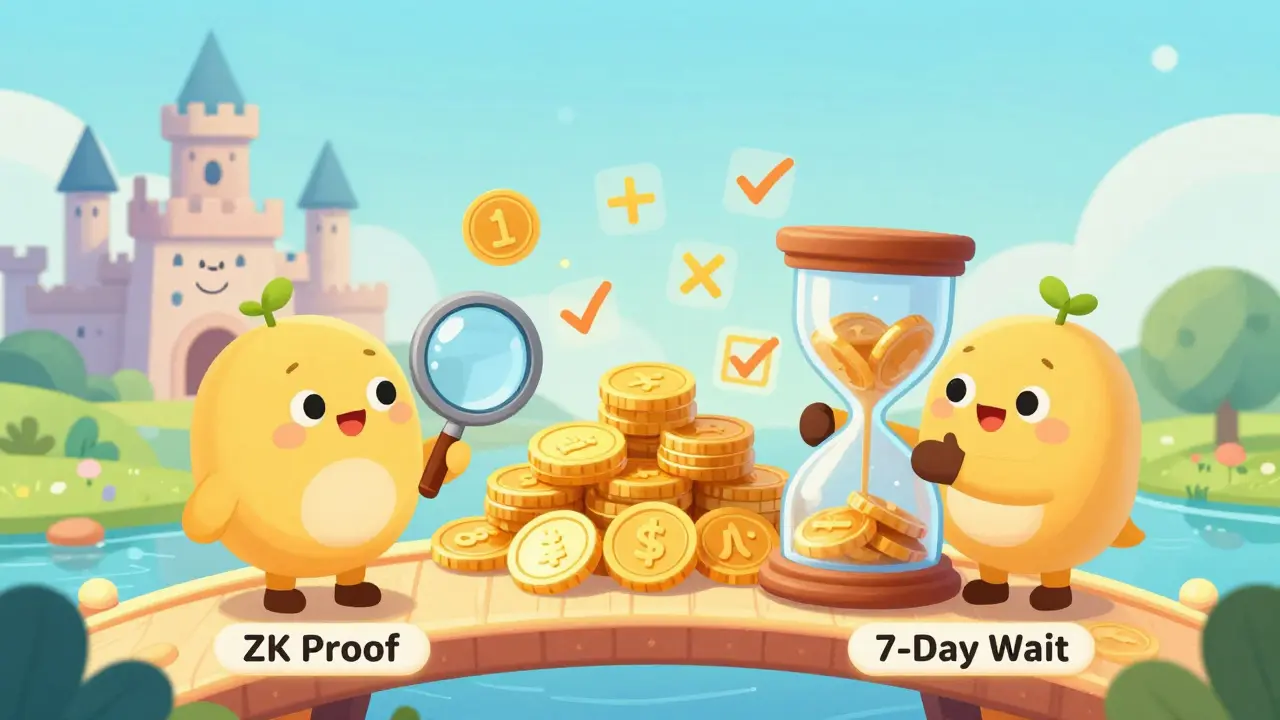
Not all Layer 2s work the same. There are two main types of bridges, defined by how they prove transactions to Ethereum:- Optimistic Rollups assume everything is valid unless someone proves otherwise. They post transaction data to Ethereum and wait 7 days. If no one challenges it, the batch is finalized. If someone spots fraud, they can submit a fraud proof and undo the bad transactions. This is slower but cheaper to run.
- Zero-Knowledge (ZK) Rollups generate a cryptographic proof for every batch of transactions. This proof is verified on Ethereum instantly. No waiting. No challenges. Just math. This is faster and more secure but harder to build.
ZK-Rollups are becoming the gold standard because they’re faster and don’t require trust. Optimistic Rollups are still widely used because they’re easier for developers to adopt. Both rely on Ethereum for security. Neither can steal your funds. But one can delay you. The other can’t.
Who Runs the Bridge? Trustless vs. Trusted
Some bridges are built to be trustless. Others? Not so much.Trustless bridges use smart contracts and cryptographic proofs. No middleman. No team that can shut it down. When you deposit ETH on a trustless bridge, a smart contract locks it. A relayer (a decentralized node) watches the Ethereum chain, verifies the deposit, and triggers the minting on Layer 2. The whole thing runs on code. You don’t need to trust anyone.
Trusted bridges rely on a group of validators-often a small team or company-to sign off on transfers. If those validators are hacked or go rogue, your money is at risk. This is why some bridges have lost hundreds of millions. In 2022, the Wormhole bridge lost $325 million because a single signature key was compromised. That’s the danger of trusting humans over math.
Today, the safest bridges are those built by Layer 2 teams themselves-like the official Arbitrum bridge or the zkSync bridge. These are called canonical bridges. They’re tightly integrated with the Layer 2 network, use ZK proofs, and are audited constantly. Third-party bridges like Multichain or RenBridge? They’re convenient, but they’re riskier.
What Happens When a Bridge Fails?
Bridges are the weakest link in Layer 2 security. In 2023 alone, over $1.2 billion was lost to bridge exploits. Why? Because they’re complex. They connect two independent systems. Each has its own rules. One tiny bug in the code can let attackers drain funds.Here’s how it usually goes:
- An attacker finds a flaw in how the bridge verifies a transaction.
- They fake a deposit on Ethereum.
- The bridge on Layer 2 believes it’s real and mints fake tokens.
- The attacker swaps those fake tokens for real ones on DeFi platforms.
- The bridge collapses under the weight of the fraud.
Even if Ethereum is perfectly secure, the bridge can still be hacked. That’s why you should never use a bridge unless you know who built it. Always check:
- Is it the official bridge for that Layer 2?
- Has it been audited by top firms like CertiK or Trail of Bits?
- Does it use ZK proofs or is it optimistic?
- Is the bridge code open-source?
If the answer to any of those is no, walk away. Your assets aren’t worth the gamble.

How to Bridge Safely: A Step-by-Step Guide
If you’re ready to move assets, here’s how to do it right:- Start with the official bridge. Go to the Layer 2’s website (like arbitrum.io or zksync.io). Find their bridge tool. Never use a third-party site.
- Connect your wallet. MetaMask or WalletConnect. Make sure you’re on Ethereum mainnet.
- Choose your token. ETH is safest. Stablecoins like USDC or DAI are next. Avoid obscure tokens.
- Enter the amount. Start small. Test with $50 first.
- Confirm the transaction. Pay the gas fee on Ethereum. Wait 2-5 minutes.
- Switch networks. In your wallet, change from Ethereum to the Layer 2 network (e.g., Arbitrum One).
- Check your balance. Your tokens should appear. If they don’t, wait. Some bridges take up to 20 minutes.
- Withdraw the same way. When you’re done, use the same bridge to send assets back.
Pro tip: Always test with a tiny amount first. If it works, you’re good. If it doesn’t, stop. Don’t try to fix it yourself. Ask the Layer 2’s support team.
The Future: Multi-Layer 2 Worlds
Right now, most Layer 2s are siloed. You can’t move from Arbitrum to zkSync without going back to Ethereum first. That’s changing. New protocols like ERC-4337 and IBC-style message passing are letting Layer 2s talk directly to each other.Imagine this: You’re on zkSync. You want to trade on a DEX on Base. Instead of bridging back to Ethereum and then to Base, you just click “Move to Base.” The bridge handles it automatically, using a secure relay between the two networks. No extra fees. No waiting.
Companies like Polygon and LayerZero are building these cross-L2 bridges now. They’ll make Layer 2s feel like one big network. But they’ll also introduce new risks. The more connections, the more attack surfaces. That’s why future bridges will rely on restaking-letting Ethereum validators also secure Layer 2 bridges by staking their ETH twice. It’s like giving the same guard two keys to two doors.
Final Warning: Don’t Rush
Layer 2s are the future of Ethereum. But they’re not magic. They’re engineering. And engineering can break. The bridge is the most critical part of the whole system. Treat it like a vault door. Don’t just trust it. Verify it.Use official bridges. Use ZK-Rollups when you can. Avoid third-party tools unless they’re audited and battle-tested. And never, ever bridge more than you’re willing to lose.
The goal isn’t to move fast. It’s to move safely. Because once your assets are on Layer 2, they’re only as secure as the bridge that got them there.
What happens if I send assets to the wrong Layer 2 network?
If you send ETH or a token to a Layer 2 address that doesn’t match the network you’re bridging to, your funds will likely be stuck forever. For example, sending USDC to an Arbitrum address while on zkSync will result in a loss. Always double-check the destination address and network before confirming. There is no recovery mechanism. Prevention is your only protection.
How long does it take to bridge assets to Layer 2?
Depends on the bridge. For ZK-Rollups like zkSync or StarkNet, deposits usually take 1-5 minutes. For Optimistic Rollups like Arbitrum or Optimism, they can take 5-15 minutes. Withdrawals back to Ethereum take longer-up to 7 days for Optimistic Rollups because of the fraud challenge window. ZK-Rollups allow withdrawals in under an hour.
Can I bridge from one Layer 2 to another without going back to Ethereum?
Not directly with most bridges today. You must withdraw back to Ethereum first, then bridge again to the other Layer 2. However, new cross-L2 bridges like LayerZero and Polygon’s zkEVM bridges are starting to enable direct transfers between Layer 2s. These are still experimental and carry higher risk-only use them with small amounts until they’re proven.
Are Layer 2 bridges safe for large amounts?
Only if you use the official, audited bridge of a major Layer 2 like Arbitrum, zkSync, or Base. Even then, no bridge is 100% immune to bugs. For large transfers, consider splitting the amount into smaller transactions over time. Never bridge your entire portfolio in one go. Always test with a small amount first.
Why do I pay gas fees on Ethereum when bridging to Layer 2?
Because the bridge contract lives on Ethereum. Locking your assets is a transaction on the Ethereum blockchain, so it requires Ethereum gas. Layer 2 doesn’t replace Ethereum-it relies on it. The gas fee is the cost of using Ethereum’s security. Once you’re on Layer 2, you pay almost nothing to transact. But to get there, you pay Ethereum’s price.