
By 2025, the debate around blockchain energy use isn’t about whether it’s a problem-it’s about which blockchains are solving it and which are falling behind. Bitcoin still uses as much electricity as Poland. But Ethereum? It now uses less than a small town. The shift isn’t gradual anymore. It’s a revolution.
Bitcoin’s Energy Footprint Is Still Massive-But It’s Changing
Bitcoin mining consumed 173 terawatt-hours (TWh) in 2025. That’s the same as the entire country of Poland. Daily, it pulls 384 gigawatt-hours (GWh) from the grid. That’s enough to power 36 million LED light bulbs for a year. And each Bitcoin transaction? It uses 1,335 kilowatt-hours (kWh). That’s the same as running a U.S. household for 45 days. The numbers sound absurd. But here’s the twist: 52.4% of that energy now comes from renewable sources-wind, hydro, and nuclear. Miners in Iceland and Norway are using geothermal and glacial water cooling to slash costs by 30-40%. In Kazakhstan, mining dropped to 7% of global output after new government rules kicked in. This isn’t greenwashing. It’s adaptation. Still, the problem remains: Bitcoin’s design forces miners to burn power to secure the network. No matter how clean the energy, the system is built on waste. And while some argue that Bitcoin mining helps absorb excess renewable energy that would otherwise go unused, critics point out that it often displaces clean power from homes and factories. The real question isn’t whether Bitcoin can be greener-it’s whether it should be.Ethereum’s Merge Changed Everything
In September 2022, Ethereum switched from proof-of-work to proof-of-stake. That single move cut its energy use by 99.9%. Before the Merge, Ethereum used 112 TWh a year-more than the Netherlands. Today? It uses 0.0026 TWh. That’s less than the annual electricity use of 600 American homes. The difference isn’t just scale-it’s philosophy. Proof-of-stake doesn’t need miners racing to solve math puzzles. Instead, validators lock up 2 ETH (about $6,400 as of December 2025) and are chosen randomly to confirm transactions. No hardware wars. No noise. No massive cooling systems. A regular laptop can run a validator node. Enterprise adoption followed fast. Companies building supply chain trackers, digital identity systems, and carbon credit ledgers now choose Ethereum because it’s scalable, secure, and sustainable. Even critics who once called Ethereum “too centralized” now admit: the Merge was the smartest move in crypto history.Other Blockchains Are Even More Efficient
Ethereum’s efficiency is impressive. But it’s not the champion. Algorand uses just 0.0002 TWh per year-equivalent to 200 U.S. homes. Cardano uses 0.0006 TWh. Tezos? A mere 0.000128 TWh. Nano? Zero transaction fees and 0.000112 kWh per transaction. That’s 150 million times more efficient than Bitcoin. These networks don’t use miners at all. They use proof-of-stake, directed acyclic graphs (DAGs), or block-lattice structures. Nano, for example, lets every user run their own blockchain. No central validators. No mining rigs. Just instant, free transactions. It’s perfect for IoT devices, micropayments, and smart appliances. Even Dogecoin, once seen as a joke, migrated to proof-of-stake in Q2 2024. Why? Because the cost of running a PoW chain became unsustainable. The message is clear: if you’re building something new, you don’t pick Bitcoin. You pick efficiency.
AI and Blockchain Are Converging-And It’s Making Mining Smarter
Here’s something you might not expect: AI is now helping crypto miners use less energy. NVIDIA’s CryptoMining AI Suite, released in early 2025, uses machine learning to predict when electricity prices drop and when renewable output peaks. It shifts mining activity to those windows, cutting energy costs by up to 18%. It’s not just about saving money. It’s about reducing emissions. AI-driven load balancing means fewer coal plants are fired up to meet mining demand. In Texas, some mining farms now sync with solar farm output in real time. When the sun sets, mining pauses. When it rises, it resumes. This isn’t a gimmick. It’s a necessity. The CMU Electricity Grid Impacts Report (2025) predicts data centers and crypto mining will consume 350% more power by 2030. Without AI optimization, that would mean blackouts in energy-poor regions. With it? We might just avoid the worst.Regulation Is Forcing Change-Fast
Governments aren’t waiting for the market to fix this. The EU’s MiCA regulation, effective January 2025, requires every crypto asset to publicly report its energy use. New York State extended its ban on proof-of-work mining through 2026. The SEC now demands quarterly carbon footprint disclosures from all U.S.-listed crypto tokens. These rules aren’t just paperwork. They’re death sentences for inefficient chains. A startup launching a blockchain in 2025 won’t even consider PoW. Why? Because investors won’t fund it. Regulators won’t approve it. Customers won’t trust it. The result? 87% of new enterprise blockchain projects in 2025 use proof-of-stake or DAG-based systems. That’s up from 42% in 2022. The shift isn’t coming. It’s already here.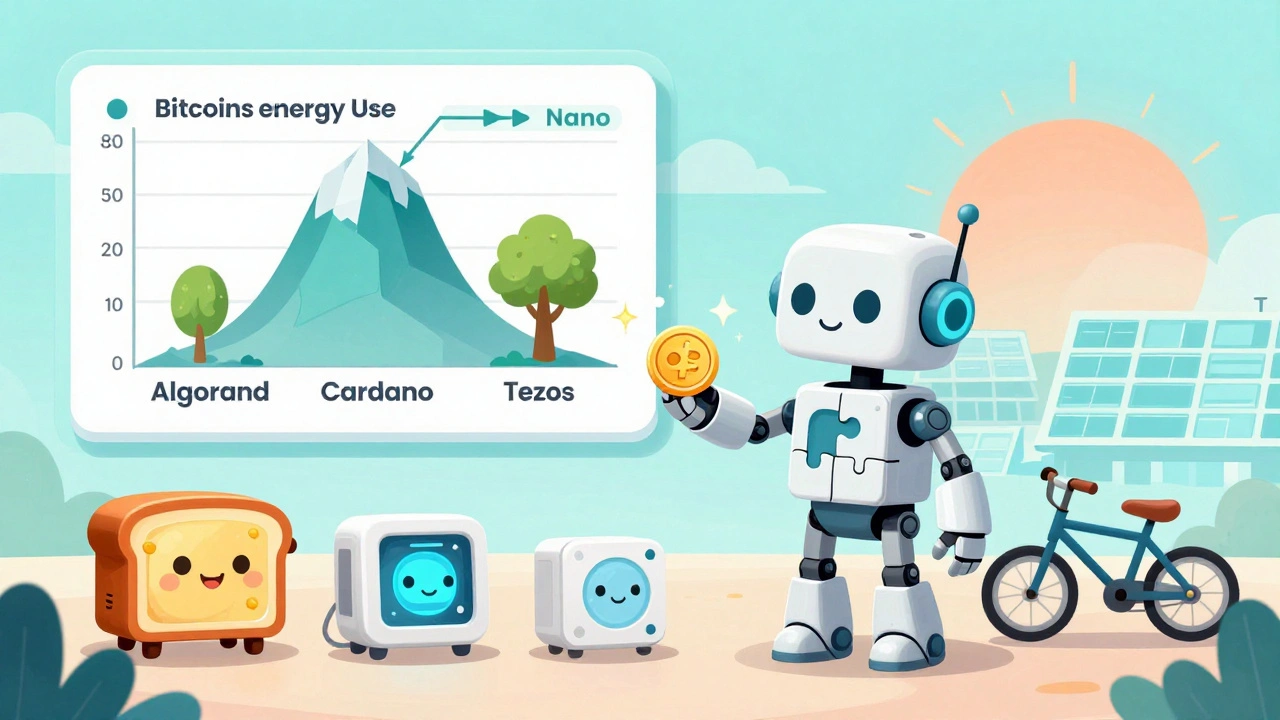
What’s Next? Three Trends to Watch
- Blockchain for renewable energy trading: Projects like Power Ledger are already letting households sell excess solar power directly to neighbors using blockchain. Each transaction uses 0.0003 kWh-less than a phone charge.
- Energy-efficient chains will dominate enterprise adoption: Deloitte reports enterprise blockchain use is growing at 72% annually, and nearly all of it is on low-energy platforms.
- PoW networks may peak in 2026: The IEA predicts blockchain energy use will hit its high point next year, then drop as PoW fades. By 2030, 95% of new chains will be proof-of-stake.
Should You Care? Here’s the Bottom Line
If you’re a developer, investor, or business leader: stop using Bitcoin for anything that isn’t long-term value storage. Its energy cost makes it terrible for payments, apps, or daily use. Ethereum, Algorand, Cardano, and Nano are better in every way-faster, cheaper, cleaner. If you’re an environmentalist: celebrate the Merge. It proved crypto can change. But stay skeptical. Renewable mining doesn’t mean zero impact. Demand still grows. Efficiency still matters. And if you’re just trying to understand the future? Look at the numbers. Bitcoin’s energy use is a relic. The future runs on proof-of-stake. And it’s already here.Is Bitcoin mining still a major energy drain in 2025?
Yes. Bitcoin mining still uses about 173 terawatt-hours (TWh) annually-equivalent to Poland’s total electricity consumption. While 52.4% of that now comes from renewable sources, the system’s design requires massive, continuous power to secure the network. No other major blockchain comes close to Bitcoin’s energy use per transaction.
How much energy does Ethereum use now after the Merge?
Post-Merge, Ethereum uses just 0.0026 TWh per year-99.9% less than before. That’s about the same as a small town. Each transaction now consumes only 0.0000026 kWh, making it over 500,000 times more efficient than Bitcoin. This shift turned Ethereum from a major energy user into a model for sustainable blockchain.
What’s the most energy-efficient blockchain in 2025?
Nano is the most energy-efficient, using just 0.000112 kWh per transaction-150 million times less than Bitcoin. It uses a block-lattice structure with Open Representative Voting, eliminating miners entirely. Algorand and Tezos are also extremely efficient, using less than 0.0003 TWh annually, making them ideal for high-volume, low-impact applications like micropayments and IoT.
Are renewable-powered Bitcoin miners truly sustainable?
Not really. While 52.4% of Bitcoin mining now uses renewable energy, much of it doesn’t add new clean power to the grid. Instead, miners often buy existing renewable electricity that would’ve gone to homes or factories. This displaces other users rather than expanding clean energy capacity. True sustainability means adding new renewables-not just using what’s already there.
Will proof-of-work blockchains disappear by 2030?
They won’t vanish overnight, but they’ll become niche. The IEA predicts blockchain energy use will peak in 2026, then decline as PoW networks shrink. By 2030, 95% of new blockchain projects will use proof-of-stake or other low-energy consensus models. Bitcoin may survive as a store of value, but PoW will no longer be the default for innovation.
Can AI really reduce blockchain’s energy use?
Yes. AI tools like NVIDIA’s CryptoMining AI Suite optimize mining schedules based on real-time electricity prices and renewable output. In practice, this cuts energy use by up to 18% without reducing mining output. AI helps miners run during off-peak hours and when solar or wind is abundant, reducing strain on the grid and lowering emissions.
Why are enterprises switching to proof-of-stake blockchains?
Because they need to meet ESG goals, avoid regulatory fines, and appeal to eco-conscious customers. In 2025, 87% of new enterprise blockchain projects used proof-of-stake or DAG-based systems. Ethereum, Cardano, and Algorand are now preferred for supply chain tracking, digital IDs, and carbon credit systems-not because they’re faster, but because they’re sustainable.