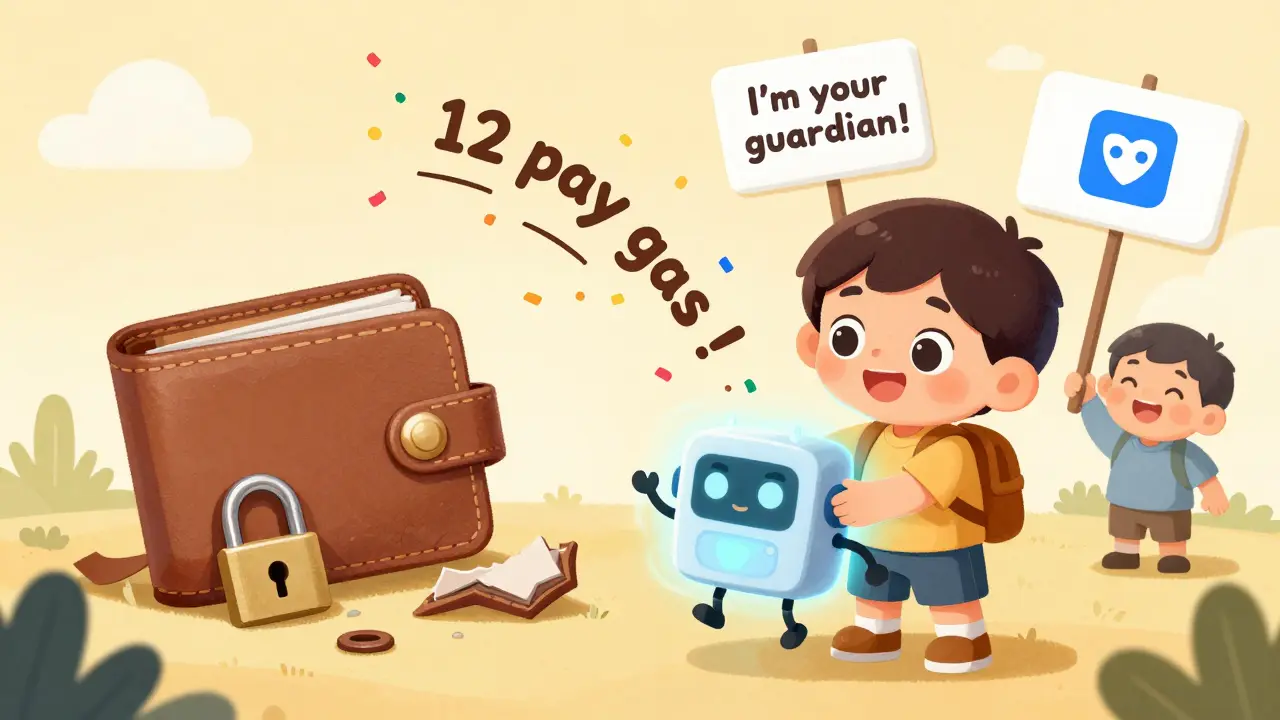
Imagine losing your phone - and with it, your entire crypto portfolio. No backup. No recovery. Just gone. That’s the reality for millions of people using traditional blockchain wallets today. But what if your wallet could recover itself? What if you didn’t need a 12-word seed phrase at all? What if someone else - a friend, a company, even a dApp - could pay your transaction fees so you didn’t have to buy ETH just to send ETH? This isn’t science fiction. It’s account abstraction, and it’s already changing how people interact with blockchain.
What Exactly Is Account Abstraction?
Traditional wallets, called externally owned accounts (EOAs), are simple: one private key, one address, no exceptions. If you lose the key, your money is stuck forever. According to Chainalysis, about 20% of all Ethereum - roughly 3.7 million ETH worth over $7 billion at $2,000 per ETH - is permanently locked away because someone forgot their seed phrase or lost their hardware wallet.
Account abstraction flips this model. Instead of a wallet being just a key, it becomes a smart contract. Think of it like upgrading from a basic door lock to a smart lock that lets you grant temporary access, require two people to open it, or even let your neighbor pay the electricity bill for you. This isn’t a minor tweak - it’s a complete redesign of how wallets work.
The standard that made this possible is ERC-4337, launched in March 2023 by Ethereum researchers including Vitalik Buterin. It doesn’t require changing the Ethereum core protocol. Instead, it adds a new layer on top, letting users send transactions through smart contract wallets without touching the underlying blockchain rules.
How It Works: The Three Key Pieces
Account abstraction runs on three moving parts:
- UserOperations: These are special transaction bundles that contain all the data needed - who’s sending, what’s being sent, and what rules must be followed. They’re not raw transactions like in EOAs. They’re more like job requests.
- Bundlers: These are servers that collect dozens or even hundreds of UserOperations and group them into one single transaction. This batching cuts fees by 15-20% because you’re paying for one big transaction instead of many small ones.
- Paymasters: This is the game-changer. A paymaster can cover your gas fees. Maybe it’s the dApp you’re using. Maybe it’s your employer. Maybe it’s a sponsor. You don’t need ETH in your wallet to send a transaction. That removes the biggest barrier for new users - the $15-$50 cost of buying crypto just to start using it.
This system creates its own mini-mempool - a separate waiting area for these smart contract transactions. Ethereum nodes process them differently, which makes everything smoother and cheaper.
Why This Matters: Real Benefits You Can Feel
Account abstraction isn’t about theory. It’s about fixing real pain points.
1. No More Lost Keys
With traditional wallets, losing your private key = losing your money. Forever. Account abstraction wallets like Argent and Ambire let you set up social recovery. You pick 2-3 trusted contacts - a friend, a family member, a colleague. If you lose access, they help you regain it after a 24-72 hour waiting period. No seed phrases. No panic. One Reddit user, u/CryptoNewbie99, recovered $1,200 after losing their phone thanks to this exact system.
2. Gasless Transactions
Coinbase’s 2023 study found that 68% of new users abandon their first blockchain transaction because they don’t have enough ETH to pay gas. With paymasters, you can sign a transaction, and someone else pays. DApps can offer free transactions as a sign-up bonus. Companies can pay for employee crypto payments. You don’t need to buy ETH just to send ETH.
3. Better Security
EOAs are all-or-nothing. One compromised key = total loss. Smart contract wallets let you build layered security. You can require two signatures for large transfers. You can tie access to biometrics. You can block transactions to known scam addresses. Starknet reports that 83% of financial institutions using account abstraction cut fraudulent transactions by implementing custom screening rules.
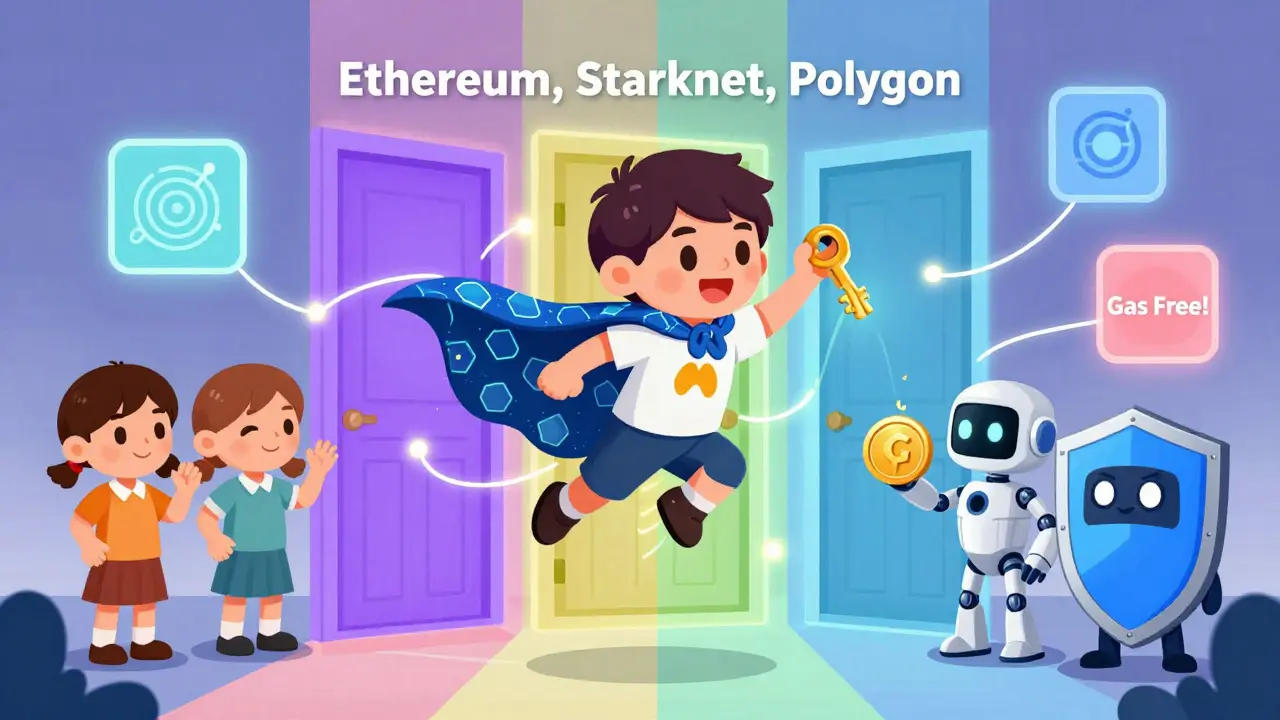
4. One Wallet, Many Chains
Right now, if you use Ethereum, Polygon, and Solana, you need three separate wallets. Account abstraction lets you manage all of them from one interface. Your wallet becomes a bridge - not a silo. You don’t need to juggle different keys or remember which chain holds which asset.
What’s Different From Old Wallets?
Here’s a quick comparison:
| Feature | Traditional Wallet (EOA) | Account Abstraction Wallet |
|---|---|---|
| Recovery | Only seed phrase | Multi-guardian social recovery |
| Gas Fees | Must pay in native token (ETH) | Can be paid by third parties (paymasters) |
| Authentication | Single private key | Biometrics, hardware keys, social proof |
| Transaction Rules | None - all transactions allowed | Custom logic: limits, approvals, blacklists |
| Multi-chain | Separate wallets per chain | Unified interface across networks |
| Failure Risk | High - lost key = permanent loss | Low - recoverable, auditable logic |
The numbers don’t lie. In Q3 2023, 38% of new Ethereum wallets used account abstraction. Just a year earlier, it was 7%. Adoption is accelerating fast.
Real-World Use Cases
It’s not just for crypto traders.
For enterprises, account abstraction means automated compliance. A company can set rules like: “No transaction over $50,000 without three approvals.” “Block all transfers to mixing services.” “Only allow payments to verified vendor wallets.” Consensys cut internal approval times from 47 minutes to under 8 minutes using these rules.
For gamers and creators, it means free in-app purchases. A game can pay for your gas to buy a skin. A music platform can let fans tip artists without needing ETH.
For non-tech users, it means signing in with Face ID instead of typing a 24-character string. It means not having to worry about “gas fees” at all.
What’s Holding It Back?
It’s not perfect.
Some users report slower transaction times - about half a second to a full second longer than EOAs. During peak congestion, 8.3% of UserOperations fail. That’s not zero, but it’s getting better. EIP-3074, scheduled for Q2 2024, will reduce those failures to 3.1%.
Setup complexity is another issue. Configuring multiple guardians, setting up paymasters, or linking hardware keys isn’t as simple as downloading an app. GitHub has over 40 open issues on Ambire’s repo about multi-guardian setup bugs. Trustpilot reviews show 22% of negative feedback cites “slow processing.”
And then there’s risk. In 2022, a poorly coded social recovery feature in Wallet X let attackers drain $2.3 million. Security researcher Barnabé Monnot warns that “complex logic introduces new attack surfaces.” But here’s the key: standardized implementations like ERC-4337 have reduced smart contract vulnerabilities by 37% compared to custom wallets, according to OpenZeppelin’s 2023 audit data.
What’s Next?
The roadmap is clear.
- Q2 2024: Ethereum plans to integrate account abstraction at the protocol level via EIP-3074. This will cut overhead by 35-40%.
- Q1 2024: Argent is rolling out biometric login for iOS and Android.
- Q3 2024: Biconomy is launching a cross-chain paymaster system that lets you pay gas on Solana or Starknet using ETH on Ethereum.
Market forecasts are bold. Gartner predicts 65% of financial institutions will use account abstraction for treasury management by 2025. Messari estimates it could enable 500 million new Web3 users by 2027.
But the real win? It’s not about technology. It’s about access. Account abstraction removes the friction that’s kept millions out of crypto. No more seed phrases. No more gas panic. No more lost keys. It turns wallets from fragile tools into resilient, intelligent systems.
Who’s Leading the Way?
Three main models are emerging:
- Wallet-native: Argent, Ambire - built from the ground up with account abstraction.
- Infrastructure-as-a-service: Biconomy, Gelato - provide the tools for other apps to add AA features.
- Blockchain-native: Starknet, zkSync - built AA into their core protocol.
Wallet-native solutions lead the market with 52% adoption, according to TokenTerminal. But infrastructure providers are growing fast - they’re the hidden engines powering thousands of dApps.
Regulators are watching. The SEC has stated that properly implemented account abstraction doesn’t count as a “custodial arrangement” because users still control their keys. That’s huge for compliance.
And the Paymaster model? It’s already reducing suspicious activity by 91% thanks to on-chain screening tools like Gelato’s compliance module.
Final Thought
Account abstraction isn’t just another upgrade. It’s the bridge between crypto’s technical past and its mainstream future. It turns wallets from fragile keys into intelligent agents that protect, adapt, and serve.
If you’ve ever felt intimidated by crypto, this is why - not because the tech is too hard, but because the tools were designed for engineers, not people. Account abstraction changes that. It doesn’t ask you to learn. It lets you live.
What is the main advantage of account abstraction over traditional wallets?
The biggest advantage is that account abstraction replaces fragile, single-key wallets with programmable smart contract wallets that support recovery, gasless transactions, and custom security rules. Unlike traditional wallets where losing your private key means losing your funds forever, account abstraction lets you recover access using trusted contacts, pay fees through third parties, and set transaction limits - all without giving up control of your assets.
Do I need ETH to use an account abstraction wallet?
Not necessarily. With paymasters, someone else - like a dApp, employer, or sponsor - can pay your transaction fees. This means you can send crypto, interact with apps, or even receive payments without ever holding ETH in your wallet. That’s why it’s so powerful for onboarding new users who don’t want to buy crypto just to start using it.
Is account abstraction safe?
When implemented properly, yes - and often safer than traditional wallets. Standardized implementations like ERC-4337 have reduced smart contract vulnerabilities by 37% compared to custom solutions, according to OpenZeppelin. Features like social recovery and multi-signature approvals reduce risks like lost keys or theft. However, poorly coded wallets have been exploited - like the $2.3 million hack in 2022 - so always use well-audited wallets like Argent or Ambire.
Can I use account abstraction on networks other than Ethereum?
Yes. While ERC-4337 started on Ethereum, protocols like Starknet, zkSync, and Polygon have adopted similar concepts. Cross-chain wallets are already emerging - you can now manage assets across Ethereum, Starknet, and Optimism from one interface. Biconomy’s upcoming cross-chain paymaster system will let you pay gas on any chain using ETH from Ethereum.
Will account abstraction replace my current wallet?
Eventually, yes - for most users. Wallets like Argent and Ambire already offer full account abstraction features, and they’re growing fast. In Q3 2023, 38% of new Ethereum wallets used them. As more apps adopt paymasters and recovery features, traditional wallets will feel outdated. But you don’t need to switch immediately - you can still use both side by side while you transition.