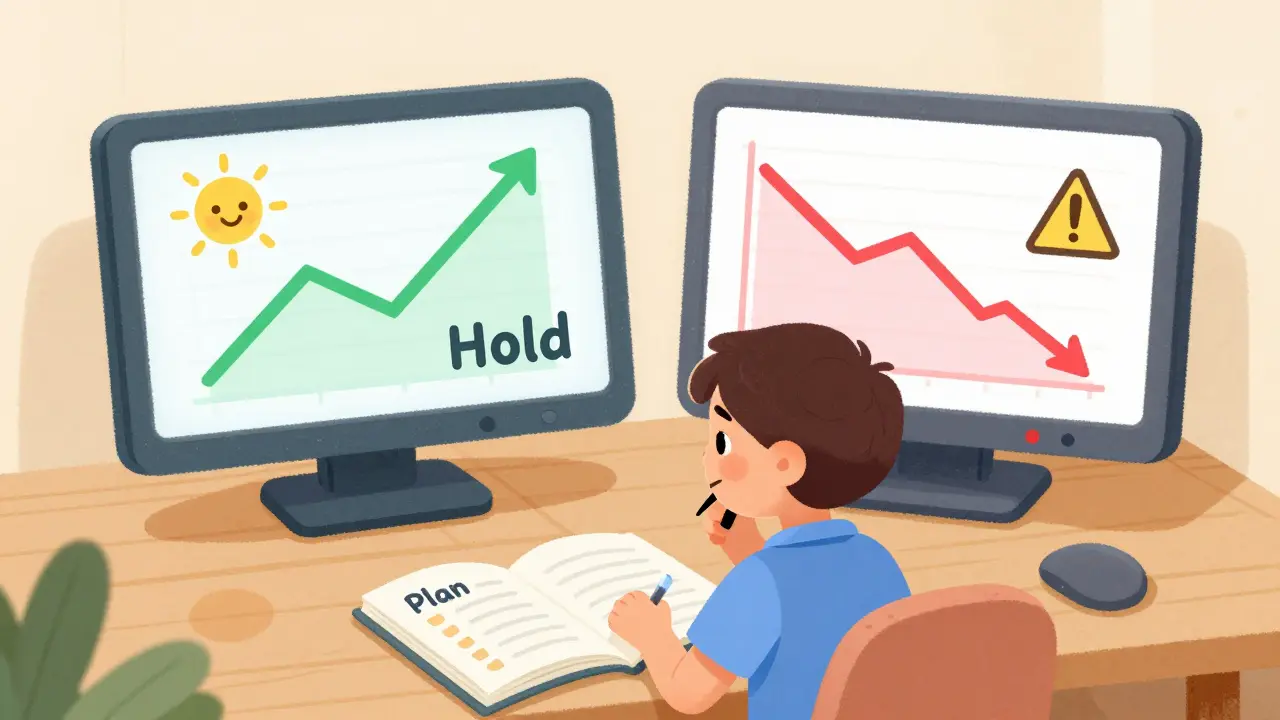
Have you ever watched a winning trade turn into a loser because you refused to take the profit? Or maybe you held onto a losing position for days, praying it would come back, only to see your account bleed out? This is the classic "hold or fold" dilemma. It’s not just about luck; it is about having a system that tells you exactly what to do when the market moves against you-or with you.
In trading, holding means keeping a position open because your original thesis still holds up. Folding means closing the trade, either to cut losses or lock in gains. The difference between a profitable trader and a broke one often comes down to how they handle these two decisions. Let’s break down how to make these choices based on logic, not emotion.
The Psychology Behind the Decision
Most traders think the hardest part of trading is finding the right entry. But the real money is made (or lost) in the exit. Trading psychology experts often reference a seven-step decision process originally developed by the University of Massachusetts Dartmouth. While it sounds academic, it maps perfectly to what happens on your screen.
When you are in a trade, you are constantly cycling through these steps: identify the decision, gather information, identify alternatives, weigh evidence, choose, act, and review. In practical terms, this means you have three main options at any given moment: buy (add to position), sell (fold/exit), or stay out (hold flat). The mistake most people make is skipping the "weigh evidence" step and reacting purely to fear or greed.
If you feel anxious about a position, ask yourself: Is my anxiety coming from a change in the market structure, or just from seeing red numbers? If the chart hasn’t changed, but your emotions have, you are likely overreacting. If the chart has broken a key level, then folding isn't emotional-it’s disciplined.
Defining Your Rules Before You Click "Buy"
You cannot decide whether to hold or fold if you didn’t define those levels before you entered the trade. Proprietary trading firms like BrightFunded emphasize that every trade needs a pre-defined plan. This plan should include three specific numeric elements:
- The Fold Level: Your non-negotiable stop loss. This is where you admit you were wrong and exit to protect capital.
- The Hold Level: Your profit target or zone where you expect the move to slow down.
- The Double-Down Conditions: Specific criteria for adding to a winning trade (never add to a loser).
Without these numbers written down, you are gambling. With them, you are managing risk. For example, if you enter a stock trade with a $50 stop loss, that determines your position size. If the price hits $50, you fold. No questions asked. This protects both your financial capital and your mental energy.
When to Hold: Letting Winners Run
Holding a position requires patience. Many traders fold too early because they are afraid of giving back profits. However, cutting winners short while letting losers run is the fastest way to lose money. So, how do you know when to keep holding?
Price action educator Nial Fuller suggests looking at trend strength. If the market is making new highs (for longs) or new lows (for shorts) consistently, the trend is strong. In this environment, holding is statistically more attractive. You can use a trailing stop to manage this. For instance, you might trail your stop behind the 8-day Exponential Moving Average (EMA) or just below the previous day’s low. This allows the trade to run as long as the momentum supports it.
Another key metric is the Average True Range (ATR). The ATR measures volatility. If your current profit is already equal to or greater than the typical ATR swing, the move is statistically significant. At this point, you don’t necessarily need to fold completely, but you should consider tightening your stop or taking partial profits. Holding indefinitely without adjusting for volatility increases the risk of a sudden reversal wiping out your gains.

When to Fold: Cutting Losses and Locking Gains
Folding is often viewed negatively, as if it means failure. In reality, folding is a vital risk management tool. There are two times to fold: when you are wrong, and when your edge is gone.
1. Thesis Invalidation
If you bought a stock because it was breaking above resistance, but it fails and drops back below, your thesis is invalid. You must fold. Do not hope it will bounce. Hope is not a strategy.
2. Stop Loss Hit
As mentioned earlier, your initial stop loss is non-negotiable. Hitting this level means the market has moved beyond your acceptable risk. Folding here prevents a small loss from becoming a catastrophic one.
3. Profit Protection
When a trade moves in your favor, you can shift from "fold or hold" to "hold with house money." Move your stop loss to breakeven once the price reaches a certain threshold. This ensures that even if the market reverses, you walk away with zero loss. Some traders also fold partially-selling half their position-to lock in guaranteed cash while letting the rest run.
Technical Signals That Dictate Your Exit
Emotions lie, but charts tell the truth. You need objective signals to trigger your hold or fold decisions. Here are common technical cues:
- Reversal Patterns: Look for pin bars, engulfing candles, or divergences on indicators like RSI. These often signal that momentum is fading, suggesting it’s time to fold or tighten stops.
- Key Support/Resistance Levels: If price approaches a major historical level where it previously reversed, it’s smart to fold some or all of your position just before hitting that wall. Trying to squeeze every last pip often leads to missing the exit entirely.
- Trend Structure Breaks: In an uptrend, price should make higher highs and higher lows. If price breaks the most recent higher low, the trend structure is damaged. This is a clear signal to fold.
| Action | Primary Trigger | Psychological State | Risk/Reward Context |
|---|---|---|---|
| Hold | Trend continues, no opposing signals | Disciplined patience | Target not yet reached; R-multiple growing |
| Fold (Loss) | Stop loss hit or thesis invalidated | Acceptance of error | Protect capital; prevent large drawdown |
| Fold (Profit) | Reversal pattern or major resistance hit | Greed control | Lock in gains; secure positive expectancy |

Options Trading: The Third Option - Rolling
If you trade options, the hold/fold binary gets more complex. Options educators like Data Driven Options introduce a third choice: rolling. Rolling involves closing your current option contract and simultaneously opening a new one, usually with a later expiration date or different strike price.
Why roll? As expiration approaches, theta decay (time value erosion) accelerates. Holding an option to expiration can be risky if the underlying asset doesn’t move enough. By rolling, you can adjust your risk profile and extend your timeline if you still believe in the direction but need more time. However, rolling costs money (commission and bid-ask spread), so it should only be done when the expected value remains positive. Novice traders often hold to expiration out of laziness or confusion, while experienced traders actively manage positions by folding or rolling to optimize outcomes.
Market Conditions Matter
Not all markets behave the same way. Your hold/fold strategy should adapt to the current environment.
Trending Markets: In strong trends, holding is favored. Prices can run for extended periods. Use wider trailing stops and focus on capturing large multiples of your risk (e.g., 3R or 4R trades).
Range-Bound Markets: In choppy, sideways markets, prices reverse frequently. Here, folding early is smarter. Take profits at support/resistance boundaries and use tighter stops. Trying to hold for a breakout in a range-bound market often results in getting stopped out repeatedly.
Understanding the context helps you avoid rigid rules that fail in specific conditions. If the market is volatile and news-driven, folds may happen faster. If it’s quiet and technical, holds may last longer.
Building a Pre-Trade Checklist
To remove emotion from the equation, create a checklist you complete before every trade. It should answer these questions:
- What is my exact entry price?
- Where is my stop loss (Fold level)?
- What is my first profit target (Partial Fold level)?
- What conditions would cause me to hold for more?
- What technical signal would invalidate my thesis immediately?
Having this written down creates a psychological contract with yourself. When the trade is live, you aren’t deciding; you’re executing. This reduces stress and improves consistency.
What does "know when to hold 'em, know when to fold 'em" mean in trading?
It refers to the critical decision-making process of determining whether to keep a trade open (hold) to capture further profits or close it (fold) to limit losses or secure gains. It emphasizes relying on predefined plans rather than emotional reactions.
Should I always move my stop loss to breakeven?
Not always. Moving to breakeven too early can result in being stopped out by normal market noise before the trend resumes. It’s better to wait until the price has moved significantly in your favor, such as reaching a key technical level or achieving a 1R profit, before adjusting your stop.
How do I know if my trade thesis is invalidated?
Your thesis is invalidated when the reason you entered the trade no longer exists. For example, if you bought based on a breakout above resistance, and the price closes back below that resistance, your bullish thesis is broken. You should fold immediately.
What is the role of ATR in holding or folding?
Average True Range (ATR) measures market volatility. It helps determine appropriate stop loss distances and profit targets. If a move exceeds the typical ATR, it may be due for a correction, signaling a potential time to fold partially or tighten stops.
Can I average down on a losing trade?
Generally, no. Averaging down (adding to a losing position) increases your risk exposure and often leads to larger losses. Professional traders only add to winning positions (doubling down) when new technical signals confirm the trend, ensuring the combined risk remains within limits.