
Imagine this: a storm knocks out the power in your office. Your internet router dies. You pick up the phone to call a client or emergency services. Does it ring? If you’re on a traditional landline, the answer is usually yes. If you’re on VoIP (Voice over Internet Protocol), the answer might be no-unless you’ve planned for it.
This single scenario has fueled the debate about which system is more reliable for decades. But the reality in 2026 is far more complex than "copper wires win because they work without power." The landscape of business communication has shifted dramatically. While landlines still hold a specific advantage during total grid failures, modern enterprise-grade VoIP systems have engineered redundancy that makes them arguably more dependable for daily operations.
The Core Difference: How They Work Determines Their Weaknesses
To understand reliability, you first need to understand the architecture. A traditional landline operates on the Public Switched Telephone Network (PSTN). It uses dedicated copper wires to create a physical circuit between two parties. This is an analog, circuit-switched system. Because the electricity comes from the central exchange, not your home or office, a basic corded phone works even if your local power goes out.
VoIP, on the other hand, converts voice into digital data packets and sends them over the internet. It is a packet-switched system. This means it relies on three things: a stable broadband connection, electrical power at your endpoint (the desk phone or computer), and proper network configuration. If any of these fail, the call drops.
On paper, the landline’s independence from local power seems like a clear victory for reliability. However, this view ignores the fragility of aging copper infrastructure. Copper lines are susceptible to corrosion, weather damage, and cross-talk interference. They require physical maintenance by technicians who are becoming harder to find as providers retire these networks.
Uptime Metrics: What the Data Actually Says
When we look at hard numbers, the narrative shifts. Modern VoIP providers do not just send calls over the open internet; they use private, redundant networks with geographically dispersed data centers.
| Metric | Traditional Landline (PSTN) | Enterprise VoIP |
|---|---|---|
| Average Uptime | 99.5% - 99.9% | 99.999% (Five Nines) |
| Annual Unplanned Downtime | ~1.8 hours (Digital PBX) | ~2.3 hours (Standard) / ~5 mins (Redundant) |
| Call Quality Consistency (MOS) | 4.0 - 4.2 (Consistent) | 3.5 - 4.5 (Variable based on network) |
| Power Outage Resilience | High (with corded phones) | Low (requires UPS/Backup) |
| Failure Recovery Time | Hours to Days (Technician visit) | Seconds to Minutes (Automatic Failover) |
According to industry reports from RingCentral and Nextiva, top-tier VoIP platforms offer Service Level Agreements (SLAs) guaranteeing 99.999% uptime. This translates to less than five minutes of downtime per year. In contrast, while landlines are robust, their repair times can be lengthy. If a copper line is cut by construction equipment, a technician must physically locate and splice the wire. With VoIP, if one data center fails, traffic automatically reroutes to another facility hundreds of miles away, often without the user noticing.
The Power Paradox: Where Landlines Still Win
Let’s address the elephant in the room: power outages. During a regional blackout, your internet modem loses power. Your VoIP phone becomes a paperweight. A traditional landline, powered by the central office, keeps working.
For critical roles like hospitals, dispatch centers, or rural homes with frequent grid instability, this is a massive advantage. The FCC’s 2022 Consumer Survey highlighted that landlines maintained 98.7% functionality during regional power outages, compared to only 42.3% for VoIP systems without backup.
However, this gap is closing. Most businesses now implement Uninterruptible Power Supplies (UPS) for their networking gear. A standard UPS can keep your router and VoIP phones running for several hours. Furthermore, many VoIP providers offer mobile app integration. If the office power goes out, you can simply download the provider’s app on your smartphone and make calls using cellular data. This "failover" capability effectively neutralizes the landline’s power advantage for most commercial users.
Weather and Physical Infrastructure Risks
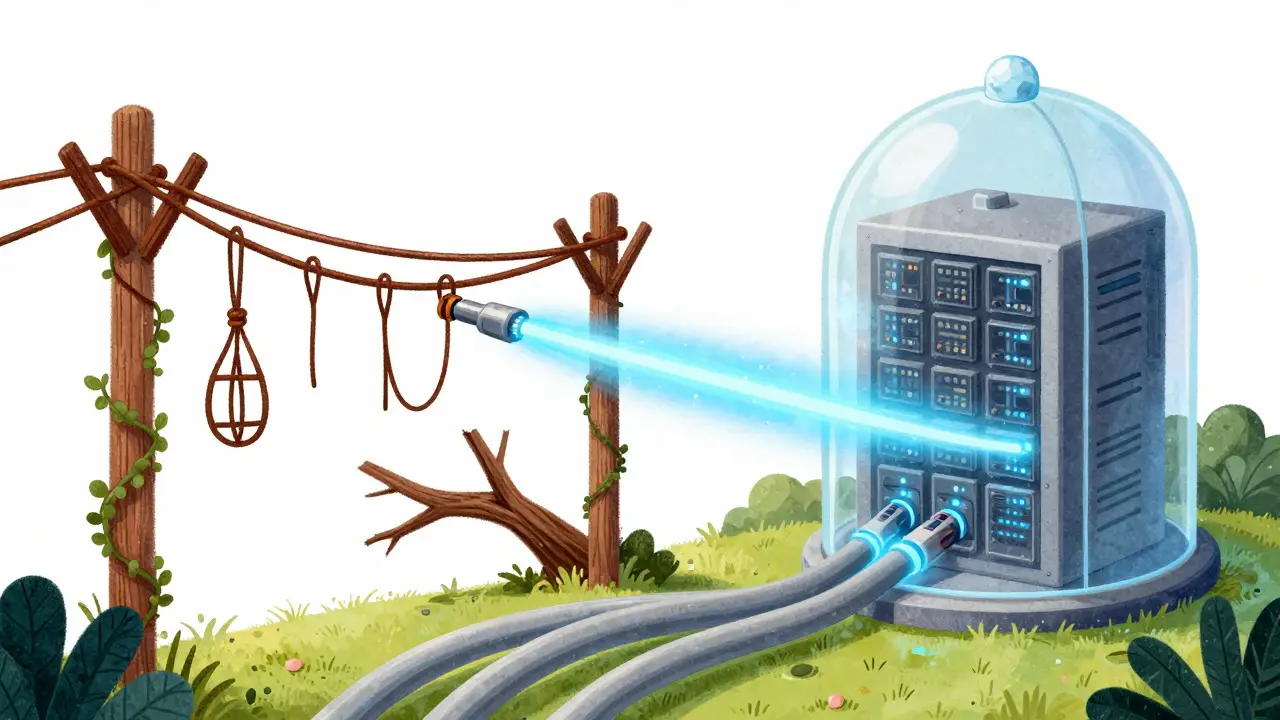
Copper wires are heavy, brittle, and exposed. High winds, ice storms, and falling trees frequently sever landline connections. In rural areas, where poles are spaced further apart, a single downed pole can take out dozens of lines. Repair crews may face dangerous conditions, delaying restoration for days.
VoIP infrastructure is largely underground or housed in hardened data centers. While fiber optic cables (which carry the internet data) can also be cut, they are generally more resilient to environmental factors than aging copper. Moreover, because VoIP is software-defined, you aren’t tied to a single physical location. If your office building suffers structural damage, your phone system doesn’t disappear. Your employees can log in from home, a hotel, or a coffee shop, and the business continues as normal. This geographic flexibility is a form of reliability that landlines simply cannot match.
Network Congestion and Call Quality
One area where landlines historically held the upper hand was consistent audio quality. PSTN provides a dedicated channel, so there is no jitter or latency. VoIP shares bandwidth with email, video streaming, and web browsing. If your network is congested, your call quality can suffer-resulting in robotic voices, echoes, or dropped calls.
But this is a management issue, not a technology flaw. By implementing Quality of Service (QoS) settings on your router, you can prioritize voice traffic over all other data. When configured correctly, VoIP delivers HD voice quality that often exceeds the clarity of analog landlines. Studies show that with proper QoS, Mean Opinion Score (MOS) ratings for VoIP consistently hit 4.0 or higher, matching landline standards.
Security and Fraud Resistance
Reliability isn’t just about staying connected; it’s about staying secure. Landlines are difficult to hack because they are isolated physical circuits. VoIP, being IP-based, faces threats like eavesdropping, toll fraud, and Denial of Service (DoS) attacks.
However, modern VoIP systems use encryption protocols (like SRTP and TLS) that protect calls end-to-end. In fact, encrypted VoIP calls are often more secure than landlines, which can be tapped physically. The real risk with VoIP is poor implementation-using weak passwords or unsecured Wi-Fi networks. For businesses, sticking to wired Ethernet connections and strong authentication practices mitigates almost all security-related reliability risks.
The Future of Reliability: Hybrid Approaches
By 2026, the industry consensus is shifting toward hybrid solutions. Pure landline setups are disappearing as telecom giants like AT&T accelerate the retirement of copper networks. Pure VoIP setups require diligent IT management. The most reliable approach combines both strengths:
- Primary System: Enterprise VoIP for features, mobility, and cost-efficiency.
- Backup Layer: Cellular failover apps and UPS battery backups for power/internet outages.
- Emergency Redundancy: A single retained landline or dedicated SMS gateway for critical alerting when all else fails.
This layered strategy ensures that no single point of failure-whether it’s a cut cable, a power outage, or a software bug-can silence your business.
Conclusion: Which Should You Choose?
If you live in a remote cabin with spotty internet and frequent blackouts, stick with the landline. Its simplicity and power independence are unmatched in those specific conditions. But for 95% of businesses and urban households, VoIP is the more reliable choice. Why? Because its reliability is proactive. It anticipates failures through redundancy, automatic rerouting, and mobile integration. Landlines react to failures by waiting for a technician to arrive. In today’s fast-paced world, that wait time is a luxury few can afford.
Is VoIP reliable during a power outage?
Not by default. Since VoIP requires power for your modem and phone, a blackout will disconnect you. However, you can maintain reliability by using a UPS (battery backup) for your network equipment or by failing over to a mobile app on your smartphone that uses cellular data.
Which has better call quality: VoIP or landline?
Landlines offer consistent, uncompressed analog audio. VoIP offers high-definition digital audio. With a stable internet connection and QoS settings enabled, VoIP call quality is often superior to landlines, providing clearer sound and fewer background noises.
Can hackers intercept VoIP calls?
Theoretically, yes, but it is rare with modern systems. Reputable VoIP providers use encryption (TLS/SRTP) to secure calls. Landlines are harder to hack remotely but can be physically tapped. Overall, encrypted VoIP is considered highly secure for business communications.
Why are landlines being phased out?
Copper infrastructure is expensive to maintain and prone to physical damage. Telecom providers are retiring these networks in favor of fiber-optic and digital technologies, which support faster speeds and integrated services like video and messaging alongside voice.
What is the best backup for VoIP reliability?
The best backup is a combination of hardware and software. Use a UPS to keep your router running during short power outages. Additionally, configure your VoIP system to automatically forward calls to your mobile phone if the primary internet connection drops.