
Imagine it’s the middle of the night. A storm has knocked out the power in your neighborhood. The lights are off, the internet router is dark, and suddenly, you need to call for help or check on a family member. For millions of seniors across the United States, this scenario isn’t just a hypothetical fear-it’s a daily reality that dictates how they choose their home phone service.
The choice between Voice over Internet Protocol (VoIP) and traditional landline phones is no longer just about monthly bills. It is a decision about safety, independence, and peace of mind. While younger generations have seamlessly moved to digital communication, older adults often find themselves caught in the crossfire of rapid technological change. On one side, you have the familiar reliability of copper wires. On the other, you have the advanced features of modern internet-based calling. So, which one actually works better for someone who values simplicity above all else?
The Core Difference: How Your Call Travels
To understand why one might be easier to use than the other, we first need to look at what’s happening under the hood. Traditional landline phones operate using analog signals transmitted over physical copper wire infrastructure. This technology dates back to Alexander Graham Bell’s patent in 1876. When you pick up a standard landline handset, you are connecting directly to a central office via these wires. Crucially, the phone line itself provides electrical power-typically 48 volts DC-from the telephone company. This means your phone works even if the electricity in your house goes out.
In contrast, VoIP technology, developed commercially in 1995 by VocalTec Communications, converts voice into digital data packets. These packets travel over your broadband internet connection. If your internet goes down, or if your modem loses power, your phone stops working unless you have specific backup equipment. This fundamental difference shapes every aspect of usability for seniors, from setup complexity to emergency reliability.
| Feature | Traditional Landline | VoIP Service |
|---|---|---|
| Power Source | Central Office Battery (Works during outages) | Home Electricity + Internet Router |
| Connection Type | Copper Wire (Analog/Digital Hybrid) | Broadband Internet (Digital Packets) |
| Audio Clarity | High (Less compression artifacts) | Variable (Depends on bandwidth) |
| Setup Complexity | Low (Plug into wall jack) | Medium/High (Router/Wi-Fi configuration) |
| Emergency Location | Automatic (Hardwired address) | Manual Update Required |
Reliability and Emergency Safety: The 911 Factor
For many seniors, the primary reason to keep a landline is not nostalgia-it’s survival. According to the National Center for Health Statistics, approximately 38.6% of U.S. households still maintain landline service as of 2025. Why? Because when seconds count, landlines offer a distinct advantage. Data from the National Emergency Number Association shows that 97% of emergency calls made via traditional landlines connect directly to local Public Safety Answering Points (PSAPs). In comparison, only 89% of VoIP calls achieve this direct connection rate.
Why the gap? With a landline, your physical address is hardwired into the system. If you collapse and drop the receiver, dispatchers know exactly where you are. With VoIP, your location is tied to your internet account settings. If you move the phone to a different room, or if you travel with a mobile VoIP adapter, you must manually update your location information. For seniors with memory issues-affecting 42% of Americans over 65 according to the Alzheimer's Association-this manual step can be a critical failure point.
Furthermore, consider power outages. During severe weather events, landlines typically remain operational for 2-4 hours thanks to central office batteries. VoIP systems, however, die instantly when the power cuts out unless you invest in battery backups like Ooma’s Linx device, which offers about 6.5 hours of talk time. For a senior living alone in a rural area, that difference can mean the difference between getting help and waiting in the dark.
Usability and Setup: The Learning Curve
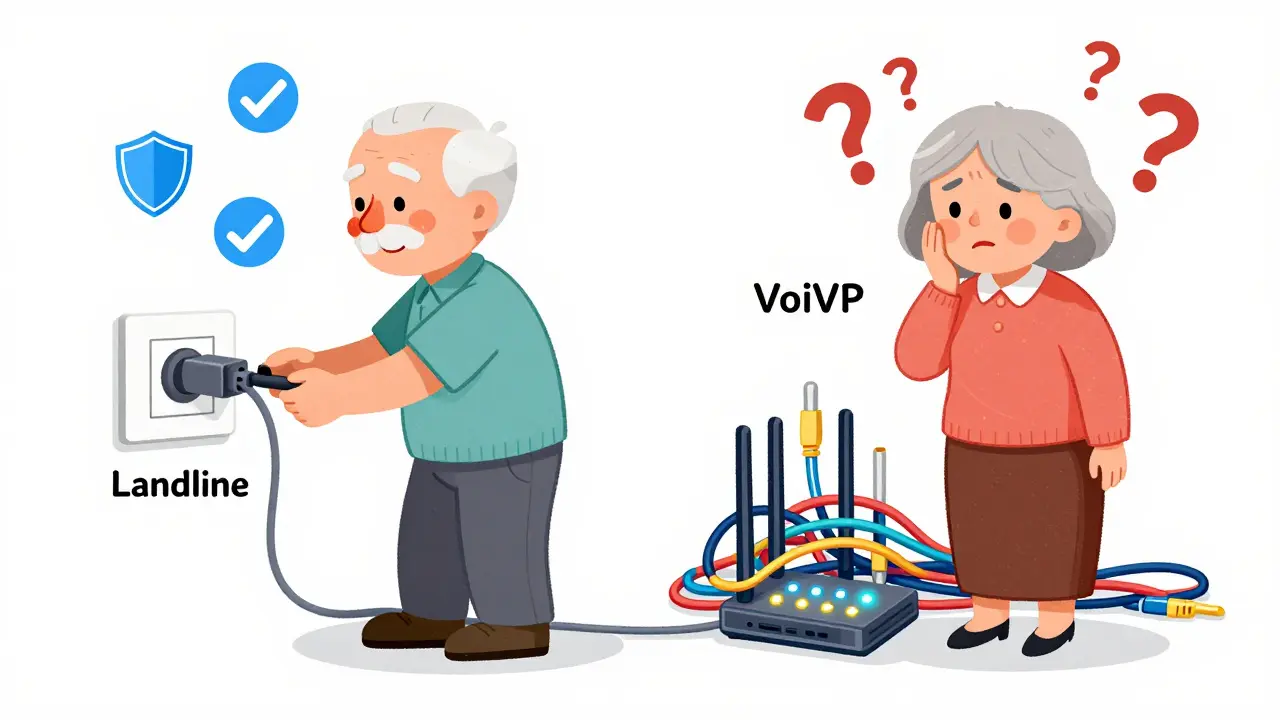
If reliability is about safety, usability is about daily frustration. Let’s be honest: setting up new technology is rarely fun for anyone, but it can be particularly daunting for older adults. A 2025 usability study by SeniorLiving.org found that the average learning curve for VoIP setup requires 2.7 hours of assistance. Compare that to 18 minutes for installing a traditional landline. That’s a massive disparity.
VoIP systems require understanding Wi-Fi networks, router connections, and sometimes app-based management. Pew Research’s Digital Readiness Gap study reveals that 78% of seniors report low confidence in managing Wi-Fi networks. When you add this to the fact that 63% of negative reviews for VoIP services cite "complicated setup" as the primary issue, the picture becomes clear. Many seniors end up relying on grandchildren or tech-savvy neighbors to get their phones working, which undermines the goal of independent living.
Traditional landlines, by contrast, are plug-and-play. You plug the cord into the wall, pick up the handset, and dial. No passwords, no firmware updates, no rebooting routers. For seniors who value simplicity, this tactile familiarity is invaluable. Consumer Cellular received a 4.3/5 star rating on SeniorAdvice.com largely because 87% of users cited "no internet required" as the top benefit. It’s simple, predictable, and consistent.
Scam Protection: Where VoIP Shines
However, landlines are not without their flaws. The biggest threat facing seniors today isn’t a power outage-it’s financial exploitation. The Federal Trade Commission reports that 52.3% of seniors are targeted by phone scams annually. This is where VoIP services provide superior protection through advanced spam filtering.
Traditional landlines have limited ability to block unwanted calls. They rely on basic caller ID, which scammers easily spoof. VoIP providers, on the other hand, leverage cloud-based algorithms to identify and block robocalls before they ever ring your phone. Services like Callcentric claim to block 98.7% of robocalls. On Reddit’s r/eldercare forum, 72% of comments about VoIP praised these call-blocking features as "life-changing." One user, RetiredEngineer82, noted that switching to a VoIP system eliminated 95% of unwanted calls, significantly reducing anxiety and stress.
This level of protection is crucial. Scam calls aren’t just annoying; they’re dangerous. They prey on confusion and urgency. By filtering out these threats automatically, VoIP systems act as a digital shield, allowing seniors to answer their phones with confidence rather than fear. For those comfortable with the initial setup, this trade-off is often worth it.
Cost Considerations: Budgeting for Communication
Let’s talk money. Pricing structures differ substantially between the two options, and inflation makes every dollar count. As of Q1 2025, traditional landlines from major providers like AT&T cost around $29.99 per month for unlimited local calls. While this seems straightforward, prices have been rising, with annual increases averaging 5.2% since 2022 according to FCC tariff filings.
VoIP services often present a more attractive price tag. Providers like Voiply offer unlimited service for as little as $7.46 per month, claiming average annual savings of $380 compared to traditional lines. However, there’s a catch: you need high-speed internet. If you don’t already have broadband, the combined cost of internet plus VoIP may exceed the price of a standalone landline. Additionally, some VoIP plans charge extra for features like dedicated support or international calling.
For seniors on fixed incomes, the total cost of ownership matters. A landline is a single bill with predictable costs. VoIP adds another layer of dependency on your internet provider, meaning any changes to your broadband plan could impact your phone service. It’s essential to calculate both the monthly fee and the potential hidden costs of maintenance and upgrades.

Customer Support: Who Answers When Things Go Wrong?
When technology fails, human support is your lifeline. Unfortunately, this is an area where VoIP currently lags behind. An AARP Member Survey from February 2025 found that 68% of VoIP providers lack senior-specific customer support training. Seniors reported average hold times of 14.3 minutes, along with frequent complaints about "technical jargon" that left them feeling confused and frustrated.
In contrast, companies like Consumer Cellular specialize in serving older adults. They offer 24/7 senior-focused support with average hold times of just 47 seconds, according to J.D. Power’s 2024 Home Communications Report. Their agents are trained to speak clearly, avoid technical terms, and patiently guide users through issues. Documentation quality also reflects this divide: landline providers average a 4.2/5 clarity rating on SeniorAdvice.com, while VoIP services score only 2.8/5.
For seniors who prefer talking to a person rather than navigating online FAQs, the quality of customer support can make or break their experience. Knowing that help is available quickly and kindly reduces the stress of owning any complex device.
The Future: Hybrid Solutions and Accessibility
The telecommunications landscape is evolving rapidly. The global senior telecommunications market is projected to reach $26.3 billion by 2029, driven largely by demand for safer, smarter communication tools. We are seeing the rise of hybrid solutions that attempt to bridge the gap between old and new technologies.
Ooma launched its Senior Safety Bundle in January 2025, featuring automatic emergency alerts triggered by falls detected via an accelerometer in their device. Community Phone is migrating copper networks to fiber optics while maintaining traditional landline interfaces. The FCC has also mandated universal service fund modifications, allocating $1.2 billion annually through 2029 specifically for senior telecommunications accessibility.
These developments suggest that the future isn’t necessarily about choosing one side over the other. Instead, we may see more integrated systems that combine the reliability of landlines with the smart features of VoIP. Until then, seniors and their families must weigh their individual needs carefully.
Making the Right Choice for You or Your Loved One
So, which option should you choose? There is no one-size-fits-all answer. If your priority is absolute reliability during emergencies, ease of use, and minimal setup hassle, a traditional landline remains the gold standard. It’s simple, sturdy, and always on when the power goes out.
However, if you are dealing with constant scam calls, want advanced features like video calling, and are comfortable with basic internet technology, VoIP offers significant advantages. Its ability to filter spam and provide customizable settings can greatly enhance daily life.
Consider creating a checklist based on your specific situation:
- Do you live in an area prone to power outages? If yes, lean toward landline or ensure you have robust VoIP backups.
- Are you frequently targeted by robocalls? If yes, VoIP’s blocking features may be worth the learning curve.
- Is technical setup a barrier? If yes, stick with landline or seek professional installation assistance.
- Do you have reliable high-speed internet? If no, VoIP is not a viable option.
Ultimately, the best phone system is the one that allows you to stay connected safely and comfortably. Whether that’s the comforting click of a rotary dial or the sleek interface of a modern VoIP handset, the goal remains the same: keeping you close to the people who matter most.
Can I use my existing landline phone with a VoIP service?
Yes, most VoIP services provide an Analog Telephone Adapter (ATA) that allows you to connect your traditional landline handset to the VoIP system. This lets you keep the familiar hardware while enjoying VoIP features like call blocking and lower rates. However, you will still need a stable internet connection for it to work.
Which is better for hearing aid compatibility?
Both VoIP and landline phones can be hearing aid compatible, but you need to check the specific model's rating. Look for devices with an M3/T3 rating, which indicates strong compatibility with magnetic induction coils in hearing aids. Brands like Panasonic and Ooma offer models specifically designed with large buttons and high-volume ringers for seniors with hearing loss.
How do I protect myself from scams if I keep a landline?
While landlines have fewer built-in blocking tools, you can register your number on the National Do Not Call Registry. Additionally, educate yourself and your family about common scam tactics. Never give out personal information over the phone, and hang up immediately if a caller pressures you to act quickly. Some third-party call-blocking devices can also be attached to landlines for added protection.
What happens to my VoIP phone during a hurricane or storm?
If the power goes out, your VoIP phone will stop working unless you have a battery backup. To prepare for storms, invest in a UPS (Uninterruptible Power Supply) for your router and VoIP adapter. Alternatively, keep a fully charged cell phone nearby as a backup communication method. Traditional landlines are generally more resilient in these scenarios due to central office power.
Is it difficult to switch from a landline to VoIP?
Switching involves canceling your old service and setting up the new one, which can take a few days. The main challenge is the technical setup of the VoIP equipment. Many providers offer free shipping and installation guides, but if you are uncomfortable with technology, consider asking a family member or hiring a local technician to help with the initial configuration. Porting your existing phone number usually takes 5-7 business days.