
That shiny per-user price tag on a VoIP provider’s website? It’s lying to you. Or at least, it’s hiding the truth. When you look at $20 or $25 a month for a business line, it looks like a no-brainer compared to your legacy landline bill. But if you stop there, you’re missing half the story.
To really know if Voice over Internet Protocol (VoIP) saves you money, you have to look at the Total Cost of Ownership (TCO). This isn’t just about what you pay each month. It’s about every dollar spent from the moment you decide to switch until the day you upgrade again-typically a three-year window. When we pull back the curtain on setup fees, hidden taxes, network upgrades, and downtime, the picture changes. For many businesses, VoIP still wins by a landslide, but only if you calculate correctly.
The Anatomy of VoIP Costs: CapEx vs. OpEx
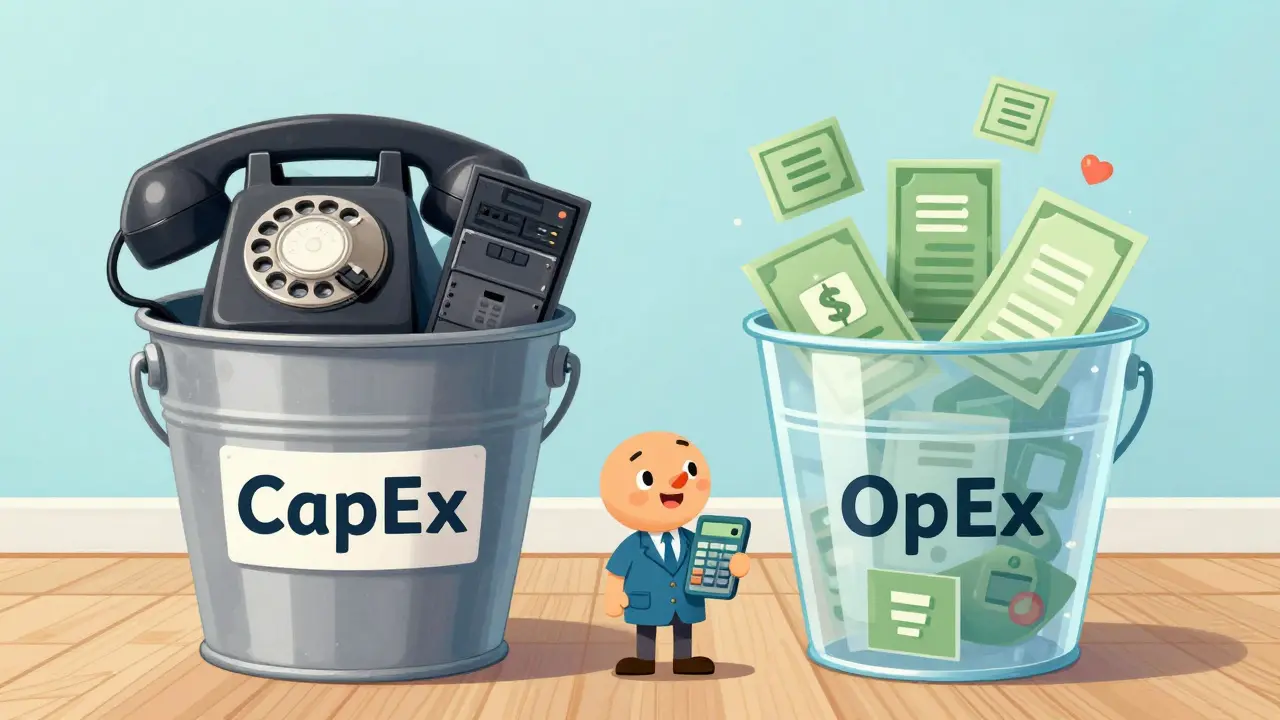
Before we dive into the numbers, let’s split the costs into two buckets. In financial terms, these are Capital Expenditures (CapEx) and Operating Expenditures (OpEx). Understanding this difference is crucial because it dictates how you fund the project and how it hits your P&L statement.
Capital Expenditures (CapEx) are your upfront costs. These are one-time payments made during Year 1 (or even Year 0, before you go live). Think of this as the "entry fee." For traditional PBX systems, this was massive-you bought physical servers, racks, and wiring closets. With modern cloud VoIP, this bucket shrinks significantly, but it doesn’t disappear.
Here is what usually lands in your CapEx bucket:
- Hardware: IP handsets, headsets, and perhaps new Power over Ethernet (PoE) switches if your current network can’t power phones.
- Professional Services: Migration fees, installation labor, and configuration time. If you hire an integrator to move you from a legacy system to the cloud, this can run thousands of dollars.
- Network Upgrades: Do you need a faster internet circuit? A Session Border Controller (SBC) for security? These are often necessary prerequisites for good call quality.
- Training & Onboarding: The cost of staff time spent learning the new system. This is often overlooked but adds up fast.
Operating Expenditures (OpEx) are the recurring monthly bills. This is where the rubber meets the road for 36 months straight. In a VoIP model, almost all your telephony costs shift here. You trade big upfront checks for predictable monthly subscriptions.
Your OpEx includes:
- Subscription Fees: The per-user, per-month charge for the service.
- Bandwidth Costs: Your monthly internet bill, which might increase if you upgraded circuits.
- Taxes & Regulatory Fees: Federal, state, and local telecom surcharges that providers add on top of the base rate.
- Support & Maintenance: Internal IT staff time managing the system or external support contracts.
The formula is simple: TCO = CapEx + (Monthly OpEx × 36 months). But as we’ll see, "Monthly OpEx" is trickier than it looks.
The Hidden Costs That Kill Savings
If you’ve ever done a TCO analysis, you know the devil is in the details. Two companies can buy the same VoIP plan, but one ends up spending 20% more over three years. Why? Because they forgot the hidden variables.
First, let’s talk about Telecom Taxes and Surcharges. Providers advertise a clean $25/user/month. But open your invoice, and you’ll see lines for Universal Service Fund (USF), 911 fees, and state regulatory charges. These can add 10-15% to your bill. Over 36 months for 50 users, that’s not pocket change. Always ask for the "all-in" monthly cost, not the base rate.
Second, consider Downtime and Productivity Loss. During migration, things break. Calls drop. Voicemail doesn’t sync. If your sales team loses four hours of productivity due to a bad cutover, what’s that worth? Multiply those lost hours by their hourly wage, then multiply by the number of employees affected. OpenMetal’s framework suggests quantifying this rigorously. A poorly planned migration can wipe out six months of projected savings.
Third, don’t ignore Integration Costs. VoIP shines when it talks to your CRM (like Salesforce or HubSpot) or helpdesk software. But getting that integration working smoothly often requires custom development or premium API licenses. If your reps spend five minutes a day manually logging calls instead of having them auto-populate, you’re losing efficiency. Factor in the cost of the integration tool and the IT time to maintain it.
VoIP vs. Legacy PBX: The 3-Year Showdown
Let’s put this into perspective. How does a cloud VoIP stack up against a traditional on-premise Private Branch Exchange (PBX) over three years?
| Cost Category | Traditional PBX (On-Premise) | Cloud VoIP / UCaaS |
|---|---|---|
| Upfront Hardware (CapEx) | High ($10k-$50k+ for servers, cards, wiring) | Low ($50-$200 per handset + minimal networking gear) |
| Installation & Setup | Very High (Requires certified engineers on-site) | Low to Medium (Remote provisioning, minimal on-site work) |
| Maintenance & Support | High (Annual maintenance contracts, spare parts inventory) | Low (Included in subscription, vendor-managed) |
| Long-Distance Calling | Variable (Per-minute charges add up quickly) | Flat Rate (Usually unlimited domestic/international included) |
| Scalability | Poor (Adding lines requires hardware purchases) | Excellent (Add users instantly via web portal) |
| End-of-Life Decommissioning | High (Disposal of old hardware, data migration) | Negligible (Cancel service, keep handsets) |
Industry analysts, including reports from The Network Installers and TeleCloud, consistently show that VoIP delivers 50-70% cost savings over legacy systems over a three-year period. Where do these savings come from?
- No Hardware Refresh Cycles: PBX systems often need major upgrades every 5-7 years. Cloud VoIP updates happen automatically on the server side. You don’t buy new boxes; you just get new features.
- Lower Long-Distance Bills: If your team calls clients nationwide or globally, flat-rate VoIP plans crush per-minute PSTN rates.
- Reduced IT Labor: Your IT staff spends less time troubleshooting physical phone lines and patch panels, freeing them up for higher-value projects.
Calculating Your Break-Even Point
You don’t need to wait three years to see if VoIP is worth it. You can calculate your break-even point right now. This tells you exactly how many months it will take for the savings to cover your initial investment.
Use this simple formula:
Break-Even Months = Total Upfront Costs (CapEx) ÷ Monthly Net Savings
Let’s say you spend $5,000 on handsets and migration services (CapEx). Your current legacy phone bill is $1,200/month. Your new VoIP bill (including taxes and bandwidth bump) is $800/month. Your monthly net savings are $400.
$5,000 ÷ $400 = 12.5 months.
In this scenario, you break even in just over a year. For the remaining 24 months of your 3-year analysis, you’re pure profit. Most small-to-mid-sized businesses find their break-even point between 6 and 18 months. If yours is longer than 24 months, you need to renegotiate your contract or reduce your hardware spend.

Growth Scenarios: What If We Hire More People?
A static TCO model assumes your company stays the same size for three years. That rarely happens. VoIP’s biggest financial advantage is scalability. Let’s look at two scenarios for a company starting with 50 users.
Scenario A: Flat Growth You stay at 50 users. Your costs remain predictable. The TCO is straightforward multiplication.
Scenario B: 20% Annual Growth Year 1: 50 users. Year 2: 60 users. Year 3: 72 users.
With a legacy PBX, adding 22 new lines in Year 2 and 3 would require buying additional license keys, possibly new hardware modules, and paying for technician visits to install them. Each new line has a high marginal cost.
With Cloud VoIP, adding a user is clicking a button and sending them a headset. The marginal cost is just the monthly subscription. As your headcount grows, the gap between VoIP and legacy TCO widens dramatically. If you expect rapid hiring, VoIP becomes even more financially attractive. Make sure your TCO model includes a column for "Projected User Count" per year to capture this dynamic.
End-of-Life and Lifecycle Management
Finally, remember that three years is just a snapshot. What happens at month 37? In a traditional model, you might be approaching the end of your hardware warranty, facing rising repair costs, and needing to plan a costly refresh. With VoIP, your "end-of-life" events are much softer. Handsets last 5-7 years. The software never expires; it evolves.
However, you should still account for Asset Depreciation. Accountants typically depreciate IP phones and network gear over 3 or 5 years. While this doesn’t change your cash flow, it affects your tax deductions and balance sheet. Ensure your finance team knows whether to write off your VoIP hardware over 36 or 60 months, as this impacts your reported profitability.
Also, budget for Data Migration and Archiving when you eventually leave a provider. Moving voicemails, call recordings, and directory structures to a new platform can incur professional service fees. Include a small contingency fund in Year 3 for potential vendor switching costs, just in case your needs outgrow your current provider.
What is the average 3-year TCO for VoIP?
There is no single "average" because costs vary wildly by company size and feature needs. However, industry data suggests VoIP reduces total telephony costs by 50-70% compared to legacy systems over three years. For a mid-sized business, this might mean saving tens of thousands of dollars by eliminating hardware maintenance and long-distance fees.
Does VoIP TCO include internet costs?
Yes, a rigorous TCO analysis must include any incremental internet costs. If you need to upgrade your broadband speed or buy a dedicated SIP trunk connection to ensure call quality, those monthly fees are part of your VoIP operating expenses.
How do I calculate the break-even point for VoIP?
Divide your total upfront costs (hardware, installation, migration) by your monthly savings (old phone bill minus new VoIP bill). The result is the number of months it takes to recoup your investment. Most businesses break even within 12-18 months.
Are there hidden costs in VoIP pricing?
Yes. Common hidden costs include federal and state telecom taxes (which can add 10-15% to the bill), activation fees, costs for integrating with CRM software, and internal IT time spent on training and troubleshooting. Always ask for the "all-in" monthly price.
Why use a 3-year period for TCO analysis?
Three years is a standard IT asset depreciation cycle and a common contract term for business services. It’s long enough to capture significant operating cost differences and amortize upfront setup costs, but short enough to remain relevant given how quickly technology changes.