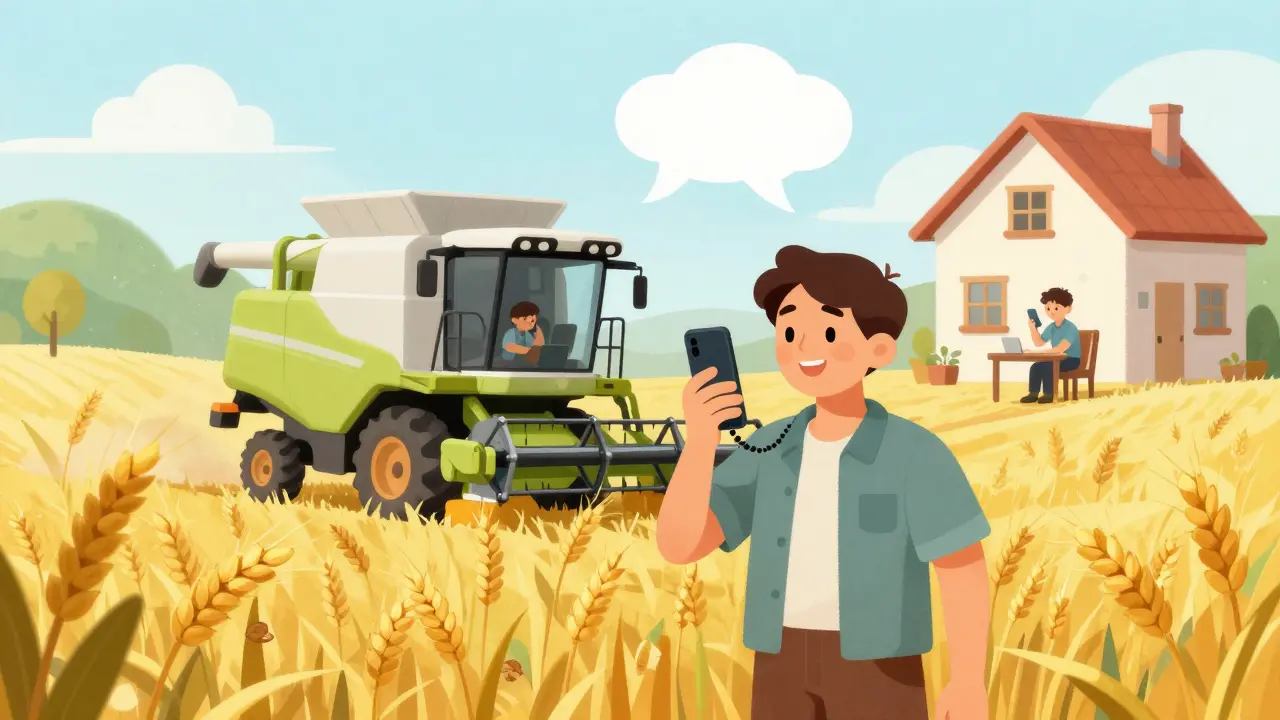
Picture this: it’s harvest season, the combine is acting up in field four, and the buyer just called to change the delivery window. In a traditional setup, you’re scrambling between a landline in the office, a cell phone with spotty signal in the barn, and maybe a two-way radio that only reaches half the crew. It’s chaotic, expensive, and frankly, unnecessary.
Voice over Internet Protocol (VoIP) has quietly revolutionized how commercial farms operate. It’s not just about making cheaper phone calls; it’s about creating a unified communication backbone that connects your fields, your office, and your supply chain partners into one seamless system. For modern agriculture, where timing is everything and data drives decisions, VoIP is becoming as essential as tractors or irrigation systems.
The Shift from Landlines to IP Telephony on Farms
For decades, farms relied on analog landlines. They were reliable but rigid. You had to be at the desk to take a call, adding lines meant running new copper wires, and long-distance charges added up fast. As broadband and cellular networks reached rural areas, farmers began adopting hosted PBX and SIP trunking solutions. By the mid-2020s, providers like Indiana Telephone Network and Airacom started explicitly targeting agricultural businesses with tailored VoIP packages.
VoIP is a technology that allows voice calls to be made over an internet connection rather than traditional telephone lines. For a farm, this means your phone system lives in the cloud or on a local server, accessible from any device with internet access. This shift enables flexibility-workers can use ruggedized smartphones or softphone apps in the field while maintaining a single business number.
The economic benefit is immediate. Cloud PBX providers typically charge between $15 and $30 per user per month for unlimited domestic calling. Compare that to maintaining multiple analog lines with per-minute fees, and the savings are clear. But the real value isn’t just cost-cutting; it’s operational agility.
Connecting the Disconnect: Network Infrastructure Challenges
You can have the best VoIP system in the world, but if your internet drops when the rain starts, it’s useless. Rural connectivity remains the biggest hurdle for farm VoIP adoption. Standard voice codecs like G.711 require about 80-100 kbit/s per call. On a solid 10 Mbit/s fixed-wireless link, that’s plenty of room. But add IoT sensor data, drone imagery uploads, and video conferencing, and bandwidth contention becomes a real issue.
Latency and jitter matter too. Conversational quality suffers if one-way latency exceeds 150 ms or jitter goes above 30 ms. Satellite links, often used in remote ranches, can introduce 500-600 ms round-trip delays, which makes real-time conversation awkward. However, companies like GroundControl are engineering satellite IoT solutions specifically for agriculture, optimizing these links so they can support both telemetry and voice traffic effectively.
Many farms are turning to hybrid networks. LTE and 5G provide mobile coverage across large properties, while private Wi-Fi mesh networks (like Rajant’s Kinetic Mesh) cover specific zones like barns or packing houses. These networks allow farms to prioritize voice traffic using Quality of Service (QoS) policies, ensuring that a critical call to a veterinarian doesn’t get buffered by a background software update on a tractor.
Day-to-Day Farm Operations: More Than Just Calls
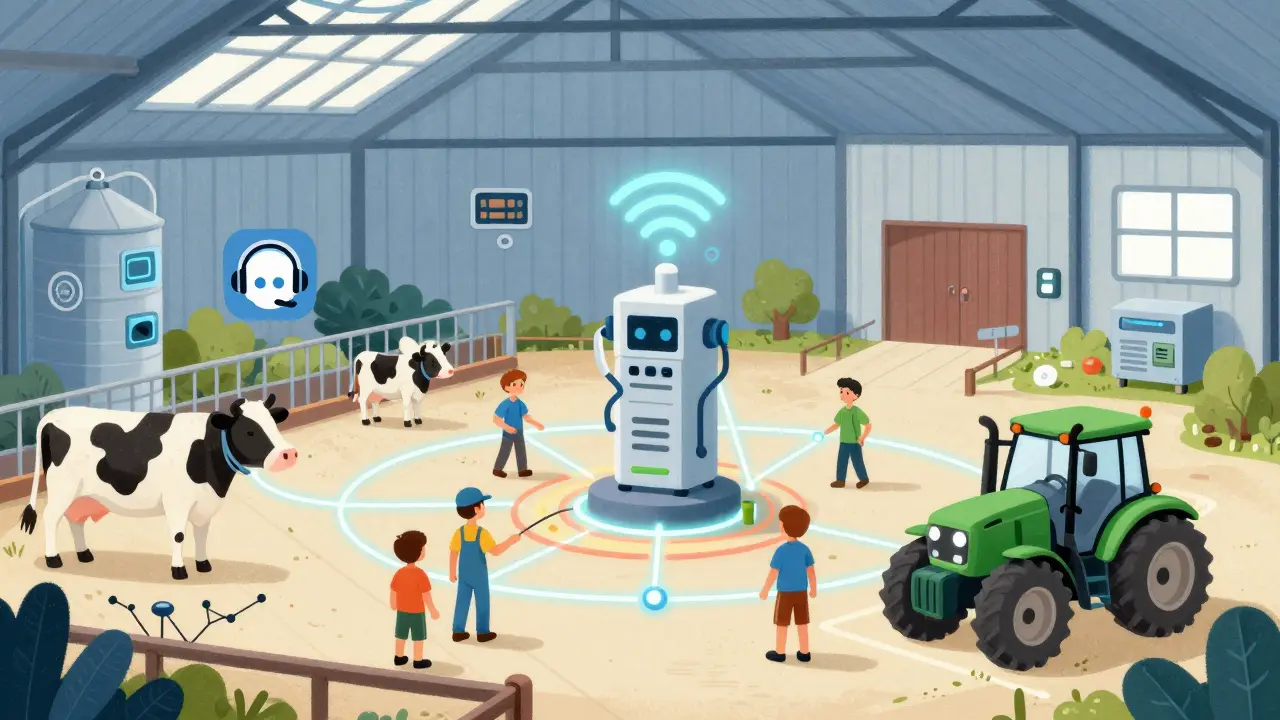
How does VoIP actually help you run the farm? Think about extension dialing. Instead of memorizing personal cell numbers for every worker, you assign extensions based on location or function. Extension 101 is the milking parlor, 102 is the grain elevator, 103 is the shop. If someone needs help in the shop, they dial 103, and it rings the person currently assigned to that station, whether they’re holding a phone or wearing a headset.
Features like hunt groups and ring-all functions are lifesavers during emergencies. If a silo alarm triggers, the system can simultaneously ring the manager’s office, the maintenance team’s phones, and the security guard’s mobile app. No more playing phone tag.
Integration with collaboration tools is another game-changer. Providers like Axia TP integrate VoIP with Microsoft Teams. This means an agronomist in the field can see a soil moisture alert on their tablet, click to start a video call with the irrigation manager, and share live sensor data-all without switching apps. The voice layer sits on top of the data layer, creating a cohesive workflow.
| Feature | Traditional Landline | Mobile-Only Setup | Farm VoIP System |
|---|---|---|---|
| Mobility | Tethered to desk | High | High (via apps/radios) |
| Call Recording | Difficult/Expensive | Not possible centrally | Automatic & Centralized |
| Cost Scaling | High per line | Variable data costs | Low flat rate per user |
| Emergency Routing | Static address | Inaccurate location | Configurable & Precise |
| Integration | None | Limited | Full (CRM, ERP, IoT) |
Supply Chain Coordination: From Field to Market
Agriculture doesn’t end at the farm gate. Coordinating with input suppliers, logistics providers, processors, and retailers requires constant communication. VoIP integrates directly into this supply chain.
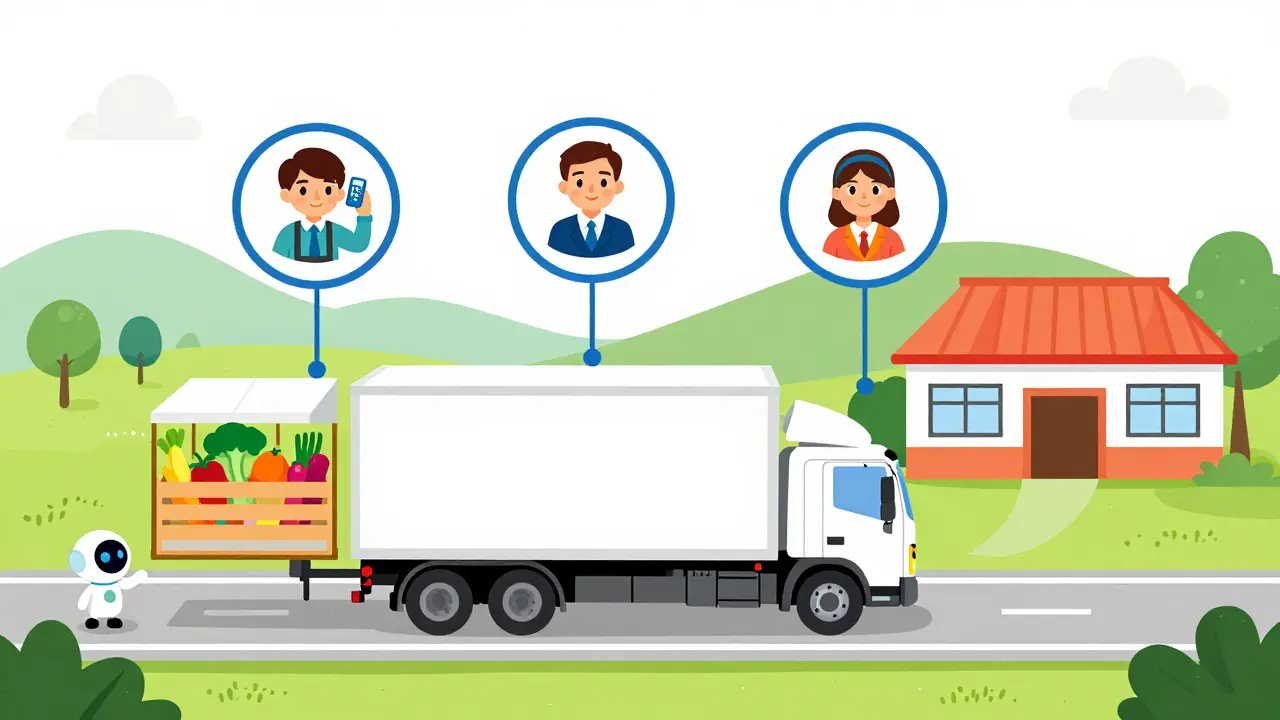
Imagine a refrigerated truck transporting perishable produce. IoT sensors monitor temperature and humidity. If the cold chain breaks, the system doesn’t just log an error-it automatically triggers a VoIP call to the logistics manager and the buyer, alerting them before the cargo spoils. This proactive communication saves thousands of dollars in rejected loads.
For farms selling to major retailers, traceability and audit trails are crucial. VoIP systems with call recording and CRM integration keep a history of every price negotiation, order change, and dispute resolution. When a contract is up for renewal, having recorded proof of agreed-upon terms can make the difference between keeping a client and losing them.
Click-to-call features embedded in farm management software streamline operations. A processor sees a delay in incoming grain due to weather and clicks a button in their dashboard to instantly call the farmer. No dialing, no searching for numbers. Just instant coordination.
Security and Resilience: Protecting Your Digital Farm
Modern farms are data-rich environments. You have ERPs, commodity trading platforms, automated irrigation controllers, and livestock monitoring systems. VoIP servers often sit alongside Operational Technology (OT) systems that control physical machinery. This proximity creates security risks.
If a hacker compromises your phone system, could they pivot to your irrigation controls? Absolutely. That’s why network segmentation is non-negotiable. Voice traffic should be isolated on its own VLAN, separated from IT networks and OT systems. Use encrypted signaling (TLS for SIP) and encrypted media (SRTP) to protect conversations from eavesdropping.
Resilience is equally important. Storms knock out power and internet connections regularly in rural areas. A robust VoIP setup includes failover mechanisms. If the primary fiber link goes down, traffic automatically reroutes through an LTE backup. Some providers offer battery-backed gateways that keep basic calling active for hours during outages.
Providers like Xobee Networks emphasize proactive security management for agribusinesses. They don’t just install phones; they harden the entire network, ensuring that your communication tools remain secure even as your digital footprint grows.
Implementation Strategies: Getting Started Right
Adopting VoIP doesn’t have to be overwhelming. For small family farms, a cloud PBX with 5-10 extensions can be set up in days. Plug-and-play IP phones or smartphone apps get everyone connected quickly. Focus on getting the basics right: stable internet, good headsets, and clear extension naming conventions.
Larger operations need more planning. Map out your physical layout. Where do workers spend most of their time? Do barns have metal roofs that block Wi-Fi signals? You might need ruggedized devices designed for dust and moisture, or push-to-talk radios integrated with VoIP for instant crew communication in dead zones.
Consider managed IT services. Companies like Axia TP handle everything from network design to ongoing maintenance. For many mid-sized farms, outsourcing VoIP management frees up internal resources to focus on production rather than troubleshooting routers.
Start with a pilot. Roll out VoIP to one department or one field crew first. Gather feedback on call quality, ease of use, and feature usefulness. Adjust your QoS settings and hardware choices before scaling to the entire operation.
The Future of Agricultural Communications
VoIP is evolving alongside smart farming technologies. As autonomous tractors and drones become common, the network carrying their data will also carry voice traffic. Private wireless networks will blend machine-to-machine telemetry with human communications, creating highly converged infrastructures.
Cellular-native VoIP (VoLTE/VoNR) will further reduce reliance on Wi-Fi, allowing seamless handoffs between towers as workers move across vast properties. Even remote ranches previously dependent on HF radio will join the IP ecosystem thanks to improved satellite IoT solutions.
The trend is clear: voice is no longer a standalone utility. It’s an integrated component of the farm’s digital nervous system, responding to sensor alerts, connecting distributed teams, and securing supply chains. Farmers who embrace this shift today will be better positioned to handle the complexities of tomorrow’s agricultural landscape.
Is VoIP reliable enough for emergency situations on a farm?
Yes, if configured correctly. VoIP systems can be set up with automatic failover to cellular networks or backup internet connections. Features like ring-all groups ensure that emergency alerts reach multiple staff members simultaneously via different devices. However, you must test these failovers regularly and ensure your equipment has battery backups for power outages.
Can I use my existing farm phone numbers with a VoIP system?
In most cases, yes. This process is called number porting. Most VoIP providers will transfer your existing landline numbers to their system for free or a small fee. This allows you to modernize your communication infrastructure without changing the contact information shared with customers and suppliers.
What kind of internet speed do I need for farm VoIP?
A general rule of thumb is 100 kbit/s upload and download per concurrent call. For a small farm with 5 simultaneous calls, you’d need about 500 kbit/s dedicated to voice. However, since farms also use internet for IoT sensors and software updates, a minimum of 10 Mbit/s symmetrical connection is recommended to prevent congestion and maintain call quality.
How does VoIP integrate with two-way radios?
Modern VoIP systems can integrate with Push-to-Talk (PTT) over Cellular or IP-based radio systems. This allows radio users to communicate with VoIP phone users seamlessly. For example, a field worker with a radio can press a button to speak to the office manager on their desk phone, bridging the gap between legacy radio habits and modern telephony.
Are there security risks in connecting VoIP to farm automation systems?
Yes, if not properly segmented. VoIP servers should never share the same network segment as critical OT systems like irrigation controllers or feeders. Use VLANs to isolate voice traffic, enable encryption (TLS/SRTP), and implement strict firewall rules. Regular security audits by managed IT providers specializing in agriculture can help mitigate these risks.