Most people assume the old copper wire running into their house is the gold standard for privacy. It feels tangible, physical, and hard to tap without someone climbing a ladder. But in 2026, that assumption is dangerously outdated. While landlines are harder to hack remotely from across the ocean, they offer zero cryptographic protection against anyone with physical access or carrier-level privileges. On the flip side, VoIP (Voice over Internet Protocol) has a reputation for being leaky, but modern encryption standards like SRTP (Secure Real-time Transport Protocol) can actually make your calls more private than traditional telephony-if you configure them correctly.
The real question isn't just "which is safer?" It's about who you are trying to hide from. Are you worried about a neighbor with a radio scanner? A corporate competitor sniffing packets on your office Wi-Fi? Or a government agency with legal authority to request recordings from your provider? The answer changes completely depending on whether you understand the difference between link encryption and end-to-end encryption. Let’s break down the actual risks, not the marketing myths.
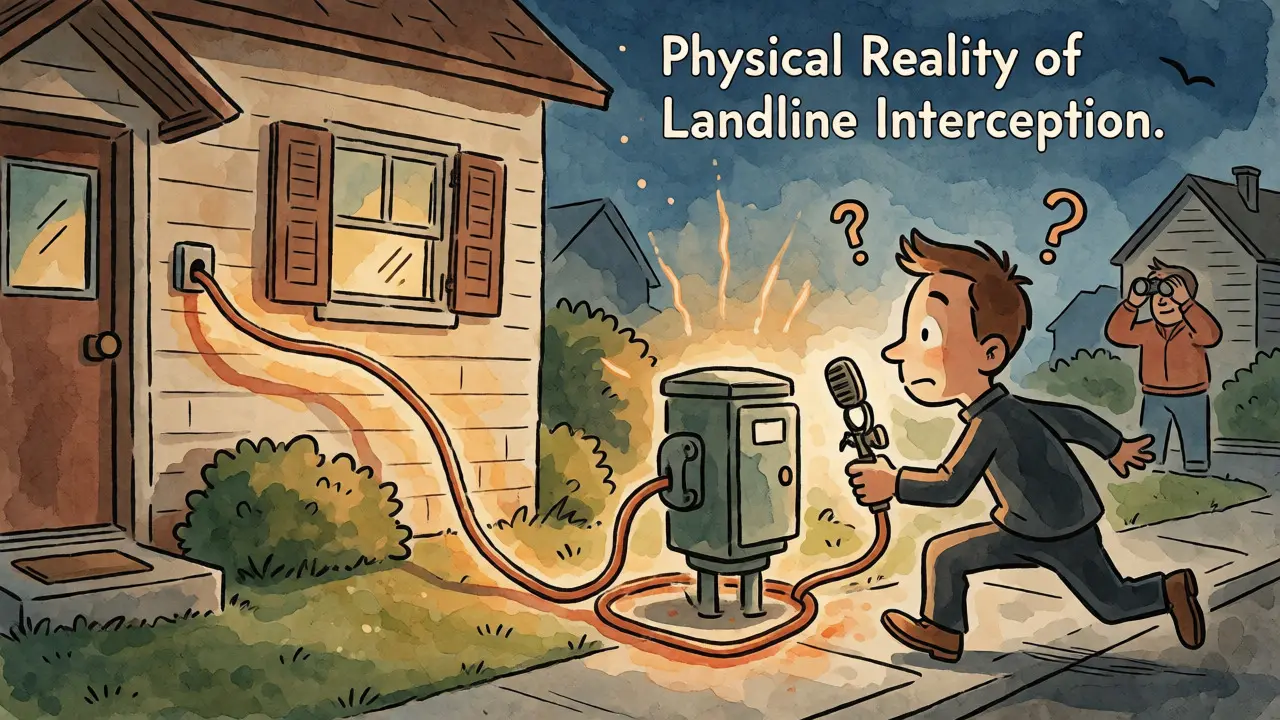
The Physical Reality of Landline Interception
Traditional circuit-switched telephone networks rely on copper pairs. For decades, the primary method of eavesdropping was simple: attach a device to the wire. This could happen at the street cabinet, the junction box outside your home, or even inside your own premises if someone planted a bug on the handset cord. Because the signal is analog (or converted to digital only within the carrier’s core network), there is no native encryption protecting the voice payload once it leaves your phone.
This lack of encryption cuts both ways. For a remote attacker sitting in another country, tapping a specific landline is difficult because they need physical proximity or cooperation from the local exchange. However, for anyone with physical access-like a landlord, a suspicious partner, or an intruder-the risk is immediate and low-tech. You don’t need a computer; you just need a clip-on microphone. Furthermore, landlines are subject to CALEA (Communications Assistance for Law Enforcement Act) requirements in the US, meaning carriers must maintain systems capable of intercepting communications when legally authorized. So, while your neighbor might not be listening, your telecom provider definitely has the technical capability to do so.
VoIP’s Expanded Attack Surface
VoIP converts your voice into data packets sent over IP networks. This introduces a different set of vulnerabilities. Instead of one copper wire, your conversation traverses routers, switches, firewalls, and potentially multiple internet service providers. Each hop is a potential interception point. If your VoIP traffic is unencrypted, anyone with access to the network path-from your office router to your ISP’s backbone-can capture the audio using simple packet-sniffing tools like Wireshark.
Signaling protocols like SIP (Session Initiation Protocol) also pose risks. Unsecured SIP messages reveal metadata: who called whom, when, for how long, and what codecs were used. Even if the audio is encrypted, this metadata can paint a detailed picture of your habits. A 2009 study highlighted that attackers could hijack emergency calls or spoof voicemail servers by manipulating these signaling messages. In 2026, while attacks have evolved, the fundamental architecture remains the same: more nodes mean more places for things to go wrong.

Encryption: The Great Equalizer
This is where VoIP pulls ahead, provided you use the right protocols. Modern VoIP security relies on two main layers: TLS (Transport Layer Security) for signaling and SRTP for media. TLS encrypts the setup instructions (the "who" and "how"), while SRTP encrypts the actual audio stream (the "what"). When both are enabled, passive eavesdroppers see nothing but gibberish.
| Feature | Standard Landline | Unencrypted VoIP | Encrypted VoIP (TLS/SRTP) | End-to-End Encrypted App |
|---|---|---|---|---|
| Remote Sniffing Risk | Low (requires physical/cabinet access) | High (packets visible on network) | Low (audio encrypted) | Very Low (keys held by users) |
| Physical Tapping Risk | High (easy to clip wire) | N/A (digital transmission) | N/A (digital transmission) | N/A (digital transmission) |
| Provider Access | Yes (carrier switch access) | Yes (server holds keys) | Yes (unless E2EE) | No (provider lacks keys) |
| Metadata Exposure | High (billing records) | Medium-High (SIP headers) | Medium (TLS hides content) | Low (limited logging) |
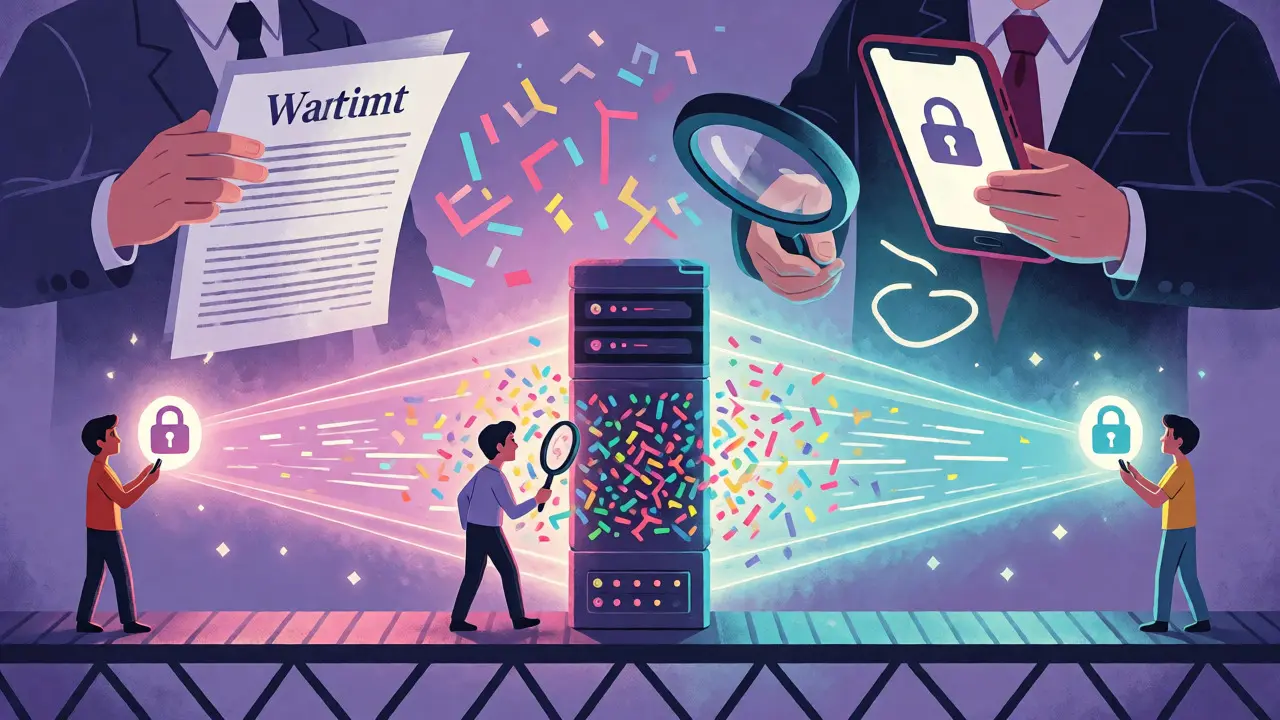
However, there is a critical distinction often missed in marketing materials: hop-by-hop encryption versus end-to-end encryption (E2EE). Most enterprise VoIP systems use hop-by-hop encryption. Your phone encrypts the call to the Session Border Controller (SBC) or PBX server. The server decrypts it to process routing, recording, or transcoding, then re-encrypts it for the next leg. This means the provider or IT admin still possesses the decryption keys. They can listen if they want to, or if compelled by law.
The End-to-End Encryption Advantage
If true confidentiality is your goal, you need end-to-end encryption. In this model, only the devices at each end of the call hold the keys. The provider acts merely as a dumb pipe, relaying encrypted packets without ever seeing the clear text. Applications like Signal or specialized secure VoIP clients achieve this. As of October 2026, CISA recommends such vetted applications for sensitive voice calls precisely because they remove the trust dependency on the telecom operator.
With E2EE, even if a government agency serves a warrant to the provider, the provider can hand over encrypted blobs that are useless without the user’s private key. This shifts the attack vector from the network to the endpoint. Now, the risk isn't someone tapping the line; it's malware on your smartphone or a compromised laptop. If your device is infected, the attacker sees everything before it gets encrypted. No amount of network security fixes a compromised endpoint.
Legal and Regulatory Implications
You cannot ignore the legal landscape. In the United States, CALEA requires telecommunications carriers and interconnected VoIP providers to maintain surveillance capabilities. This means that even if you use encrypted VoIP, if your provider manages the keys (hop-by-hop), they can technically provide decrypted audio to authorities with a valid warrant. The FCC extended these obligations to VoIP providers back in 2005, treating them similarly to traditional telcos.
Landlines, meanwhile, operate under established wiretap laws. A wiretap generally requires judicial approval, distinct from simpler trap-and-trace orders that only record numbers. While the legal bar is high, the technical ease of execution for law enforcement is lower on landlines because the infrastructure is centralized and standardized. With VoIP, the complexity of the stack can sometimes obscure who exactly has access, leading to potential gaps in accountability unless contracts explicitly define key ownership.
Practical Steps to Secure Your Communications
So, how do you decide? Here is a quick checklist based on your threat model:
- For Home Users: If you worry about neighbors or casual snooping, a standard landline is fine. If you use VoIP, ensure your router firmware is updated and WPA3 encryption is active on your Wi-Fi. Consider switching to an app-based service like Signal for highly personal conversations.
- For Small Businesses: Demand TLS and SRTP support from your VoIP provider. Ask specifically if encryption is terminated at their SBC. If yes, assume they can hear your calls. Use strong, unique passwords for all SIP accounts to prevent toll fraud and registration hijacking.
- For High-Security Needs: Do not rely on standard carrier VoIP. Use an end-to-end encrypted solution. Verify that the provider does not retain logs that link call timing to identity. Regularly audit endpoint devices for malware, as the device itself is now the weakest link.
Remember, security is rarely absolute. It is a trade-off between convenience, cost, and control. VoIP offers flexibility and powerful encryption options that landlines simply cannot match digitally. But it demands better configuration. A misconfigured VoIP system is less secure than a plain old landline. A well-configured one, especially with E2EE, is significantly more private.
Can my VoIP provider hear my calls?
If you use standard business VoIP with hop-by-hop encryption, yes. The provider’s servers usually decrypt the audio to route it, which means they possess the keys and can technically access the content. If you use end-to-end encrypted apps, the provider cannot hear your calls because they do not have the decryption keys.
Is a landline easier to wiretap than VoIP?
It depends on the attacker. For a remote hacker, VoIP is easier to intercept if unencrypted because they can sniff packets anywhere on the internet. For a local attacker with physical access, a landline is much easier to tap using simple hardware clips. Landlines have no built-in encryption, so physical access equals full access.
What is SRTP and why does it matter?
SRTP (Secure Real-time Transport Protocol) is the standard for encrypting voice media in VoIP calls. Without SRTP, your voice data travels as clear text packets. Enabling SRTP ensures that even if someone captures the packets, they cannot decode the audio without the session keys.
Does CALEA apply to VoIP services?
Yes. The FCC ruled in 2005 that interconnected VoIP providers must comply with CALEA. This means they must have the technical capability to intercept communications when presented with a lawful order, similar to traditional telephone companies.
Is Wi-Fi safe for VoIP calls?
Wi-Fi itself is not inherently unsafe, but public or poorly secured Wi-Fi networks increase the risk of man-in-the-middle attacks. Always use WPA2 or WPA3 encryption on your home network. For sensitive calls on public Wi-Fi, use a VPN or an end-to-end encrypted application to protect against local network sniffers.