
Most businesses treat their VoIP systems like a black box. Calls go in, conversations happen, and the system spits out analytics dashboards. But there is a hidden risk lurking in those dashboards: data retention. If you are storing call recordings, transcripts, or metadata longer than necessary, you aren't just wasting server space-you are potentially breaking the law. In the UK and EU, regulators don't care if you forgot to delete old files. They expect you to have a written policy, automated deletion jobs, and a clear reason for every second of audio kept on file.
This guide cuts through the legal jargon. We will look at exactly how long you should keep different types of VoIP data, why regulations like GDPR and FCA rules dictate these timelines, and how to set up your storage so it survives an audit without bankrupting your IT budget.
The Golden Rule: Purpose Determines Duration
There is no single "correct" retention period for all VoIP data. The length depends entirely on why you are keeping it. This is the core principle of the General Data Protection Regulation (GDPR), specifically the storage limitation principle in Article 5(1)(e). It states that personal data must be kept "no longer than is necessary" for the purposes for which it is processed. Once the purpose is fulfilled, the data must go.
Think about it this way: If you record a customer service call to resolve a billing dispute, do you need that recording five years later? Probably not. Once the dispute is closed, the justification for holding that specific audio file vanishes. Keeping it "just in case" is actually a violation. Regulators view indefinite retention as high-risk because it increases the surface area for data breaches and complicates subject access requests (SARs).
To stay compliant, you need to segment your data. You cannot apply one rule to everything. A financial trading firm has different needs than a local plumbing business. Your policy must reflect these differences explicitly.
Breaking Down VoIP Data Types and Their Lifespans
VoIP analytics platforms generate several distinct categories of data. Each category carries a different level of sensitivity and regulatory weight. Here is how typical retention periods break down across common use cases:
- Call Recordings (Audio): These are the most sensitive assets because they contain voice biometrics and conversation content. For general quality assurance (QA) and training, 30-90 days is the standard sweet spot. This allows managers to review recent performance trends without hoarding data indefinitely. Sales teams might stretch this to 6-12 months to cover contract dispute windows, but anything beyond a year usually requires a strong legal justification.
- Call Detail Records (CDRs): CDRs are logs containing source/destination numbers, timestamps, and duration. They don’t contain audio, making them less sensitive but still personal data. Because they are critical for billing reconciliation, fraud detection, and network engineering, providers typically retain them for 12-24 months. In the US, FCC guidelines often push carriers toward an 18-24 month window.
- Voicemail Messages: Voicemails are transient by nature. Most users listen once and move on. Retaining them for more than 30-90 days rarely adds analytical value and creates unnecessary storage bloat. Automated purge schedules should handle this automatically.
- Transcripts and Metadata: With the rise of AI-driven analytics, many platforms now store text transcripts alongside audio. These are treated similarly to recordings under GDPR. If the audio is deleted, the transcript derived from it should also be purged unless anonymized. Sentiment scores and keyword tags can sometimes be retained longer if stripped of personally identifiable information (PII), but check your vendor’s terms carefully.
Sector-Specific Regulations That Override General Rules
If you operate in a regulated industry, the "general business" rules above are merely starting points. Specific laws mandate much longer retention periods, and failing to meet them can result in heavy fines.
| Sector/Regulation | Data Type | Minimum Retention | Key Reason |
|---|---|---|---|
| FCA / MiFID II | Relevant Communications | 5-7 Years | Financial advice, trading execution, and market abuse investigations require long-term evidence trails. |
| HIPAA | Patient Care Records | 6 Years | Healthcare communications linked to patient treatment plans fall under strict medical record-keeping laws. |
| Ofcom (UK) | Emergency Call Data | 12 Months | Location and routing logs for emergency services must be available for investigation of response times. |
| PCI DSS | Payment Card Audio | Until Redacted | Recordings containing credit card numbers must be paused or redacted; stored only as long as needed for transaction verification. |
For firms regulated by the Financial Conduct Authority (FCA) in the UK, the rules are non-negotiable. Under SYSC 9.1 and COBS 11.8, any communication related to a trade or investment advice must be recorded and kept for at least five years. Some firms extend this to seven years to account for potential regulator requests for extended retention. If you are in finance, do not try to apply a 90-day QA policy to your trading desk calls. You will fail an audit.
The Technical Challenge: Deleting Data Everywhere
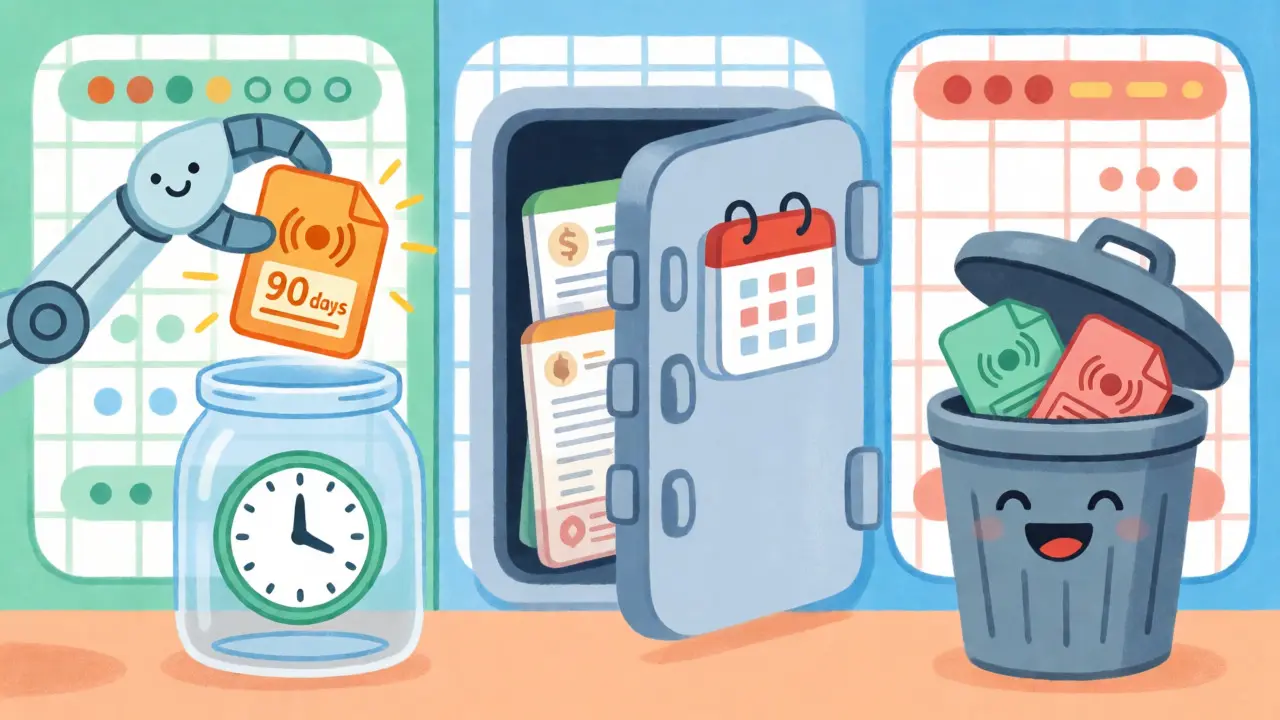
Writing a policy is easy. Enforcing it technically is where most companies stumble. GDPR requires "irreversible" deletion. This means simply moving a file to a trash folder isn't enough. The data must be gone from primary storage, backups, archives, and any third-party analytics tools that ingested it.
Consider a typical workflow: A call is recorded on your VoIP PBX. It is synced to a CRM for agent notes. Then, an AI tool processes it for sentiment analysis, creating a transcript in a separate database. Finally, a nightly backup copies the raw audio to cold storage. If you delete the call from the PBX after 90 days, did you actually delete it? Probably not. The copy likely remains in the CRM, the AI database, and the backup tape.
To solve this, you need automated lifecycle management. Modern VoIP platforms allow you to set granular retention rules per queue or user group. Ensure these settings cascade to connected systems via APIs. If your analytics provider doesn't support automatic deletion triggers, you may need a middleware script to purge derivative data when the source recording expires. Remember, backups are tricky. Many organizations adopt a "backup rotation" policy where older backups are overwritten, effectively deleting old data after a set number of cycles (e.g., 6 months). Document this process clearly to prove compliance during an inspection.
Legal Holds: When to Pause the Clock
Sometimes, you need to keep data longer than your standard policy dictates. This happens during active litigation, internal investigations, or regulatory inquiries. This mechanism is called a legal hold.
A robust retention policy includes a procedure for suspending automated deletion for specific records. For example, if a customer threatens legal action over a sales call, you flag that recording. Even if its 90-day expiry date arrives, the system prevents deletion until the legal team releases the hold. Without this feature, you risk spoliation-destroying evidence relevant to a lawsuit-which can lead to severe penalties in court.
Test your legal hold functionality regularly. Can you isolate a single call from thousands of others? Does the hold persist even if the user deletes the file manually? These edge cases are where compliance failures often occur.

Common Pitfalls and How to Avoid Them
Based on audits and operational feedback, here are the most frequent mistakes businesses make with VoIP data retention:
- Indefinite Retention: Storing everything forever because "storage is cheap." This violates GDPR's storage limitation principle and increases breach liability. Keep it lean.
- Lack of Written Policy: Having a setting in the software isn't a policy. You need a document stating who owns the data, what the periods are, and how deletions are verified. Auditors want paperwork.
- Ignoring Transcripts: Companies often delete audio but forget the AI-generated transcripts. If the transcript contains names or PII, it is still personal data. Delete it alongside the audio.
- One-Size-Fits-All Approach: Applying a 5-year rule to general support calls wastes resources. Apply a 90-day rule to financial trades and miss deadlines. Segment your queues.
- Unverified Deletion: Assuming the system worked. Maintain deletion logs. If a regulator asks, "Show me proof you deleted this batch," you need a timestamped log entry confirming the purge.
Implementation Checklist for 2026
Ready to tighten up your VoIP governance? Follow these steps to build a defensible retention strategy:
- Inventory Your Data: Map every place VoIP data lives. PBX, CRM, Analytics Dashboard, Backups, Email Notifications.
- Define Purposes: Why are we recording? QA? Training? Legal Defense? Billing? Assign a purpose to each data stream.
- Set Periods by Category:
- General Support: 30-90 Days
- Sales/Marketing: 6-12 Months
- Financial/Regulated: 5-7 Years
- CDRs/Billing: 12-24 Months
- Configure Automation: Enable auto-delete features in your VoIP platform. Ensure API hooks exist for external tools.
- Draft the Policy: Write a simple document explaining the rules. Include exceptions for legal holds.
- Train Staff: Tell employees why recordings disappear. Manage expectations so they know to download important clips immediately if needed.
- Audit Quarterly: Randomly sample deleted data to ensure it is truly gone. Check logs for errors.
How long should I keep VoIP call recordings for GDPR compliance?
For general business use, such as quality assurance and staff training, 30 to 90 days is typically considered sufficient and compliant. However, if you are in a regulated sector like finance (FCA/MiFID II), you must retain relevant communications for 5 to 7 years. Always base your decision on a documented business purpose rather than keeping data "just in case."
Do I need to delete VoIP call detail records (CDRs) too?
Yes, CDRs are considered personal data because they contain phone numbers and timestamps. While they are less sensitive than audio, they still fall under GDPR. Typical retention periods for CDRs range from 12 to 24 months to support billing disputes and fraud detection. After this period, they should be anonymized or deleted.
What happens to AI-generated transcripts when I delete the audio?
If the transcript contains personally identifiable information (names, addresses, etc.), it must be deleted alongside the audio recording. Simply deleting the audio file does not remove the text data stored in your analytics database. Ensure your VoIP provider or analytics tool offers automated cleanup of derivative data to maintain full compliance.
Can I keep recordings longer if I have a legal dispute?
Absolutely. This is known as a "legal hold." If a recording is relevant to ongoing litigation or a regulatory investigation, you can suspend the automated deletion process for that specific file. Your retention policy should include a clear procedure for placing and releasing legal holds to prevent accidental destruction of evidence.
Does PCI DSS affect my VoIP recording retention?
PCI DSS focuses on securing payment card data rather than setting a specific retention time. However, it impacts how you record calls. You must pause recording or use tone suppression when customers enter credit card details. Any recordings that accidentally capture card numbers should be secured strictly and deleted as soon as possible, often within 30 days, to minimize risk.