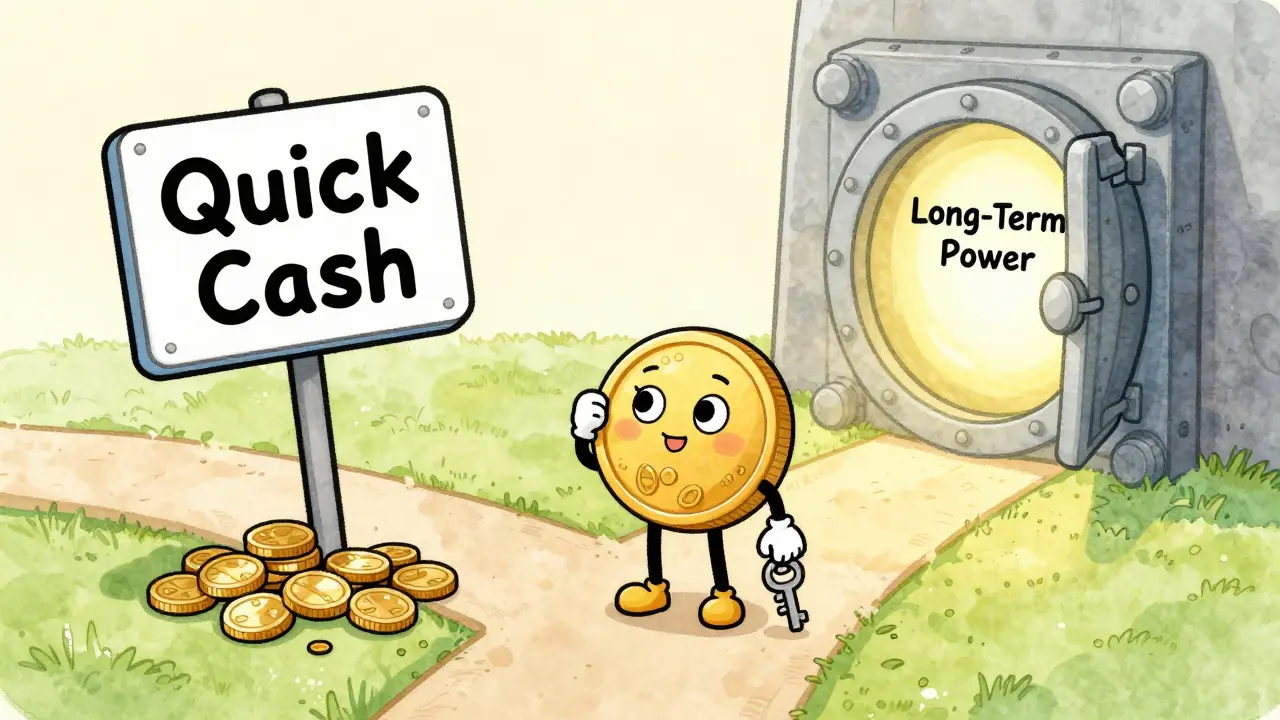
You hold a token. You want to vote on how the protocol uses its money. But if you can sell that token in seconds, why would you care about the project’s health five years from now? This is the exact problem veTokenomics, or vote-escrowed tokenomics, was designed to solve. It forces users to choose between quick cash and long-term power by locking their assets for months or even years. In return, they get voting rights and higher rewards. It sounds simple, but this mechanism has reshaped how decentralized finance (DeFi) protocols manage liquidity and distribute fees.
How Lock-to-Vote Mechanics Work
At its core, veTokenomics changes the rules of engagement. Instead of "one token, one vote," the system uses a formula based on time and commitment. When you lock your base token-like CRV or BAL-you don’t just get a receipt; you get a derived voting balance that decays over time. The longer you lock, the more power you have initially, but that power fades as your unlock date approaches.
Let’s look at the math behind it. The voting weight ($w$) is calculated as:
- $w = a \times t / t_{max}$
Here, $a$ is the amount of tokens you locked, $t$ is the remaining time until your lock expires, and $t_{max}$ is the maximum possible lock duration (usually 4 years). If you lock 100 tokens for the full 4 years, you start with maximum voting weight. After two years, your weight drops by half. To keep your influence, you must extend your lock. This creates a continuous cycle of re-locking, ensuring that only truly committed holders maintain significant governance power.
| Protocol | Base Token | Max Lock Time | LP Reward Boost | Fee Share Access |
|---|---|---|---|---|
| Curve Finance | CRV | 4 Years | Up to 2.5x | Yes (50% of fees) |
| Balancer | BAL | 4 Years | Variable | Yes |
| Velodrome Finance | VELO | 4 Years | High Multiplier | Yes (via Gauges) |
Controlling Emissions Through Gauge Voting
The real magic of veTokenomics isn't just voting on proposals; it's controlling where new tokens go. Protocols like Curve use a system called "gauges." Think of gauges as faucets that dispense newly minted tokens to different liquidity pools every week. Who controls the faucet handles? The veToken holders.
When you hold veTokens, you cast votes to direct these emissions toward specific pools. If you vote for a pool, liquidity providers in that pool earn extra rewards. This creates a marketplace for liquidity. External projects that want their trading pairs to be deep and liquid will pay veToken holders to vote for their pools. These payments are often called "bribes" or "delegated votes."
This setup aligns incentives perfectly. The protocol wants healthy liquidity. Liquidity providers want high yields. Projects want trading volume. And veToken holders get paid in bribes and fee shares to make it all happen. It turns governance into an economic engine rather than a dusty voting forum.

The Rise of ve(3,3) DEXs
While Curve pioneered the model, newer platforms took it further. Enter the ve(3,3) DEXs, such as Velodrome, Thena, and Equalizer. These platforms combine the vote-escrow mechanics of Curve with cooperative game theory concepts from Olympus-style staking. The "(3,3)" refers to a win-win-win scenario for three parties: the protocol, the liquidity providers, and the voters.
In traditional AMMs like Uniswap, liquidity providers take all the risk for a small fee. In ve(3,3) models, the protocol actively manages emissions to support LPs. By directing heavy token rewards to specific pools, these DEXs ensure that traders experience low slippage and high liquidity. In exchange, LPs share a portion of their trading fees with the veToken holders who voted for their pool. This mutualization of fees makes the entire ecosystem more sustainable because rewards come from actual usage, not just infinite inflation.
Benefits vs. Risks: What You Need to Know
Is veTokenomics perfect? Far from it. While it solves the short-termism problem, it introduces new challenges that you need to weigh carefully before locking your funds.
The Benefits:
- Long-Term Alignment: Holders are incentivized to think in years, not minutes. They won't dump tokens if it hurts the protocol's value.
- Higher Yields: Locking tokens often grants multipliers on liquidity mining rewards. On Curve, you can boost your APY up to 2.5x just by holding veCRV.
- Revenue Sharing: You get a cut of the protocol's trading fees, turning your token holding into a dividend-like income stream.
The Risks:
- Liquidity Lock-Up: Once you lock, you can't sell. If the market crashes, you're stuck. Your capital is illiquid for the duration of the lock.
- Complexity: Understanding gauge weights, bribe markets, and decay curves requires a steep learning curve. One wrong click can mean missed rewards.
- Governance Capture: Large entities (whales) can dominate voting power, potentially steering emissions in ways that benefit them at the expense of smaller users.

Who Should Use veTokenomics?
If you are a casual investor looking for quick gains, veTokenomics is likely not for you. The requirement to lock assets for weeks or years contradicts the desire for immediate liquidity. However, if you are a sophisticated DeFi participant, this model offers powerful tools.
Consider using veTokenomics if:
- You believe in the long-term viability of the protocol.
- You have capital you don't need for at least several months.
- You understand how to calculate break-even points considering lock-up periods and potential price depreciation.
- You want to participate in the governance economy by selling votes or claiming bribes.
For most people, starting with a shorter lock period (e.g., 1 year instead of 4) is a safer way to test the waters. It gives you some voting power and yield boosts without tying up your capital for half a decade.
Conclusion
veTokenomics represents a mature evolution in DeFi design. By linking voting power to time-locked assets, protocols like Curve and Balancer have created systems where governance has real economic weight. While the complexity and lock-up risks are real, the alignment of incentives between developers, users, and investors is unmatched by traditional token models. As the space moves toward fee-driven sustainability rather than pure speculation, understanding these mechanisms becomes essential for anyone serious about decentralized finance.
What is the difference between veTokenomics and standard governance?
Standard governance usually follows a "one token, one vote" rule where tokens can be sold instantly. veTokenomics requires locking tokens for a set period to gain voting power. This power decays over time, forcing participants to commit long-term to maintain influence. It also ties voting power directly to economic rewards like fee sharing.
Can I sell my veTokens?
No, veTokens themselves are non-transferable. You cannot send them to another wallet or sell them on an exchange. However, you can sometimes sell the *voting rights* associated with them through delegation platforms or bribe markets, allowing others to vote on your behalf in exchange for payment.
What happens when my lock expires?
When your lock expires, your voting power drops to zero, and you lose access to boosted rewards and fee shares. At this point, you can withdraw your original base tokens (minus any gas fees). To regain voting power, you must initiate a new lock transaction.
Are ve(3,3) DEXs safer than Curve?
Safety depends on the specific protocol's smart contract audits and treasury health, not just the model. ve(3,3) DEXs like Velodrome aim to be more sustainable by relying on trading fees rather than pure inflation, which can reduce sell pressure. However, they are often newer and may carry higher smart contract risk compared to established platforms like Curve.
Why do projects pay bribes to veToken holders?
Projects pay bribes to attract liquidity to their specific trading pools. By convincing veToken holders to vote for their pool, they ensure that liquidity providers receive higher rewards. This draws in more liquidity, which reduces slippage for traders and makes the project's token more attractive to buy and sell.