
You probably hear the terms "blockchain" and "distributed ledger technology" (DLT) used interchangeably. It’s like calling a Ferrari just a "car." Technically true, but it misses the point. Distributed Ledger Technology is the broader category of infrastructure that allows multiple parties to share a single source of truth without needing a middleman. Blockchain is just one specific way to build that infrastructure. If you’re trying to figure out why your bank cares about this, or if your startup needs it, understanding the difference isn't just academic-it’s critical for making smart tech decisions.
The Core Problem: Trust Without a Middleman
Think about how traditional banking works. When you send money to a friend, you trust the bank to keep the ledger accurate. The bank is the central authority. They hold the master record. If their server goes down, or if they make an error, you’re stuck waiting for them to fix it. Worse, you have to trust that they aren’t manipulating the data behind closed doors.
DLT flips this model on its head. Instead of one central database, the ledger is copied across thousands of computers, called nodes. Every node has an identical copy of the transaction history. When someone sends money, the network checks if it’s valid. If everyone agrees, the entry is added to every copy simultaneously. This removes the single point of failure. You don’t need to trust a person or a company; you trust the code and the math.
How DLT Actually Works: The Workflow
It sounds complex, but the process follows a logical sequence. Let’s break down what happens when a transaction hits a DLT network:
- Initiation: A user requests a transaction, like sending Bitcoin or updating a supply chain record.
- Broadcast: This request is sent to all peer-to-peer nodes in the network.
- Validation: Nodes check the transaction against pre-defined rules. Is the sender who they say they are? Do they have enough funds?
- Consensus: This is the magic step. The network must agree that the transaction is valid. Different systems use different methods to reach this agreement, which we’ll cover later.
- Recording: Once agreed upon, the transaction is grouped into a block (in blockchain) or another structure, cryptographically sealed, and added to the ledger.
- Update: Every node updates its local copy of the ledger. The state of the network changes permanently.
Notice that last part: "permanently." In most DLT systems, once data is written, it cannot be changed. This property is known as immutability. It means you can audit the entire history of an asset from its origin to today with absolute certainty.
Key Architectural Pillars of DLT
To really understand DLT, you need to grasp the four pillars that make it secure and functional. These aren't just buzzwords; they are technical requirements.
| Pillar | Definition | Why It Matters |
|---|---|---|
| Decentralization | No single entity controls the network. | Reduces cost and eliminates single points of failure. |
| Consensus Mechanisms | Rules for agreeing on transaction validity. | Prevents fraud and double-spending without a referee. |
| Cryptography | Uses hashing and digital signatures. | Secures data integrity and verifies identity. |
| Immutability | Data cannot be altered retroactively. | Creates a tamper-proof audit trail. |
Let’s look closer at cryptography. It’s not just about encryption for privacy. It’s about integrity. Each block contains a unique hash, a digital fingerprint of the data inside it, plus the hash of the previous block. If someone tries to change a transaction in Block 10, the hash changes. That breaks the link to Block 11, which breaks the link to Block 12, and so on. To fake a record, you’d have to recalculate the hashes for every subsequent block and convince the majority of the network to accept your version. It’s computationally expensive and practically impossible in large networks.
It’s Not Just Blockchain: Other DLT Structures
Here is where many people get confused. Blockchain is the most famous type of DLT, but it’s not the only one. Think of DLT as the vehicle, and blockchain as a sedan. There are other vehicles too.
- Blockchain: Transactions are grouped into blocks, chained chronologically. Best for transparency and security. Examples: Bitcoin, Ethereum.
- Directed Acyclic Graph (DAG): No blocks. Transactions confirm each other directly. This allows for parallel processing, meaning faster speeds and often no fees. Examples: IOTA, Nano.
- Hashgraph: Uses a gossip protocol and virtual voting to reach consensus much faster than traditional mining. Example: Hedera Hashgraph.
Why does this matter? If you’re building a system that needs to handle millions of micro-transactions per second, like IoT devices talking to each other, a traditional blockchain might be too slow. A DAG-based DLT could be a better fit because it doesn’t force transactions into sequential blocks.
Reaching Agreement: Consensus Mechanisms
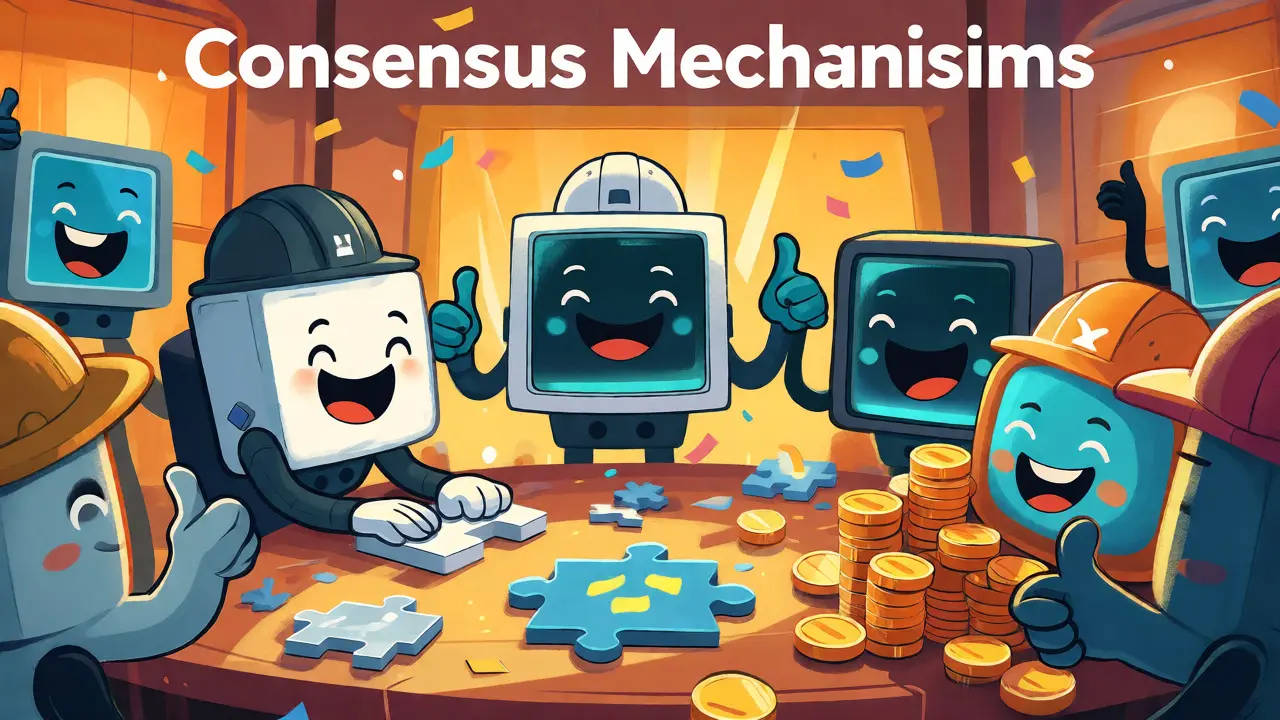
Since there’s no boss telling everyone what’s true, how do nodes agree? They use consensus algorithms. This is the engine room of any DLT system.
Proof-of-Work (PoW) is the original method, famously used by Bitcoin. Miners compete to solve complex math puzzles. The first to solve it gets to add the next block. It’s secure but energy-intensive.
Proof-of-Stake (PoS) is the modern alternative, now powering Ethereum. Instead of burning electricity, validators lock up (stake) their own coins. If they act honestly, they earn rewards. If they cheat, they lose their stake. It’s far more energy-efficient and scales better.
For private enterprise networks, where participants are known entities (like banks), algorithms like Practical Byzantine Fault Tolerance (PBFT) are common. PBFT relies on voting among trusted nodes rather than computational work or financial stakes. It’s fast and final, but it requires a higher level of initial trust among the members.

Real-World Applications Beyond Crypto
While Bitcoin made DLT famous, the technology’s real power lies outside of cryptocurrency speculation. Here is where DLT is actually changing industries:
- Supply Chain: Walmart uses DLT to track mangoes from farm to store. If there’s an E. coli outbreak, they can trace the contaminated batch in seconds instead of days. This saves lives and reduces waste.
- Finance: Cross-border payments currently take days and involve multiple intermediaries (SWIFT, correspondent banks). DLT enables near-instant settlement with lower fees. Major banks are testing projects using platforms like R3 Corda.
- Healthcare: Patient records are often siloed in different hospitals. A DLT-based system could give patients control over their own data, allowing them to grant temporary access to doctors while keeping a permanent audit log of who viewed their records.
- Voting: Government agencies are exploring DLT for elections to ensure votes are counted accurately and cannot be tampered with after the fact.
DLT vs. Traditional Centralized Databases
Should you always use DLT? No. In fact, for most small businesses, a standard SQL database is cheaper and faster. DLT adds complexity. Use DLT when you need multi-party collaboration without trusting a single administrator.
| Feature | Centralized DB (e.g., MySQL) | Distributed Ledger (e.g., Hyperledger Fabric) |
|---|---|---|
| Control | Single Admin | Shared Network |
| Trust Model | Institutional Trust | Cryptographic/Mathematical Trust |
| Data Alteration | Easy (UPDATE command) | Hard/Impossible (Append-only) |
| Performance | Very High (Internal optimization) | Lower (Network overhead + Consensus) |
| Best For | Single-company apps | Multi-party ecosystems |
The trade-off is clear. You gain transparency and security, but you sacrifice some speed and simplicity. If you’re building an internal HR tool, stick to SQL. If you’re coordinating inventory between suppliers, manufacturers, and retailers, DLT starts to make sense.
The Future of DLT
We are past the hype phase. The focus now is on interoperability-getting different DLTs to talk to each other. Imagine a world where your medical records (on one DLT) can securely interact with your insurance claims (on another) without a centralized broker holding all your data hostage.
As regulatory frameworks mature, especially in regions like the EU with MiCA regulations, we will see more institutional adoption. The technology is stabilizing. The question isn’t "if" DLT will be integrated into enterprise systems, but "how soon" and "which architecture" will win for specific use cases.
Is DLT the same thing as blockchain?
No. Blockchain is a specific type of DLT. All blockchains are distributed ledgers, but not all distributed ledgers are blockchains. Other types include Directed Acyclic Graphs (DAGs) and Hashgraphs, which use different data structures and consensus methods.
Do I need cryptocurrency to use DLT?
Not necessarily. While public blockchains like Bitcoin require tokens to incentivize miners, private DLTs used by enterprises (like Hyperledger) often do not require a native cryptocurrency. They rely on permissioned nodes that are already trusted partners.
What is the biggest disadvantage of DLT?
Scalability and complexity. Reaching consensus across thousands of nodes takes time and computational resources. Writing data is slower than in a centralized database, and managing the keys and permissions can be technically challenging for non-experts.
Can data on a DLT be deleted?
Generally, no. Most DLTs are append-only, meaning new data is added, but old data remains forever. Some newer architectures allow for 'pruning' old data or storing heavy data off-chain while keeping a cryptographic proof on-chain, but the core ledger entries are typically immutable.
Who maintains the ledger in a DLT system?
The network participants maintain it collectively. In public networks, anyone can run a node. In private networks, a consortium of organizations runs the nodes. There is no single administrator responsible for backups or uptime; the redundancy is built into the network design.