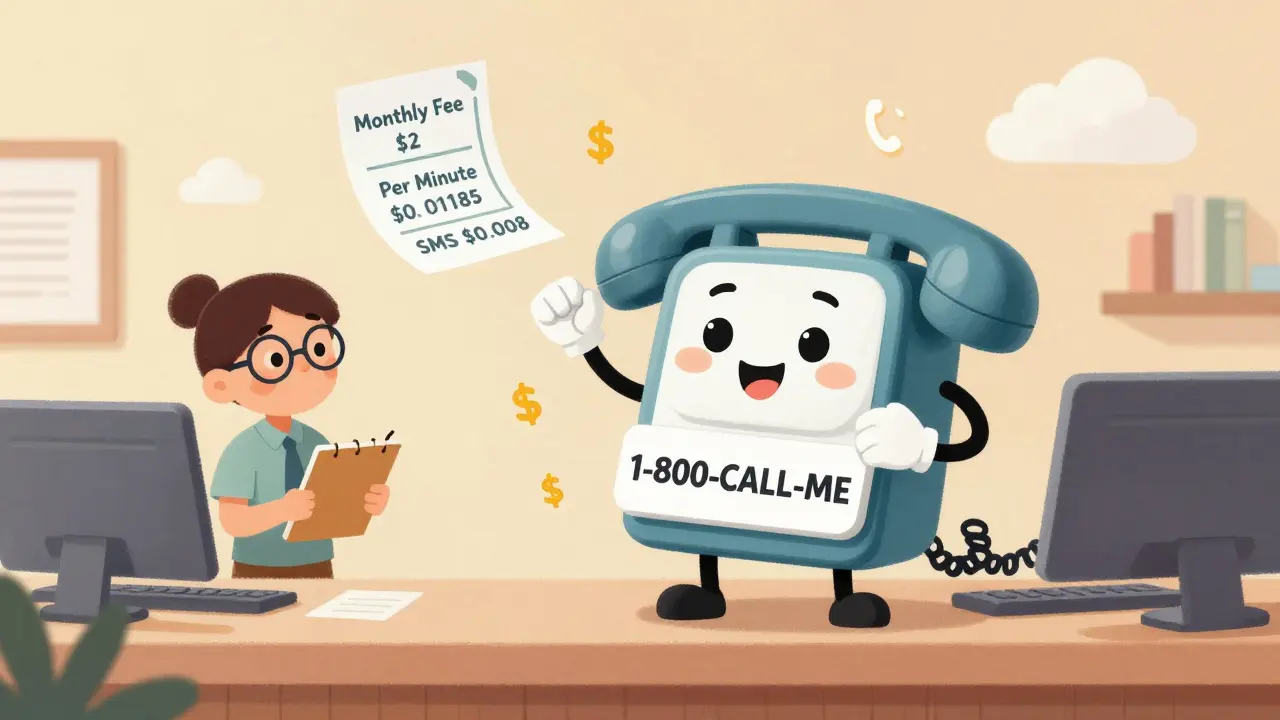
When you think about toll-free numbers, you probably picture a business line that customers can call for free-800, 888, 877. But behind that simple number is a pricing structure that can get messy fast. If you're running a small business or even a solo operation, you need to know exactly what you're paying for. Because the cost of a toll-free number isn’t just a monthly fee. It’s per-minute charges, setup fees, add-ons, and hidden tiers. And if you don’t understand how it all adds up, you could be overpaying by hundreds a month.
What You’re Actually Paying For
A toll-free number in VoIP isn’t like a landline you rent from a phone company. It’s a digital service tied to your VoIP platform. That means your cost breaks down into three main pieces:
- Monthly rental for the number itself
- Per-minute charges for every inbound call
- Platform subscription if you’re using a full VoIP system
Some providers bundle all this into one price. Others charge you separately. And that makes a huge difference in your total bill.
Basic Number Rental: How Much Does It Cost?
Let’s start with the number itself. The cheapest providers charge as little as $1.50 per month for a standard toll-free number. IPComms, for example, offers standard 800 numbers at $2.00 monthly with no contracts, no setup fees, and instant activation. That’s it. No hidden costs. Just the number.
But if you want a vanity number-one that spells something like 1-800-PLUMBING-that’s a different story. Those cost $5.00 per month with IPComms. Other providers like Grasshopper charge $10-$14.99 monthly for vanity numbers. Why? Because they’re easier to remember, stick in people’s minds, and boost branding. For a small business, that’s often worth it.
Compare that to local numbers. IPComms charges $1.50 per month for a local number with even lower per-minute rates ($0.0049). But local numbers don’t give you national reach. If you’re trying to build trust with customers across the country, a toll-free number is still the standard.
Per-Minute Inbound Charges: The Real Cost Killer
This is where most people get surprised. The monthly fee is small. But if you get 500 calls a month, and each call lasts 5 minutes, you’re talking 2,500 minutes. At $0.03 per minute? That’s $75 in call charges alone.
Here’s how rates stack up across providers:
| Provider | Monthly Number Cost | Inbound Per-Minute Rate | Notes |
|---|---|---|---|
| IPComms | $2.00 | $0.0185 | No contracts, no minimums |
| DIFForsale (Starter) | $3.00 | $0.019 | Pro Plan drops to $0.015/min |
| DIFForsale (Pro) | $3.00 | $0.015 | Best for high volume |
| VoiceLine Global | $5.95 | $0.038 | Simpler plan, higher rate |
| 800.com (Overage) | N/A | $0.06 | Only if you exceed plan minutes |
| RingCentral (Overage) | $4.99/month | Not listed | Plans include minute buckets |
Notice the gap between $0.015 and $0.038? That’s more than double. If you make 1,000 calls a month at 5 minutes each (5,000 minutes total), here’s what it costs:
- At $0.015/min: $75
- At $0.038/min: $190
That’s $115 extra per month just for the provider you pick. That’s a laptop. That’s a month’s worth of software subscriptions. It’s not a small difference.
Minute Plans vs. Pay-As-You-Go
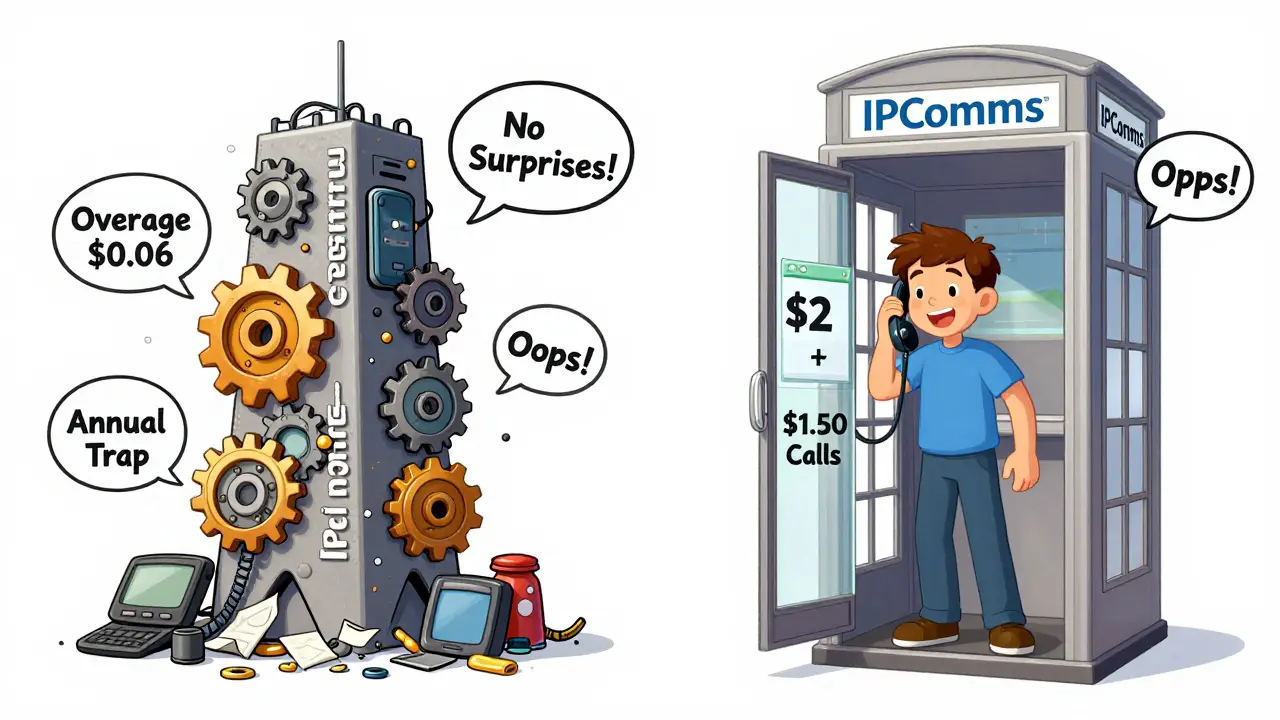
Some providers don’t charge per minute. They give you a monthly bucket of minutes. RingCentral, for example, includes 100, 1,000, or 10,000 minutes depending on your plan. If you go over? You pay overage-but they don’t tell you how much. That’s risky.
800.com is clearer. Their Unlimited plan costs $49/month (billed annually) and includes unlimited calls. But if you go with their Pro plan ($127/year), you get 5,000 minutes. Go over? $0.06 per minute. So if you hit 6,000 minutes, you pay $60 extra. That’s almost as much as the Unlimited plan.
Pay-as-you-go is better if your call volume is unpredictable. IPComms and DIFForsale let you pay only for what you use. No minimums. No surprise bills. If you get 20 calls a week? You pay $1.50 for the number and maybe $2 in call charges. If you get 500? You pay $10. No penalty.
But if you know your usage? A plan with included minutes can save you money. If you consistently use 3,000 minutes a month, a $29 plan with 2,592 included minutes is cheaper than paying $0.0185 per minute ($55.50).
Platform Pricing: When Your Phone System Includes the Number
Most businesses don’t just need a toll-free number. They need a full VoIP system: call forwarding, voicemail-to-email, IVR menus, team messaging, CRM integration. That’s where providers like Nextiva, RingCentral, and CloudTalk come in.
Here’s how it works: instead of paying $2 for the number and $0.0185 per minute, you pay $25-$75 per user per month for the whole package. And the toll-free number is just one feature in it.
- Nextiva Core Plan: $15/user/month - includes unlimited calling, no extra toll-free fee
- Nextiva Engage Plan: $25/user/month - adds toll-free number + advanced reporting
- Nextiva Power Suite CX: $75/user/month - full call center with AI analytics
Same with RingCentral: $4.99/month for an extra toll-free number, but you’re already paying $30-$60 per user for the platform. So the number itself is almost free. But you’re locked into their ecosystem.
Grasshopper and OpenPhone (Quo) are in the middle. Grasshopper’s Solo Plan is $31/month for one number and three extensions. OpenPhone is $19/month for a mobile-first experience with texting and calling. These are great for solopreneurs or teams under 5 people.
What’s Hidden? SMS, MMS, and International
Most people forget about text messages. But if customers text your toll-free number, you’re paying for that too.
DIFForsale charges $0.008 per inbound SMS and $0.02 per MMS. That adds up fast if you’re handling customer support via text. Outbound SMS? Only $0.003 per message. So if you send 500 texts a month? That’s $1.50. Not much-but still, it’s a line item.
International toll-free numbers? They’re expensive. $14.99/month minimum. And you’ll pay extra per-minute rates for international callers. If you serve clients in Canada, Mexico, or the UK, you might need local numbers there too. That’s another $5-$15 per number.
Who Should Choose What?
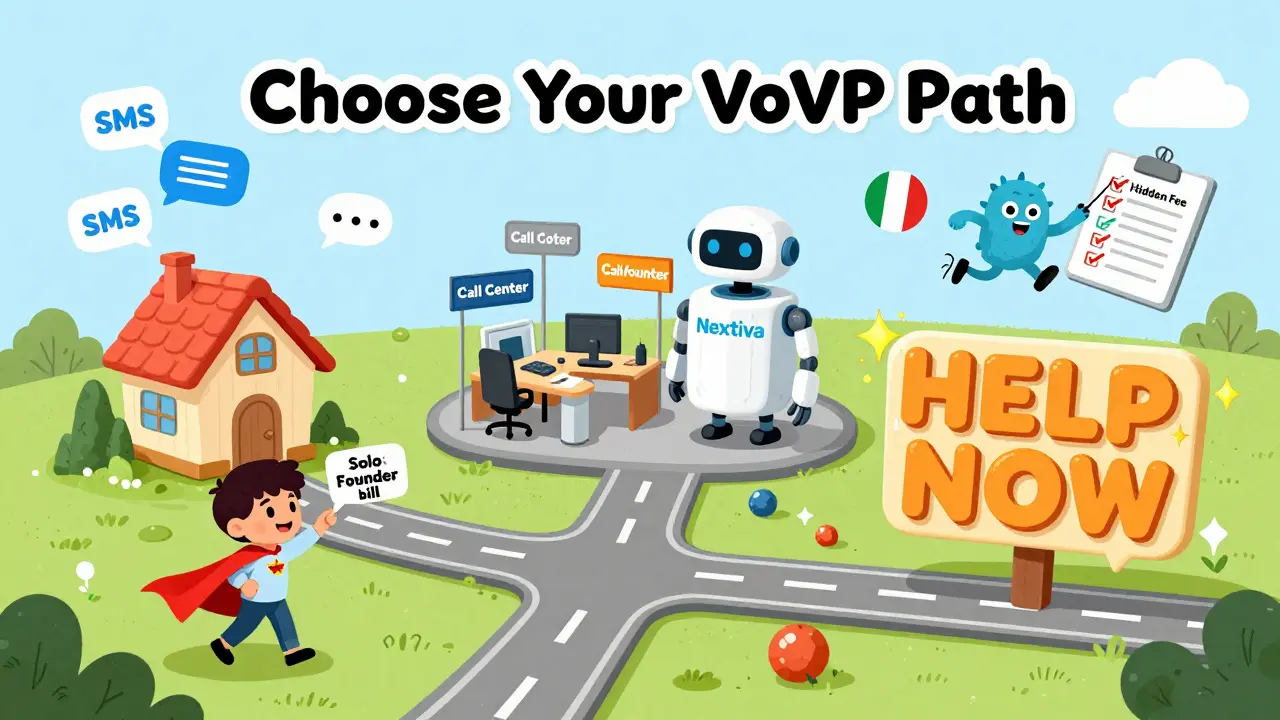
Here’s how to pick:
- Solo founder or freelancer: Go with IPComms or OpenPhone. $2/month for the number + pay-as-you-go calls. Keep it simple.
- Small business (5-15 people): DIFForsale Pro or Grasshopper. If you get over 2,000 minutes/month, go with DIFForsale. If you want texting and team features, Grasshopper or OpenPhone.
- Support-heavy business (call center, SaaS): Nextiva or RingCentral. You need IVR, call recording, analytics. The platform cost is worth it.
- High-volume, unpredictable calls: Pay-as-you-go providers like IPComms. No plans. No overage surprises.
- Brand-focused business: Pay extra for a vanity number. $5/month is cheap for a number that becomes part of your marketing.
What to Avoid
- Providers that don’t list overage rates - RingCentral and others hide this. You could get hit with $0.10/minute without warning.
- Annual billing traps - 800.com makes you pay upfront. If you cancel early, you lose the rest.
- Assuming “unlimited” means free - Even “unlimited” plans often throttle speed, limit features, or require minimum commitments.
- Buying from telecom resellers - They mark up prices. Go direct to VoIP providers like IPComms or DIFForsale.
Final Tip: Test Before You Commit
Most VoIP providers offer free trials. Use them. Set up a test number. Let 10 customers call it. See how the system handles the load. Check the call logs. See what the bill looks like after 30 days. Don’t just pick the cheapest number. Pick the system that matches your actual usage.
Because in VoIP, the real cost isn’t the number. It’s the surprise at the end of the month. And if you know what you’re paying for, you’ll never be surprised again.
Are toll-free numbers more expensive than local numbers in VoIP?
Yes, toll-free numbers typically cost more to rent-$2-$5/month vs. $1.50 for local numbers. But the bigger difference is in inbound call rates. Local numbers often have lower per-minute charges ($0.0049), while toll-free rates range from $0.015 to $0.038. If you need national reach, toll-free is worth the extra cost. If you only serve one area, local is cheaper.
Can I get a toll-free number without a monthly subscription?
Yes. Providers like IPComms and DIFForsale offer pay-as-you-go toll-free numbers with no monthly subscription. You only pay $2/month for the number itself and then pay per minute for calls. No contracts. No minimum usage. You can cancel anytime.
Do I pay extra if someone calls from outside the U.S.?
It depends. Most U.S. toll-free numbers accept international calls, but you’ll pay higher per-minute rates-sometimes $0.10 or more. Some providers charge extra for international inbound traffic. If you get a lot of calls from Canada or Europe, consider getting a local number in those countries too.
Is a vanity toll-free number worth the extra cost?
If your business relies on word-of-mouth or advertising, yes. A number like 1-800-HELP-NOW sticks in people’s heads. That’s marketing value. For $5/month extra, it’s a low-cost brand investment. For a B2B company with no advertising? Maybe not.
How do I avoid surprise charges on my VoIP bill?
Always ask: What’s the overage rate? Is there a minimum usage? Are SMS/MMS included? Are international calls capped? Read the fine print. Choose providers that list all rates upfront-like IPComms or DIFForsale. Avoid providers that bury costs in "custom pricing" or "enterprise plans."