
Most people look at a crypto token price chart and see gambling. They watch the candles go up and down, hoping to catch a pump before the dump. But there is a different way to look at these assets. You can look at the economic engine under the hood. This is what we call tokenomics, which is the economic design of a crypto token-supply, issuance, distribution, utility, incentives and governance-and how those elements drive value, security and user behavior. When you strip away the hype, three specific mechanisms stand out as the real drivers of sustainable demand: access rights, trading discounts, and fee sharing.
If you are building a protocol or trying to decide whether to hold a native token, understanding these three levers is crucial. They turn a speculative coin into an asset with recurring, usage-based demand. Let's break down how they work in practice.
The Power of Access Rights
Imagine a club where you need a membership card to get through the door. In crypto, that card is often the native token. This is known as token-gated access. It’s not just about paying for something; it’s about proving you have skin in the game to use certain features.
Access rights create demand because they limit supply of functionality. If only token holders can mint a new NFT collection, vote on critical protocol upgrades, or access high-yield lending pools, then users *must* acquire the token to participate. According to industry guides from 2025 and 2026, this "access" bucket is one of the primary utilities that distinguish robust tokens from weak ones. It ties ownership directly to platform functionality.
For example, some decentralized exchanges (DEXs) allow token stakers to earn a higher percentage of the trading fees generated by the pool. Without holding the token, you are just a passive trader. With it, you become a participant in the revenue stream. This shifts the narrative from "buy low, sell high" to "hold to earn."
Trading Discounts: The Most Proven Utility Model
While access rights gatekeep features, discounts save you money. And nothing drives immediate adoption like saving cash. By mid-2026, offering trading fee discounts to token holders has become ubiquitous among major centralized exchanges. Every major exchange in recent studies offers some form of discount scheme.
There are generally three ways this works:
- Paying with the token: You spend your tokens to pay for fees, often getting a flat percentage off (e.g., 25% off).
- Holding thresholds: You keep a minimum dollar value of tokens in your account to qualify for lower tiered rates.
- Tiered holdings: The more tokens you hold, the deeper the discount.
Let's look at a concrete example from design guides. A protocol might structure its tiers like this:
| Token Holdings | Trading Fee Discount | Withdrawal Fee Discount |
|---|---|---|
| 100 Tokens | 10% | 5% |
| 1,000 Tokens | 20% | 10% |
| 5,000 Tokens | 30% | 15% |
| 25,000 Tokens | 40% | 20% |
| 100,000 Tokens | 50% | 25% |
This creates a rational economic decision for active traders. If you expect to pay $1,000 in fees next month, buying enough tokens to unlock a 25% discount saves you $250. If the cost to buy those tokens is less than $250, you are making a profit just by using the platform. Design experts recommend that the fee savings at each tier should exceed the cost of acquiring that tier’s token holdings within a reasonable timeframe, typically 30 to 90 days for active traders.
Fee Sharing and Buyback-Burn Mechanisms
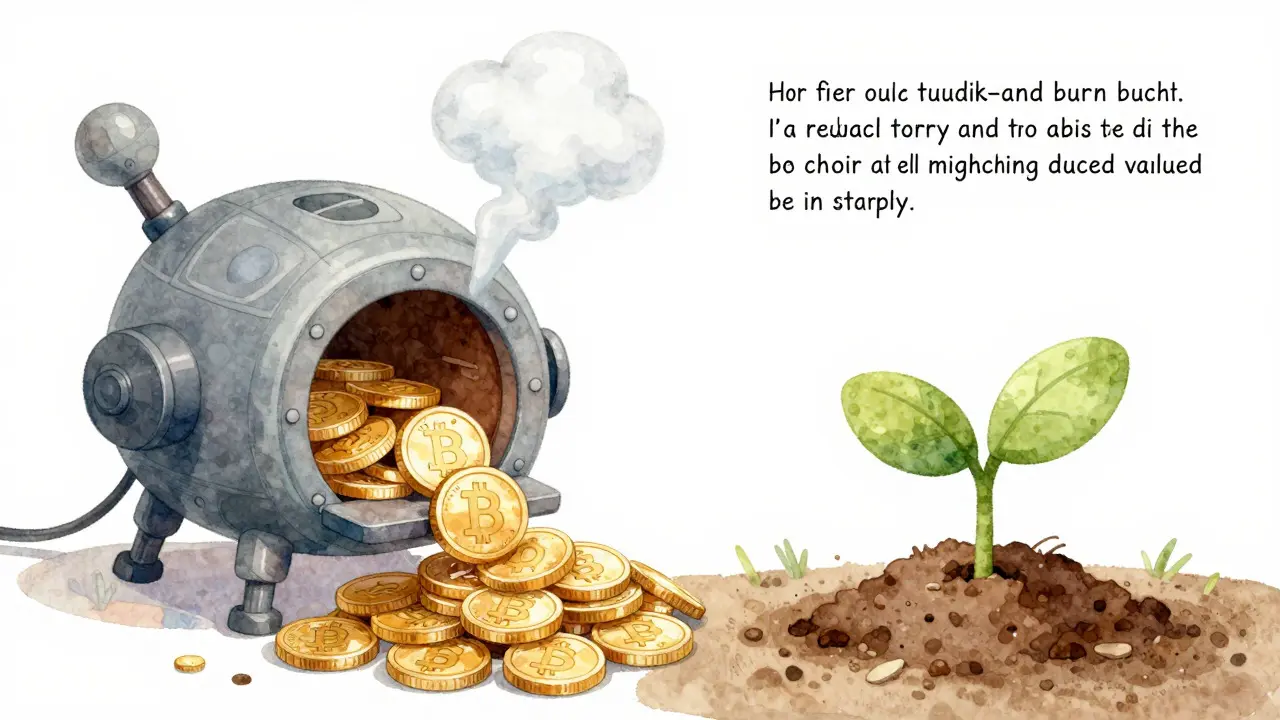
Discounts save you money today, but fee sharing promises you value tomorrow. This is where protocols take a cut of their revenue and use it to support the token price. The most common method is the "buyback-and-burn" model.
Here is how it flows: The protocol collects fees from transactions. Instead of keeping all that money in the bank, they allocate a fixed percentage to buy back their own tokens from the open market. Once bought, those tokens are sent to a "burn address," effectively destroying them forever. This reduces the circulating supply. Basic economics tells us that if demand stays steady while supply drops, the price per unit goes up.
Look at the history of major exchange tokens. Binance Coin (BNB) committed early on to using 20% of quarterly profits to buy back and burn BNB until 50% of the total supply was destroyed. FTX Token (FTT) pledged to use one-third (33.33%) of all fees for repurchases. Bitfinex’s LEO token aims to purchase and destroy 100% of its initial supply over time.
These aren't just marketing stunts; they are hard-coded or legally binding commitments that tie the token's scarcity directly to the platform's success. If the exchange makes more money, they buy more tokens. If they buy more tokens, the supply shrinks. This creates a feedback loop where user activity fuels token deflation.
Real-World Evidence: Does It Work?
Skeptics might argue that these mechanisms are just tricks to prop up prices. However, empirical data suggests otherwise. A 2026 study published in Frontiers in Blockchain analyzed Ethereum tokenomics and found a positive, statistically significant relationship between ETH price and transaction fees (correlation coefficient ρ = 0.268, p < 0.05). This supports the "Network Utility Valuation" concept: when people actually use the network, fees go up, and the token price tends to follow.
This indicates that fee-driven demand is measurable. It’s not magic. It’s a reflection of real usage. When a protocol has genuine utility-whether it’s gas payments for computation or discounts for trading-the demand for the token becomes organic rather than purely speculative.
Risks and Pitfalls to Watch For
Not all tokenomics designs are created equal. There are traps here. The biggest risk is "farm-and-dump" behavior. If a project offers massive discounts or rewards without requiring long-term commitment, users will grab the benefits and sell immediately. To combat this, good designs include vesting schedules and contribution-based rewards.
Another pitfall is over-deflation. If a protocol burns too many tokens too quickly, liquidity can dry up. You might have a rare token, but if no one can easily buy or sell it, the price becomes volatile and unstable. Experts recommend balancing aggressive burns with sufficient circulating supply to maintain healthy markets.
Also, beware of tokens where the discount is tiny compared to the token's volatility. If a token swings 20% in a day, a 5% trading fee discount is meaningless noise. The math has to make sense for the user.
How to Evaluate a Token’s Demand Drivers
So, how do you tell if a token has strong demand drivers? Ask these questions:
- Is the utility real? Do you need the token to use the core product, or is it just a bonus?
- Are the numbers transparent? Can you see exactly what percentage of fees goes to burns or treasury? Look for clear allocations like "40% of fees to buy-and-burn."
- Does the discount make economic sense? Calculate the breakeven point. How much do you need to trade to justify buying the token?
- Is the supply schedule honest? Check the vesting periods. Are insiders dumping on retail investors, or is everyone aligned for the long term?
By focusing on these fundamentals, you move beyond the noise of social media hype and start looking at crypto like a serious economic instrument.
What are the three main demand drivers in tokenomics?
The three main demand drivers are access rights (using tokens to unlock features), discounts (reducing fees by holding or spending tokens), and fee sharing (protocols using revenue to buy back and burn tokens).
How do fee discounts create demand for a token?
Fee discounts create demand by offering tangible financial benefits. Active traders buy and hold tokens to reduce their transaction costs, creating a steady stream of non-speculative buyers who need the token to operate efficiently.
What is a buyback-and-burn mechanism?
A buyback-and-burn mechanism is when a protocol uses a portion of its revenue to purchase its own tokens from the market and then destroys them. This reduces the total circulating supply, which can increase the value of remaining tokens if demand holds steady.
Why are access rights important in token design?
Access rights ensure that the token is necessary to use the platform’s core features. This prevents the token from being purely speculative and ties its value directly to the utility and popularity of the underlying service.
Can fee-sharing models fail?
Yes, they can fail if the protocol doesn't generate enough revenue to fund buybacks, or if the burn rate is too aggressive, leading to liquidity issues. Additionally, if the discount offered isn't significant enough compared to the token's volatility, users may ignore the incentive.