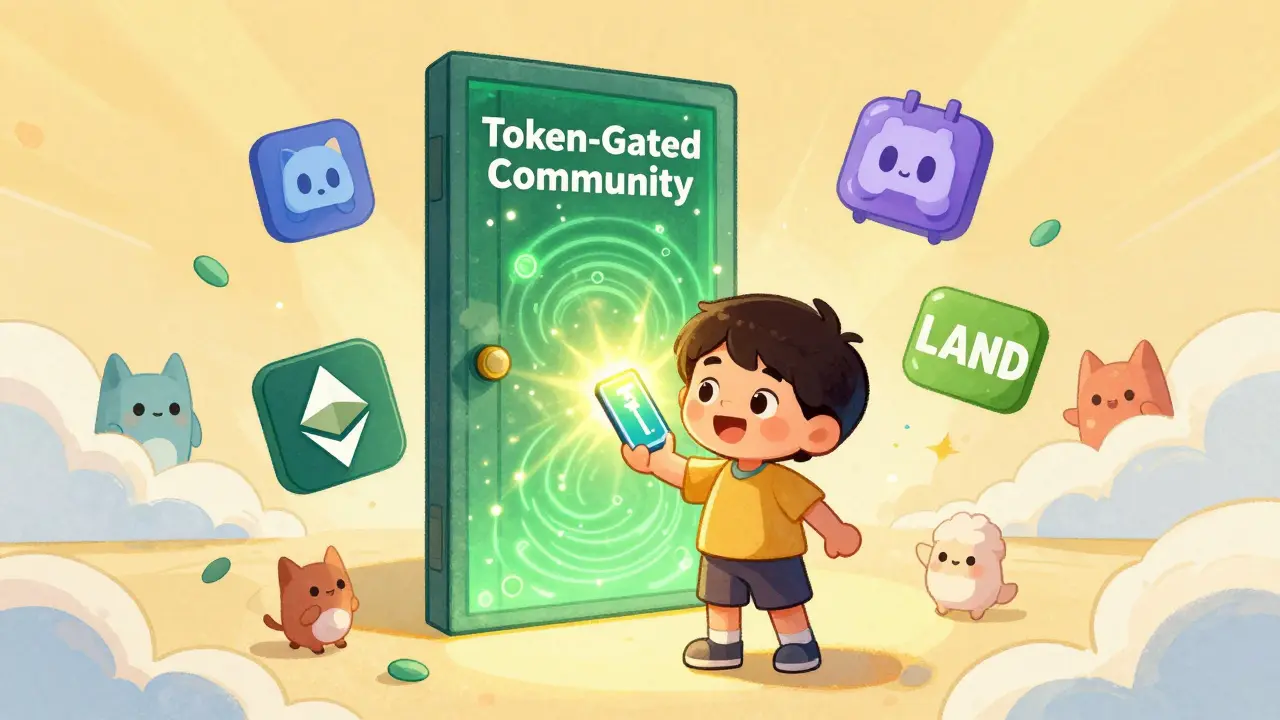
What Exactly Is Token Gating?
Token gating is how Web3 communities decide who gets in. It’s not about passwords or emails. It’s about what’s in your crypto wallet. If you own a specific NFT or token-like a Bored Ape, a FWB token, or a Decentraland LAND-you automatically get access to private Discord channels, exclusive events, members-only content, or even virtual real estate. No sign-ups. No waiting for approval. The blockchain checks your wallet, and if you meet the requirement, you’re in. It’s like a digital VIP pass that can’t be faked.
Unlike traditional membership systems where you pay a monthly fee and get a username, token gating ties access directly to ownership. You don’t just pay for access-you own a piece of it. And because it’s on the blockchain, that ownership is permanent, transferable, and verifiable anywhere. If you sell your NFT, you lose access. If someone else buys it, they gain it. No middleman needed.
How It Works Behind the Scenes
When you join a token-gated community, you connect your wallet-usually MetaMask, Phantom, or WalletConnect-to a platform like Collab.Land or Formo.so. The system doesn’t ask for your name, email, or ID. Instead, it asks your wallet to sign a quick message. That signature proves you control the wallet. Then, a smart contract checks if you hold the required tokens.
There are two main ways this works. The first is balance-based: you need at least one Bored Ape, or 100 FWB tokens. The second is attribute-based: you need an NFT with a specific trait, like "Background: Gold" or "Level: 5." Some communities even combine both. For example, you might need to own a token AND have participated in at least five community calls in the last month.
Verification happens in under two seconds on Layer 2 chains like Polygon, and under five seconds on Ethereum. No personal data is stored. No database to hack. The only thing that matters is what’s in your wallet. That’s why fraud rates are below 0.02%-way lower than traditional login systems.
Why People Love It (And Why Some Hate It)
People who’ve been in token-gated communities say the energy is different. Engagement is 73% higher than in regular Discord servers, according to Formo.so’s 2025 study. Why? Because you’re not just a member-you’re a stakeholder. If your NFT goes up in value, your access becomes more valuable too. That creates real incentive to show up, contribute, and help the community grow.
Take Friends With Benefits (FWB). With over 10,000 members as of late 2025, it’s one of the largest token-gated communities. Members don’t just chat-they fund projects together. One member told Reddit how a casual conversation in a token-gated channel led to $250,000 in funding for a new NFT art tool. That doesn’t happen in a regular Facebook group.
But it’s not perfect. A third of users report frustration. Wallet connections fail. Mobile apps glitch. Setup takes 18 minutes on average. And if your NFT drops 50% in value, you might lose access to something you paid for. One Trustpilot review from November 2025 said: "Paid 0.5 ETH for access to what turned out to be a poorly moderated Discord channel. Token gating doesn’t guarantee quality."
Token Gating vs. Traditional Memberships
Traditional memberships are locked in. You pay $20 a month for a course, and you get access until you cancel. That’s it. No resale value. No interoperability. No way to prove you’re part of the group outside that one platform.
Token-gated access is different. Your NFT is portable. You can use it across multiple platforms. MANA tokens from Decentraland work in 17 other metaverse spaces thanks to partnerships. Your Bored Ape isn’t just a profile pic-it’s a key to events, merchandise drops, and even real-world parties.
Updates are instant too. A community can change perks via smart contract in under three seconds. A traditional company? It takes days to update a database. And if you sell your token, the new owner inherits your access. That’s something no gym membership or SaaS subscription can do.
But here’s the catch: token gating only works if people understand crypto. Only 12% of Fortune 500 companies use it. Most users are under 45 and already own crypto. For the average person, connecting a wallet feels like installing a new operating system.
The Dark Side: Exclusion and Wealth Bias
Token gating sounds fair-own it, get in. But what if owning it costs $10,000? That’s not inclusion. That’s exclusion.
MIT’s Dr. Marcus Wong pointed out in a 2025 paper that communities relying only on token ownership often become rich-kid clubs. When Bored Apes hit 42 ETH, engagement dropped 40%. Why? Because the people who could afford the NFTs weren’t the ones contributing ideas-they were just holding for profit.
That’s why the smartest communities now mix ownership with participation. Formo.so’s 2026 update added reputation scores. You need the token AND a history of helping others. You can’t just buy your way in. You have to earn your place.
Decentraland’s LAND system is a good example. Owning land gives you access-but only if you actually build something on it. Owners spend 3.7 times more time in-platform than non-owners. The system rewards creation, not just cash.

Who’s Building This Stuff?
Collab.Land is still the leader. It powers 45% of all Discord-based token-gated communities, supports 40+ blockchains, and works with 30+ wallets. Their platform is simple: connect, verify, gain access. Developers love it. Their documentation scores 4.6 out of 5.
Formo.so is catching up fast. They added reputation-based access and dynamic gating-where permissions change if the token price drops or spikes. Venly.io is pushing "Dynamic Token Gating" that adjusts access based on real-time market data. And Thirdweb offers open-source tools that let developers set up token gating in under a week.
But not all platforms are equal. Some have poor mobile support. Others don’t re-verify after token transfers. That’s why 63% of failed implementations happen: the system checks your wallet once, then forgets to check again. If you sell your NFT and buy a new one, you shouldn’t still have access. But many systems don’t catch that.
Is This the Future-or Just a Fad?
Gartner says token gating is on the "Slope of Enlightenment." That means people are starting to use it wisely, not just because it’s trendy. Forrester warns it won’t go mainstream until it’s easier for non-crypto users. And the SEC is watching. If a token gives you profit-sharing rights, it might be classified as a security.
But the future is in standards like ERC-6551. This new protocol lets NFTs act like their own wallets. Imagine your Bored Ape NFT holding your access tokens, your reputation score, and even your digital ID. No more juggling multiple wallets. The NFT becomes your identity.
Project Galaxy and ENS are already testing this. ENS domains (.eth addresses) linked to token-gated access grew 22% month-over-month in late 2025. That’s a sign people are starting to treat their blockchain identity as real.
Token gating isn’t about replacing passwords. It’s about replacing bureaucracy. It’s about letting communities run themselves-with rules written in code, not in HR handbooks. The tech works. The question is: who gets to use it, and why?
Should You Join a Token-Gated Community?
If you’re already into crypto, yes. But don’t buy an NFT just for access. Look at what the community actually does. Are people building things? Are they sharing value? Or is it just a place where people talk about price charts?
Start small. Join a community with low entry cost-maybe a 0.01 ETH token. See how the conversations go. Test the wallet connection. Check if the moderators are active. If it feels alive, stay. If it feels like a ghost town, leave.
And if you’re a creator? Don’t just slap a token on your Discord and call it a community. Build real value. Offer exclusive content. Host live events. Let members vote on what happens next. Token gating isn’t a magic button. It’s a tool. Use it well, and you’ll build something that lasts. Use it poorly, and you’ll end up with a $10,000 club that no one wants to be part of.