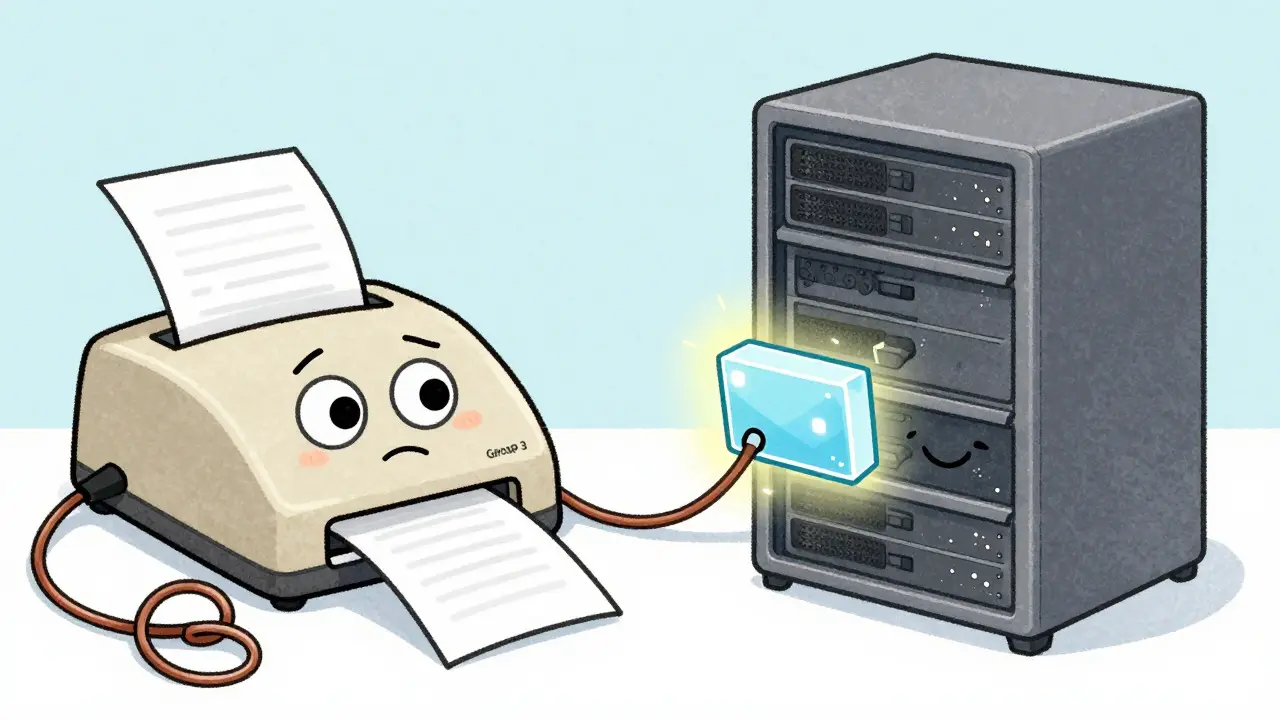
Picture this: you send a critical contract via fax to a client across the country. You hear the modem screech, wait for the confirmation page, and... silence. Or worse, a garbled mess of black lines and static. For years, moving legacy Group 3 fax machines is traditional analog devices that transmit documents over standard telephone lines using specific acoustic tones onto modern digital networks was a nightmare. The old Public Switched Telephone Network (PSTN) treated every call like a dedicated copper wire, but Voice over IP (VoIP) chops audio into tiny packets, compresses them, and sends them over the internet. Those two worlds do not mix well.
This is where the T.38 protocol is an ITU-T standard designed to enable real-time fax transmission over IP networks by demodulating analog signals into data packets steps in. It is not just a patch; it is the industry-standard bridge that allows faxes to survive the chaotic environment of the internet without turning into unreadable noise. If you are managing a business phone system or dealing with VoIP infrastructure, understanding T.38 is the difference between reliable document exchange and constant troubleshooting calls.
What Exactly Is the T.38 Protocol?
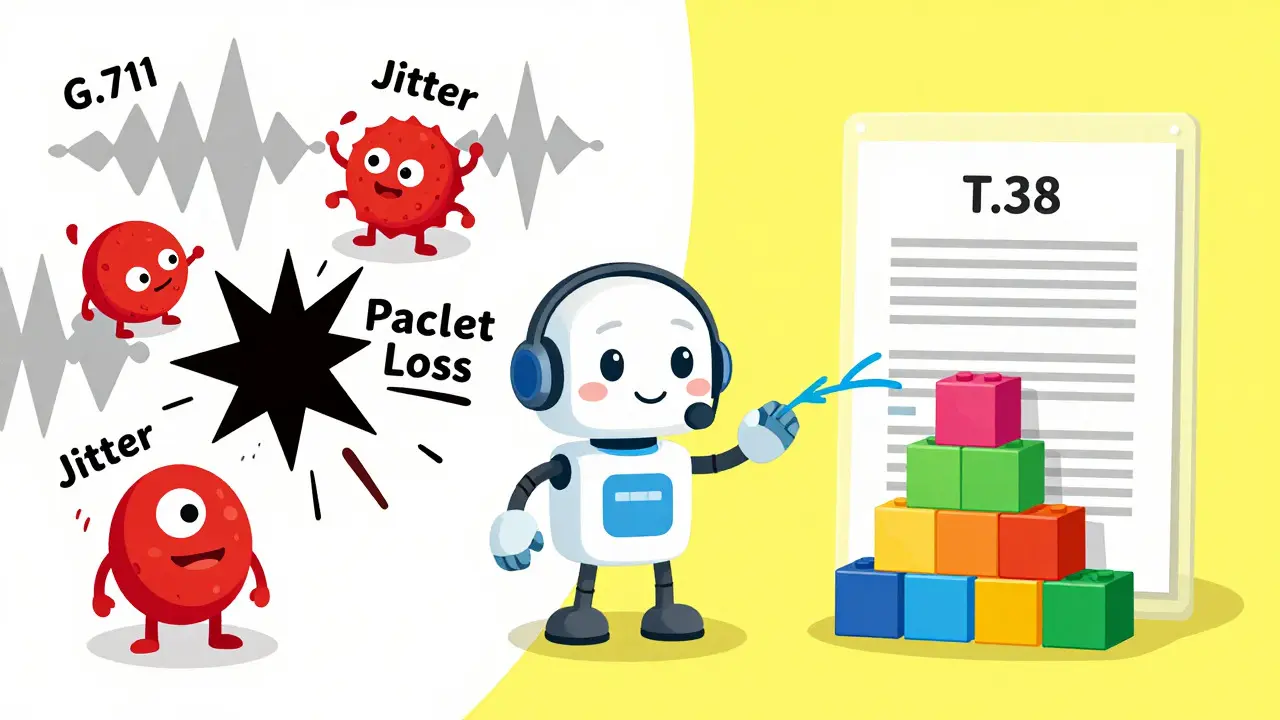
At its core, T.38 is a set of rules defined by the International Telecommunication Union (ITU-T). Its formal title is "Procedures for real-time Group 3 facsimile communication over IP networks." The first version hit the scene in June 1998, right when VoIP started gaining traction. Engineers realized quickly that sending fax tones through voice codecs caused massive failures due to jitter, packet loss, and compression artifacts.
The current active standard is T.38 (11/2015), which consolidates years of updates and fixes. Its job is simple but critical: it acts as a translator. Instead of trying to force analog fax sounds through a digital voice pipe, T.38 strips the sound away entirely. It converts the fax signal into raw data, sends that data across the IP network, and rebuilds the sound on the other end. This process is known as Fax Relay is a method where gateways convert analog fax signals into digital data packets for transport over IP networks before converting them back to analog at the destination.
Think of it like mailing a letter versus recording yourself reading the letter over the phone. G.711 pass-through is the latter-you are sending the voice of the fax machine. T.38 is the former-you are sending the actual text and image data directly. When the receiving gateway gets the data, it generates the exact tones your fax machine expects to hear. Your physical fax machine never knows it traveled over the internet.
How T.38 Works Under the Hood
To understand why T.38 is so effective, you need to look at the handshake process. A typical T.38 session follows a precise sequence involving signaling protocols like SIP (Session Initiation Protocol) or H.323.
- Initial Call Setup: The call starts as a standard VoIP voice call. Both endpoints use a high-quality audio codec, usually G.711 is a standard uncompressed PCM audio codec used in telephony that provides clear voice quality but consumes significant bandwidth, to ensure compatibility.
- Tone Detection: The gateway listens for specific fax tones, such as CED (Called Station Identification) or CNG (Calling Tone). These are the acoustic handshakes that tell the network, "Hey, we are about to send a fax, not talk."
- SIP Re-INVITE: Once the tone is detected, the sending gateway issues a SIP re-INVITE message. This tells the receiving side, "Let's switch media types from audio to T.38 data."
- Negotiation: The receiver responds. If it supports T.38, it accepts the change. If not, it might send a 488 "Not Acceptable Here" response, forcing the call to fall back to G.711 passthrough.
- Data Transmission: With T.38 active, the analog V.21, V.27ter, V.29, or V.17 modem signals are demodulated into T.38 Internet Facsimile Protocol (IFP) frames. These frames travel over TCP or UDP.
The magic happens in step five. Because T.38 carries data rather than audio, it can implement error control mechanisms that audio streams cannot handle. It uses Forward Error Correction (FEC) or packet redundancy to ensure that if a few packets get lost in transit, the fax image remains intact.
T.38 vs. G.711 Passthrough: The Real Battle
You will often hear administrators debate whether to use T.38 or just stick with G.711 passthrough. G.711 passthrough treats the fax exactly like a voice call. It records the screeching modem noises, puts them into RTP packets, and sends them along. It works-sometimes. But it is incredibly fragile.
| Feature | T.38 Fax Relay | G.711 Passthrough |
|---|---|---|
| Reliability | High (>98% success rate in lab tests) | Low (fails easily with packet loss/jitter) |
| Bandwidth Usage | Low (~12-16 kbps average) | High (constant 64 kbps) |
| Jitter Tolerance | Excellent (handles up to 500ms delay) | Poor (requires near-zero jitter) |
| Packet Loss Handling | Robust (uses FEC/redundancy) | Brittle (lost packets = corrupted pages) |
| Codec Sensitivity | Immune (data-based) | High (compression destroys fax tones) |
| Complexity | Moderate (requires negotiation) | Low (simple audio stream) |
Why does G.711 fail? Because VoIP networks are optimized for human speech. Features like echo cancellation, silence suppression (Voice Activity Detection), and aggressive compression algorithms view fax tones as noise or silence and strip them out. A Dialogic white paper highlights that T.38 can achieve success rates upwards of 98% even with 4% packet loss and 500ms one-way delay. In contrast, G.711 fails frequently under these same conditions. If your fax consistently fails on page 2 or triggers repeated retrains, you are likely stuck on a brittle G.711 path.
Configuration Best Practices for Success
Even the best protocol will fail if configured poorly. Implementing T.38 requires discipline. Here is what you need to check on your PBX, SBC, or gateway to ensure smooth operations.
- Disable Silence Suppression: This is non-negotiable. If your system thinks the fax tones are silence and stops sending packets, the connection drops. Turn off Voice Activity Detection (VAD) on all fax trunks.
- Manage Echo Cancellation: Echo cancellers can distort fax signals. Configure your equipment to automatically disable echo cancellation when fax tones are detected.
- Set MaxDatagram Size: Fragmentation kills T.38. Bandwidth recommends setting the MaxDatagram size to 176 bytes in SIP trunks to avoid fragmentation issues, especially on paths with smaller MTUs.
- Enable Redundancy: In lossy environments (like cellular backhauls or congested public internet links), enable T.38 redundancy. Levels 1 to 3 add duplicate packets to mask losses. Start with level 1 and increase only if needed to balance latency and reliability.
- Lock Baud Rates: While T.38 supports high-speed modulations like V.17 (14,400 bps), marginal networks may struggle. Lowering the maximum baud rate on the fax machine or ATA can improve stability on DSL or cable connections.
- Force T.38 Where Possible: Use configuration commands like `fax protocol t38 nse force` (on Cisco IOS) to prioritize T.38 negotiation. Only allow fallback to G.711 if absolutely necessary.

When Should You Use T.38?
T.38 is the gold standard for real-time Fax over IP. You should use it whenever you have analog fax machines, multifunction printers (MFPs), or IP-PBXs connected to a VoIP network. It is particularly vital for industries with strict regulatory requirements for fax transmission, such as healthcare (HIPAA compliance) and legal sectors, where proof of delivery and document integrity are paramount.
However, there is an alternative: T.37 protocol is a store-and-forward fax standard that transmits faxes as email attachments via SMTP, eliminating real-time timing constraints. T.37 sends faxes as email attachments. It is highly reliable because it doesn't care about real-time jitter or packet loss. But it lacks the interactive nature of traditional faxing. If you need immediate confirmation, interactive negotiation, or compatibility with legacy terminals that expect a ringing phone, T.38 is your only choice.
In 2026, with cloud communications becoming ubiquitous, T.38 support is expected from major providers like Twilio, Bandwidth, and Vonage. If a provider claims they support fax but relies solely on G.711 passthrough without T.38 options, treat their service with caution. They are selling you a workaround, not a solution.
Troubleshooting Common T.38 Issues
Despite its robustness, T.38 deployments can encounter hiccups. Here is how to diagnose common problems.
Issue: Fax fails immediately with "No Answer" or busy signal.
Cause: The SIP re-INVITE is being rejected. The far-end gateway does not support T.38 or has it disabled.
Fix: Check the SDP offer/answer logs. Ensure both sides advertise `image/t38` as a supported media type. If the remote side rejects it, configure your local gateway to fall back to G.711 gracefully, but investigate why T.38 isn't enabled on the trunk.
Issue: Fax completes but pages are blank or garbled.
Cause: Packet loss or excessive jitter corrupting the data stream, or incorrect redundancy settings.
Fix: Increase T.38 redundancy levels. Check your network path for congestion. Ensure QoS policies prioritize fax traffic (DSCP EF or CS4).
Issue: Handshake stalls after initial tones.
Cause: Echo cancellation or silence suppression interfering with the negotiation phase.
Fix: Disable VAD and EC on the specific dial-peer or trunk handling the fax call. Verify that the jitter buffer is fixed and large enough to absorb network variance.
T.38 is not going anywhere. As long as businesses rely on fax for legal and operational reasons, this protocol will remain the backbone of reliable FoIP. By understanding how it works and configuring it correctly, you eliminate the guesswork and ensure your documents arrive exactly as intended.
Is T.38 better than G.711 for faxing over VoIP?
Yes, T.38 is significantly more reliable than G.711 passthrough. T.38 converts fax signals into data packets, making them immune to voice codec compression and allowing for error correction. G.711 sends fax tones as audio, which is easily distorted by jitter, packet loss, and silence suppression, leading to frequent failures.
What is the difference between T.38 and T.37?
T.38 is a real-time protocol that mimics traditional fax behavior over IP networks, requiring simultaneous connection between sender and receiver. T.37 is a store-and-forward protocol that sends faxes as email attachments via SMTP. T.38 is used for interactive faxing with legacy machines, while T.37 is used for asynchronous, email-like fax transmission.
Do I need to disable silence suppression for T.38?
Yes. Silence suppression (Voice Activity Detection) should be disabled on all trunks and channels carrying fax traffic. If the system interprets fax tones as silence and stops transmitting packets, the fax handshake will fail or the connection will drop.
How does T.38 handle packet loss?
T.38 handles packet loss through Forward Error Correction (FEC) and packet redundancy. It can send duplicate packets or parity information, allowing the receiving gateway to reconstruct missing data without interrupting the fax session. This makes it far more resilient than audio-based methods.
Can T.38 work over both TCP and UDP?
Yes, the T.38 specification supports both TCP and UDP transport layers. UDP is commonly used with built-in redundancy for real-time performance, while TCP provides inherent reliability but may introduce higher latency. The choice depends on the network environment and gateway implementation.