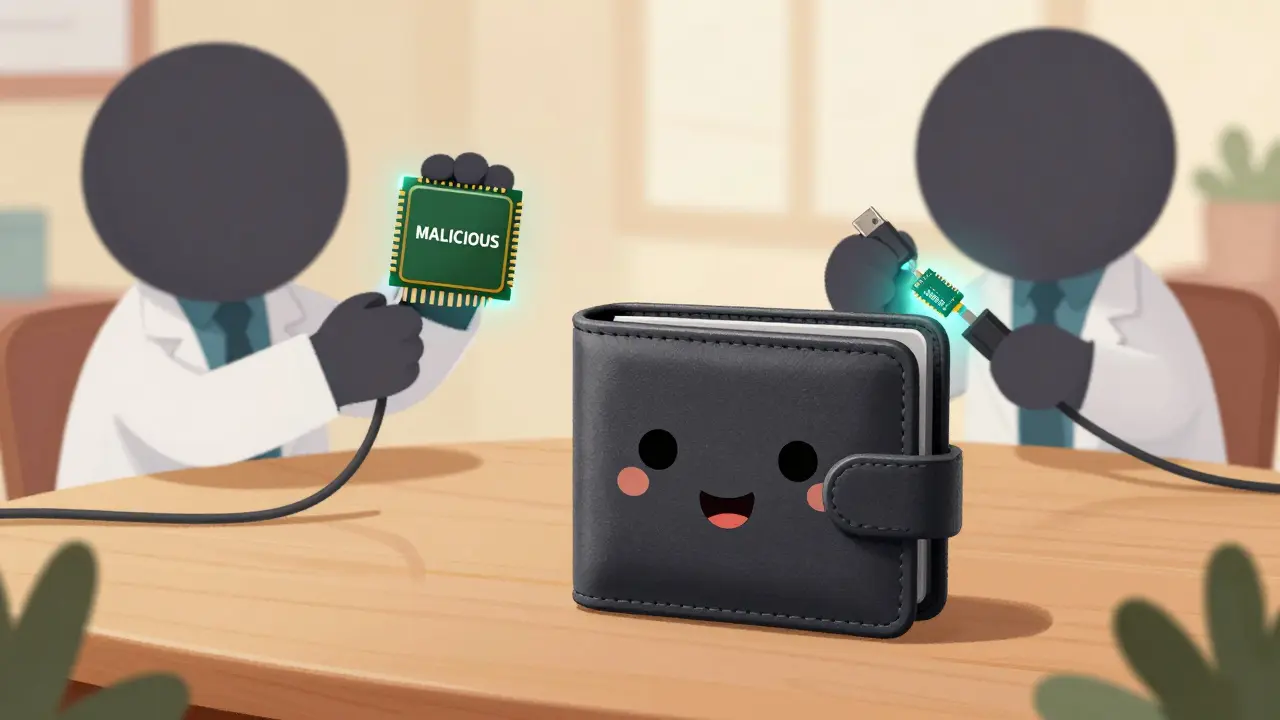
When you buy a hardware wallet like a Trezor or Ledger, you assume it’s secure. You trust that the device you unbox came straight from the manufacturer, with clean firmware, untouched components, and no hidden backdoors. But what if that trust is broken before you even received the device? Supply chain risks in crypto hardware and firmware are not theoretical. They’re happening right now - and they’re harder to detect than any software hack.
How Attackers Get Into Your Wallet Before You Do
Most people think of hacking as someone breaking into your computer remotely. But in crypto, the real danger often starts much earlier - in a factory in Vietnam, a shipping container in Rotterdam, or a warehouse in Texas. Attackers don’t need to break into your home network. They just need to slip malware into the firmware during manufacturing or swap out a chip before it ships.
Here’s how it works: A hardware wallet uses a microcontroller - usually a customized chip like the TRZ32F429 in Trezor Safe 3 and 5 - to generate and store your private keys. If that chip is replaced with a counterfeit version, or if the firmware is preloaded with malicious code, every transaction you make could be silently monitored. The attacker doesn’t need to touch your device again. They already own it.
These aren’t sci-fi scenarios. In 2023, Ledger had a breach where malicious code was pushed through an npm package used by their developers. The result? $600,000 stolen from users who thought their wallets were safe. The code didn’t come from a hacker breaking in - it came from inside their own build pipeline.
Counterfeit Hardware Is Everywhere
The global chip shortage has made counterfeit hardware easier to sell - and harder to spot. Companies that need GPUs for AI servers, network switches for data centers, or even crypto mining rigs are desperate. They turn to gray market suppliers. And those suppliers? They’re selling re-labeled old hardware, cloned chips, or devices with firmware that was never updated since 2018.
Imagine buying what looks like a brand-new router. You plug it in. Everything works. But behind the scenes, it’s running firmware with hardcoded admin credentials. It logs every packet that passes through. It sends copies of your wallet recovery phrases to a server in Russia. And because it’s hardware-level, your firewall, antivirus, and endpoint detection tools? They can’t see it. They only check software. This device is invisible to them.
According to HP Wolf Security’s 2025 report, 63% of IT professionals believe the next major nation-state cyberattack will start with a compromised hardware supply chain. That’s not paranoia. That’s experience.
Why Voltage Glitching and Firmware Tampering Are So Dangerous
Some attacks don’t even require physical access after delivery. Voltage glitching is one of them. Researchers found that the TRZ32F429 chip used in Trezor devices can be tricked into skipping security checks by briefly dropping the voltage during a critical operation. This causes the device to execute unintended code - code that could be preloaded by an attacker during manufacturing.
It’s like slipping a fake key into a lock so it turns just enough to unlock, but only when you’re not looking. The device still shows “Secure Boot Enabled.” The screen says “Firmware Verified.” But underneath? It’s already compromised.
This isn’t just about wallets. It’s about any device that stores secrets: enterprise-grade USB security keys, smart cards for two-factor authentication, even industrial controllers that manage crypto mining farms. If the firmware isn’t signed and verified at the hardware level, it’s just a time bomb.

Who’s Behind These Attacks?
It’s not just random hackers. Nation-states have been investing in hardware-level espionage for years. The U.S. government’s NDAA Section 889 bans federal agencies from using equipment from certain Chinese manufacturers like Huawei and ZTE - not because they’re evil, but because they can’t be trusted to resist pressure to build backdoors.
Similarly, the EU’s Cyber Resilience Act (effective 2026) now requires all hardware sold in Europe to have tamper-proof firmware signing and mandatory vulnerability disclosure. China, Russia, and North Korea have all been linked to supply chain operations targeting crypto infrastructure. The goal? Long-term, undetected access to private keys.
Even if you’re not a government target, you’re still at risk. Criminal groups are now selling pre-infected hardware wallets on dark web marketplaces. You think you’re buying a new Ledger Nano X. You’re actually buying a device that already sent its recovery phrase to a botnet operator.
How to Protect Yourself
Here’s what actually works - not just theory, but real steps you can take today:
- Buy only from official vendors - No exceptions. If a deal seems too good to be true on eBay, Amazon Marketplace, or AliExpress, it is. Counterfeit hardware is often sold as “new” or “refurbished.”
- Verify firmware signatures - Always check that your device’s firmware is cryptographically signed by the manufacturer. Most wallets now have a “Verify Firmware” option in their companion app. Use it every time you update.
- Use hardware attestation - Some enterprise-grade wallets now support platform certificates that prove the device’s identity and firmware integrity. If your wallet supports it, enable it.
- Never trust a device you didn’t unbox yourself - If you received a wallet from your employer, your custodian, or a third-party service, assume it’s compromised until proven otherwise. Demand proof of factory seal and cryptographic attestation.
- Monitor for firmware updates - A sudden firmware update after purchase? That’s a red flag. Attackers sometimes push fake updates to re-infect devices. Always check the official website before installing.
- Store recovery phrases offline - Even if your wallet is hacked, your private keys are safe if you wrote them down on paper and locked them in a safe. No digital backup should ever be tied to a device you didn’t fully control from the start.

What Companies Should Do
If you’re running a business that handles crypto assets - whether you’re a DeFi platform, a hedge fund, or a crypto exchange - your supply chain risk is even higher. Here’s what you need:
- Require cryptographic signing for all firmware - Every update, patch, or configuration change must be signed with a private key only your team controls.
- Use zero trust for hardware - Treat every device as hostile until proven otherwise. Don’t just assume it’s clean because it came from a vendor.
- Conduct third-party audits - Ask your hardware suppliers: “Where are your chips made? Who tests the firmware? Can you provide a chain of custody log?” If they can’t answer, find another supplier.
- Implement firmware integrity monitoring - Tools like Intel’s TXT or AMD’s SEV can verify that the firmware hasn’t changed since it left the factory. If your devices support them, use them.
- Train staff on supply chain risks - Employees who order hardware need to know the difference between an OEM and a gray market reseller. One mistake can compromise your entire network.
The Future Won’t Get Easier
The crypto industry is moving toward self-custody. More people are holding their own keys. That’s good. But it also means more hardware wallets are in circulation - and more targets for attackers. With AI now being used to automate firmware reverse-engineering and exploit discovery, the speed of these attacks is accelerating.
Regulations are catching up - the EU’s Cyber Resilience Act, the U.S. CISA guidelines, and NIST’s new hardware security framework are pushing manufacturers toward transparency. But until every device comes with a digital certificate you can verify yourself, you’re still playing Russian roulette with your crypto.
Don’t assume your wallet is safe. Verify it. Every time.
Can I trust a hardware wallet bought from Amazon?
Buying a hardware wallet from Amazon or eBay increases your risk significantly. Many listings are counterfeit devices with pre-installed malware. Even if the packaging looks official, the firmware may be compromised. Always purchase directly from the manufacturer’s website or an authorized reseller. Check the product page for a list of approved sellers.
How do I know if my firmware has been tampered with?
Most legitimate hardware wallets have a built-in verification tool. For example, Ledger Live and Trezor Suite can check the cryptographic signature of your firmware. If the signature doesn’t match the manufacturer’s public key, the firmware is altered. You should also compare the device’s serial number with the one listed on the official website. Any mismatch means the device was tampered with.
Are all hardware wallets vulnerable to voltage glitching?
No, but many older or low-cost models are. Voltage glitching targets chips with weak power regulation and no hardware-level protection. Devices using common microcontrollers like STM32 without secure boot or tamper detection are at higher risk. Newer wallets like Ledger Nano S Plus and Trezor Model T include hardware defenses against this attack. Always check the manufacturer’s security whitepaper for details on hardware protections.
Can software updates fix a compromised hardware wallet?
No. If the firmware was altered at the hardware level - for example, by replacing a chip or injecting malicious code into the bootloader - a software update won’t remove it. The malicious code lives in persistent memory that survives reboots and updates. The only safe solution is to stop using the device and replace it with a new one from a trusted source.
What should I do if I suspect my wallet was compromised?
Immediately move all funds to a wallet you know is secure - preferably one you’ve never used before and bought directly from the manufacturer. Do not reuse the recovery phrase from the suspected device. Then, report the issue to the manufacturer and check if others have reported similar problems. If you’re a business, notify your security team and begin a forensic audit of your hardware inventory.