
What Makes a Stablecoin Really Stable?
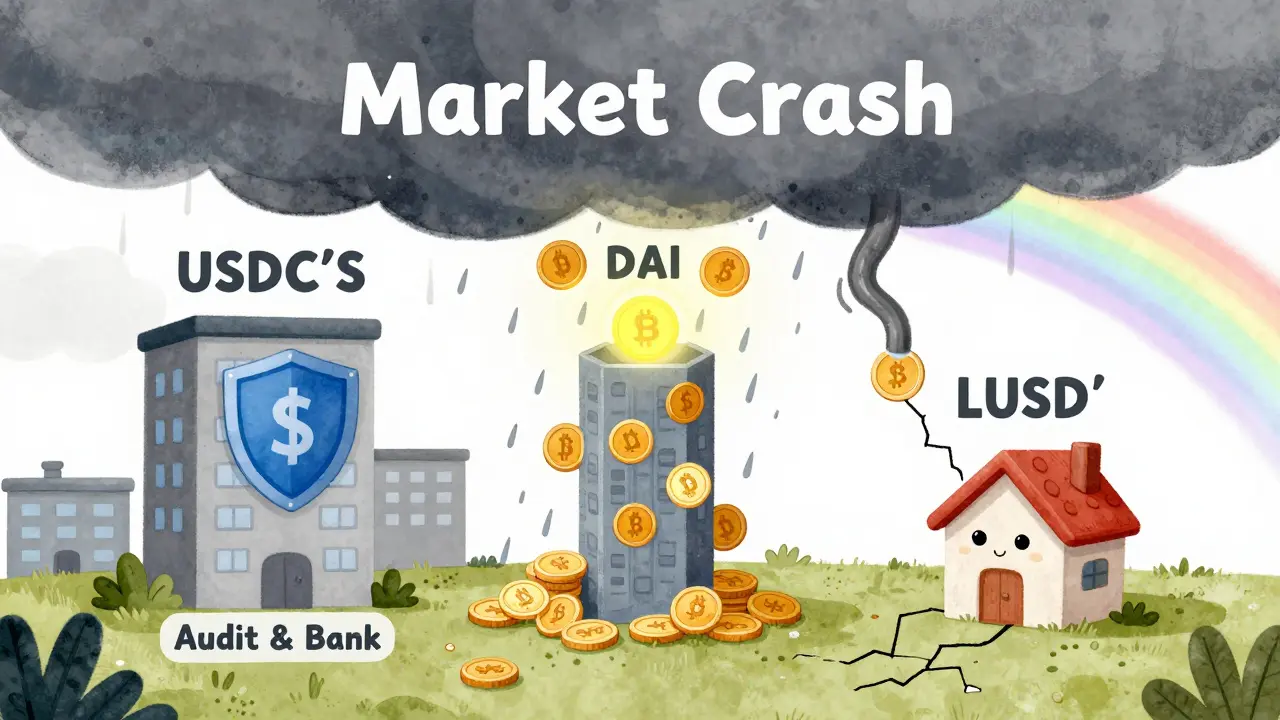
When you hear "stablecoin," you might think it’s just digital money that stays at $1. But not all stablecoins are built the same. Behind every $1 peg is a different kind of collateral-and that makes all the difference in how they behave when markets shake. DAI, USDC, and LUSD all claim to be stable, but their backing, rules, and risks are wildly different. If you’re using any of them in DeFi, you need to know which one fits your risk tolerance.
USDC: The Institutional Choice
USDC is the stablecoin banks and big companies use. It’s backed 1:1 by cash and short-term U.S. Treasury bonds, audited monthly by Grant Thornton. That’s not just marketing-it’s legal compliance. Circle, its issuer, holds reserves in Bank of New York Mellon after the Silicon Valley Bank collapse in 2023. That move was a direct response to losing $3.3 billion in SVB deposits, which briefly knocked USDC down to $0.87.
Today, USDC has a $34.7 billion market cap and handles $274 billion in quarterly transactions. It works on 12 blockchains, from Ethereum to Solana, and integrates directly into Visa’s B2B payment system. Businesses use it because it’s predictable. Settlements take 15 seconds. Fees are under $0.05. And if something goes wrong, Circle has a dedicated enterprise support team that responds in under two hours.
But here’s the trade-off: USDC isn’t decentralized. You’re trusting Circle and the U.S. financial system. If regulators decide to freeze accounts or shut down access, they can. That’s why you won’t find USDC in truly permissionless DeFi apps that refuse KYC. It’s stable, but it’s also controlled.
DAI: The Decentralized Compromise
DAI is the only stablecoin designed to survive without a central authority. It’s backed by a mix of crypto assets-ETH, wBTC-and, increasingly, real-world assets like U.S. Treasuries. As of December 2025, 42% of its collateral was in Treasuries, 35% in other stablecoins (including USDC), and 23% in crypto. That’s a major shift from its early days, when it was almost entirely crypto-backed.
This hybrid model was born out of necessity. During the March 2023 banking crisis, DAI dropped to $0.85 because over half its collateral was USDC-and USDC itself depegged. MakerDAO responded by slowly moving into real-world assets to reduce exposure to crypto volatility. Now, those Treasuries generate a 4.7% yield, which helps pay down DAI’s 0.5% stability fee.
DAI runs on 9 networks, including Ethereum and all major Layer 2s. It’s used by 78% of DeFi lending protocols because it’s censorship-resistant. No bank can freeze your DAI. But managing it isn’t easy. You need to lock up more than $1.50 in collateral to borrow $1 in DAI. If ETH crashes 30% overnight, your position can get liquidated-even if you think you’re safe. One Reddit user lost $12,000 in December 2025 because their oracle feed lagged during a flash crash.
Its governance is active: 17 proposals passed in Q4 2025 alone. But that also means DAI’s rules can change. The upcoming Endgame Plan splits governance into five subDAOs, each managing different collateral types. It’s complex, but it’s the closest thing DeFi has to a self-sustaining monetary system.
LUSD: The Minimalist Experiment
LUSD is the odd one out. It’s backed by Ethereum alone, requires only 110% collateral, and has no governance. No votes. No upgrades. No fees. That’s the pitch: pure automation. Liquity Protocol locks your ETH, lets you mint LUSD, and walks away. No team can change the rules.
That sounds ideal-until the market crashes. In May 2025, ETH dropped 35% in two days. LUSD’s collateral ratio fell below 110%. The system kicked into recovery mode. LUSD briefly depegged to $0.92. Users had to pay a 1% fee to redeem their LUSD for ETH. It wasn’t a failure-it was designed to happen-but it exposed a flaw: single-asset collateral doesn’t survive black swan events.
LUSD’s market cap is just $387 million. It trades on only two chains: Ethereum and Arbitrum. Daily volume? $12.3 million. That’s tiny compared to DAI’s $987 million and USDC’s $4.2 billion. Most users are speculators or hardcore DeFi purists. The support community is small-2,300 active Discord members-and response times average over 18 hours.
Liquity’s upcoming v2.1 update, launching March 31, 2026, will add partial stablecoin collateral. That’s a quiet admission: pure ETH backing isn’t enough. But even then, it won’t have governance. It’s still a bet on code over people.
Which One Should You Use?
Here’s how to pick:
- Use USDC if you’re a business, doing cross-border payments, or want regulatory safety. It’s the most reliable for everyday use. Just accept that you’re trusting a company and the U.S. government.
- Use DAI if you’re deep in DeFi, want to avoid KYC, and can handle the complexity. It’s the backbone of lending, borrowing, and yield farming. But monitor your collateral ratio. Set alerts. Know how liquidations work.
- Use LUSD only if you’re testing a minimal, governance-free system and can tolerate volatility. It’s not for beginners. It’s not for large sums. And it’s not a store of value-it’s a tool for specific DeFi strategies.

The Bigger Picture
The stablecoin market hit $178.4 billion in January 2026. USDC owns 76% of it. DAI has 18%. LUSD? Just 1.2%. That tells you something: the market is choosing regulation over pure decentralization.
Regulators are catching up. The EU’s MiCA law requires all stablecoins to hold 100% high-quality liquid assets by July 2026. That’s a problem for DAI, since it still holds crypto. The U.S. Payment, Stablecoin, and Digital Asset Act of 2025 forces regular audits-something USDC already does well.
Meanwhile, DAI’s pivot to real-world assets is a quiet revolution. It’s no longer a pure DeFi token. It’s becoming a bridge between crypto and traditional finance. Some call that a betrayal of DeFi’s ideals. Others say it’s the only way to survive.
Final Thoughts
There’s no "best" stablecoin. Only the right one for your use case. USDC is the safe choice. DAI is the DeFi native. LUSD is the bold experiment. Each has trade-offs in control, risk, and complexity.
Don’t just pick the one with the biggest market cap. Ask: Who holds my collateral? What happens if the market crashes? Can I trust the people behind it-or just the code?
Is USDC really safe after the SVB collapse?
Yes, but with caveats. After losing $3.3 billion in SVB deposits in March 2023, Circle moved its reserves to Bank of New York Mellon and now holds only cash and U.S. Treasuries. Monthly audits by Grant Thornton confirm this. USDC has maintained a $1 peg since then, with only 0.02% average daily volatility in 2025. But it’s still centralized-Circle can freeze funds, and regulators can restrict access. It’s safe from market crashes, not from legal action.
Why did DAI drop to $0.85 in 2023?
DAI dropped because over 50% of its collateral was USDC-and USDC itself depegged after Silicon Valley Bank failed. Since DAI is backed by other assets, when those assets lost value, DAI lost value too. MakerDAO didn’t fail; it was caught in a chain reaction. That event forced DAI to shift from crypto-heavy collateral to real-world assets like Treasuries, which now make up 42% of its backing.
Can LUSD be trusted with no governance?
It’s designed to be trusted without governance-but that’s also its weakness. No one can change the rules, which is good for censorship resistance. But when ETH crashed 35% in May 2025, LUSD depegged because its 110% collateral ratio couldn’t handle the drop. The system worked as coded-it triggered recovery mode-but users still lost money. No governance means no emergency fixes. It’s a philosophical choice, not a practical one.
Which stablecoin has the lowest risk?
According to the Blockchain Association’s December 2025 risk assessment, USDC has the lowest risk score at 1.2/10, thanks to its regulated reserves and audit transparency. DAI is medium risk (4.7/10) due to its crypto exposure and governance complexity. LUSD is elevated risk (6.3/10) because of its single-asset collateral and lack of fallbacks. Academic research from the University of Zurich confirms this: DAI’s diversified model offers 99.98% liquidation coverage; LUSD’s model only 98.7%.
Should I use DAI or USDC for DeFi lending?
Most DeFi protocols use DAI because it’s permissionless and doesn’t require KYC. But if you’re borrowing large amounts or want to avoid liquidation risk, USDC is more stable. However, many DeFi apps won’t accept USDC because it’s centralized. The trade-off is: DAI gives you freedom but demands more attention. USDC gives you safety but limits your access.
Is LUSD worth using in 2026?
Only if you’re a technical user experimenting with governance-free systems. LUSD’s liquidity is thin, its support is slow, and its collateral model is fragile. The March 2026 update will add stablecoin collateral, which helps-but it still won’t have governance. For most people, it’s too risky. For a few, it’s a fascinating test of whether code can replace institutions.