
Losing your crypto because you misplaced a seed phrase feels like watching money burn. It is a nightmare scenario that has trapped billions of dollars in digital assets. You type the wrong letters, drop the hardware device, or suffer a hard drive crash. There is no customer support line to call. That reality drives the need for better security models.
This is where social recovery wallets change the game. They move away from the single point of failure inherent in seed phrases. Instead of relying on a string of words you must hide perfectly, these wallets use a network of trusted people or devices called guardians. If you lose access, these guardians help you get back in. It turns a solitary struggle into a community-supported safety net.
What Is a Social Recovery Wallet?
Social Recovery Wallets are smart contract wallets that utilize a primary signing key for daily operations while employing a decentralized group of trusted entities called guardians to facilitate account recovery if the original access key is lost or compromised.
Traditional wallets like MetaMask rely entirely on a seed phrase. This works fine until something goes wrong. Social recovery changes the architecture. You sign everyday transactions normally, just like you expect. But the recovery mechanism lives separately within a smart contract on the blockchain. This separation means your daily usage remains fast and simple. You do not wait for five friends to sign every coffee purchase transaction.
The innovation addresses the fundamental weakness of self-custody. In standard setups, the seed phrase represents the only backup. If that fails, funds are gone forever. Vitalik Buterin, co-founder of Ethereum, has publicly identified social recovery wallets as his preferred personal cryptocurrency storage method. This endorsement signals that the technology solves a critical problem for long-term holders.
The Role of Guardians in Recovery
Guardians form the backbone of this system. Unlike the cold anonymity of a private key, guardians represent real-world trust. They can be Ethereum addresses controlled by friends, family members, institutional custodians, or even hardware wallets stored in different locations. The specific identity of these parties matters less than their reliability and diversity.
Crucially, guardians do not need to know each other. They do not need to know the balance of your wallet. They simply agree to verify that a recovery request comes from you when needed. This setup makes it incredibly difficult for attackers to succeed. To steal your funds, an attacker would need to compromise multiple guardians simultaneously rather than just stealing one password.
You might worry about asking a friend to guard your crypto. It sounds invasive. However, most implementations allow for automated flows. Your friend does not handle your assets directly. They just confirm identity requests. By 2026, wallet interfaces make this process seamless. A notification pops up on their phone. They approve. Access restores.
Understanding Threshold Calibration
Selecting your threshold settings involves balancing security with practical usability. The most common configuration is a 3-of-5 threshold. This means three out of five appointed guardians must agree to authorize a recovery. An attacker would need to hack three distinct systems to take over your account. For you, recovering a lost phone requires contacting three reliable people.
Lower thresholds offer speed but reduce security margins. A 2-of-5 setting gets you back in faster but leaves more room for error or attack. Higher thresholds like 4-of-5 boost protection but risk locking you out completely if two guardians become unreachable during an emergency. You must think about availability versus risk.
| Feature | Seed Phrase Wallet | Social Recovery Wallet |
|---|---|---|
| Recovery Method | Single secret key | Multi-party approval |
| User Experience | Simple signing | Simple signing |
| Risk of Loss | Permanent loss possible | Recoverable via guardians |
| Daily Signatures Required | One | One |
| Setup Complexity | Low | Moderate (requires selecting guardians) |
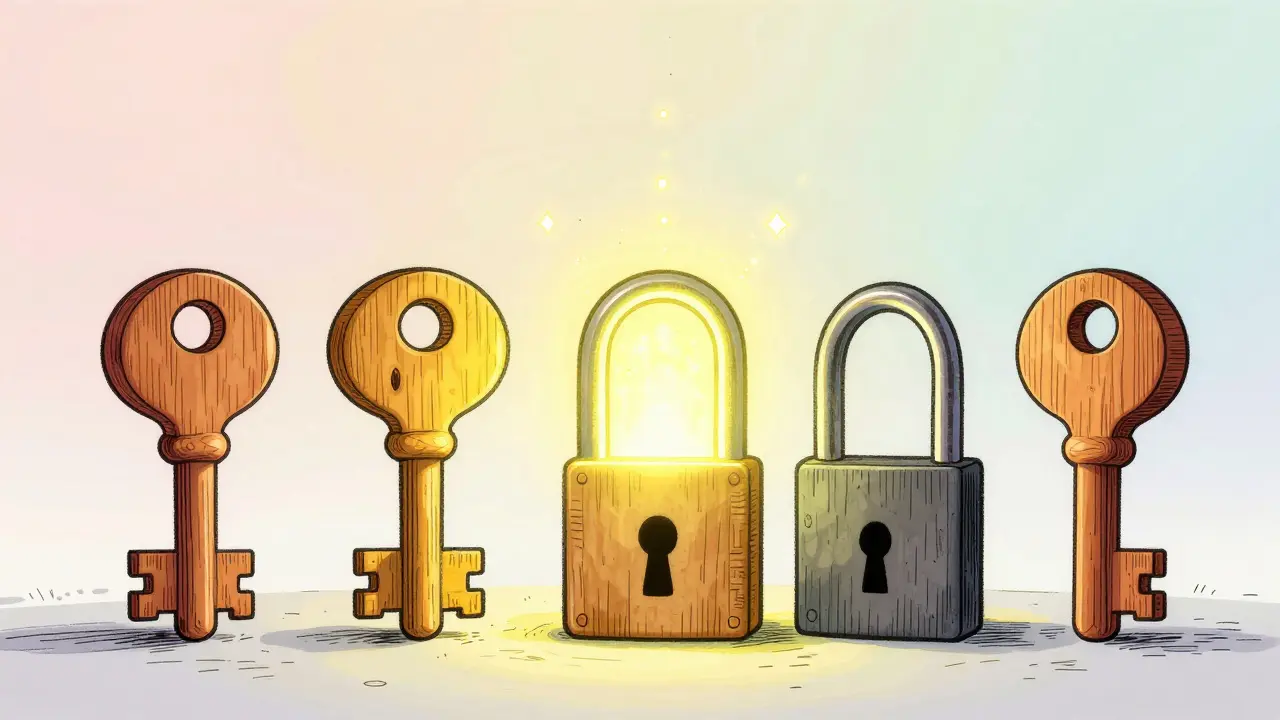
Security Layers and Time Delays
Speed is good, but security needs breathing room. Most social recovery protocols enforce time delays once a majority of guardians approve a request. With implementations like Argent, the system enforces a security delay, commonly 48 hours, before granting access to a new device. This window gives the original owner a chance to intervene.
If someone hacks your account and tries to change your keys, you still have the original key (unless lost too). You can spot the unauthorized request during those 48 hours and cancel it. Some advanced implementations extend this further through vault mechanisms. You can move assets to an automatically generated vault address instantly. Removing assets from that vault triggers a longer delay, often a week, allowing time for cancellation.
Cryptographic techniques add another layer. Shamir's Secret Sharing allows splitting your original key into fragments. Each guardian holds a share, typically represented as a sequence of English words. No individual possesses enough information to reconstruct the key alone. This ensures mathematically secure distribution of recovery power.
Privacy Concerns and Solutions
Transparency helps accountability but creates privacy risks. In straightforward implementations, the set of guardians becomes visible on-chain. Anyone can query the wallet contract. If one guardian address links to a known identity through ENS domains or past activity, your social graph exposes itself.
To mitigate this, developers use commitment hashes. You store hashed versions of guardian addresses instead of raw public keys using functions like Poseidon or SHA-256. The contract verifies the preimage matches during recovery without revealing identities beforehand. This balances the need for verification with the desire for anonymity.
Current Implementations and Standards
Different platforms build on these concepts using various tools. Safe, formerly known as Gnosis Safe, enables flexible M-of-N signing schemes. Users configure a primary signer and backup owners who assist in emergencies. Backup owners can range from relatives to institutional custodians.
Argent implements a streamlined version where users select trusted contacts. Once the majority approves, the wallet grants access. Both benefit from ERC-4337, the Ethereum Account Abstraction standard. This protocol provides the underlying infrastructure enabling these features across different chains. By March 2026, widespread adoption of ERC-4337 makes switching between compatible wallets smoother.
Frequently Asked Questions
Can guardians steal my funds directly?
No, guardians cannot access your funds directly. They only possess authority to initiate recovery processes, such as changing your signing key. They do not control the assets themselves.
How many guardians should I select?
A typical setup involves selecting 3 to 7 guardians from diverse circles. Using 3 from different backgrounds (e.g., one friend, one institution, one hardware wallet) reduces the risk of coordinated attacks.
Is social recovery compatible with DeFi?
Yes, modern social recovery wallets interact fully with DeFi protocols. ERC-4337 compatibility ensures these accounts function like standard External Owned Accounts for dApps.
What happens if I lose contact with all guardians?
Most wallets allow you to update your guardian list proactively. You should refresh your list annually. If you cannot update and lose contact, recovery becomes difficult, highlighting the importance of keeping relationships maintained.
Do I pay extra fees for recovery?
Recovery transactions require gas fees on the blockchain. These costs depend on network congestion. Daily usage fees remain standard, as recovery is an occasional event rather than a recurring subscription.
Looking Ahead
Adoption patterns show social recovery gaining traction among serious holders. The technology addresses a demonstrated market need where conventional wallets result in permanently lost cryptocurrency due to mismanagement. As we move deeper into 2026, institutional adoption expands as custodians recognize the user experience benefits.
The system creates a strong defensive layer against unauthorized access and single points of failure. It combines the ease of use you love with the redundancy of enterprise security. While no system guarantees immunity, spreading risk across trusted humans significantly lowers the probability of catastrophic loss compared to hiding a piece of paper.