
Imagine writing a hit song and waiting eighteen months to see the first dollar of streaming revenue. Now imagine getting paid within twenty-four hours, with every fraction of a cent tracked on an immutable ledger. This is the promise of smart contract royalty tracking, which uses self-executing code on a blockchain to automate payments to rights holders based on usage data. For decades, musicians have relied on opaque collection societies and label accounting systems that often lose track of small payments or delay them indefinitely. As of mid-2026, this technology has moved from theoretical whitepapers to early-stage commercial pilots, offering a tangible solution to one of the music industry’s oldest problems.
The Problem with Traditional Royalty Collection
To understand why smart contracts matter, you first need to look at how broken the current system is. When a song streams on Spotify or Apple Music, the data travels through a labyrinth of intermediaries. There are digital service providers (DSPs), performance rights organizations (PROs) like ASCAP or BMI, mechanical licensing collectives, and record labels. Each step adds latency and potential for error. A single transaction can involve more than five different entities before the money reaches the artist.
The metadata problem makes it worse. Millions of tracks lack consistent identification codes, leading to unclaimed royalties that sit in black-box accounts. If your name is misspelled in a database, or if your split sheet isn’t perfectly aligned with the publisher’s records, your share disappears into the void. The U.S. Music Modernization Act (MMA) of 2018 tried to fix some of this by creating a centralized mechanical licensing database, but it still relies on manual reconciliation and quarterly reporting cycles. For independent artists earning fractions of a cent per stream, these delays mean cash flow instability that can derail careers.
How Smart Contracts Automate Payments
Smart contracts are computer programs stored on a blockchain that automatically execute actions when predefined conditions are met. In the context of music, they act as autonomous accountants. Instead of sending invoices and waiting for checks, you encode your royalty agreement directly into code. Here is how the workflow typically functions in modern pilot systems:
- Metadata Registration: An artist uploads their track details-songwriters, producers, publishers, and ownership percentages-to a decentralized storage system like IPFS. This creates a permanent, tamper-proof record of who owns what.
- NFT Minting: The track is linked to a Non-Fungible Token (NFT) or a unique identifier on a blockchain like Ethereum or Polygon. This token represents the rights bundle and contains the smart contract logic for splits.
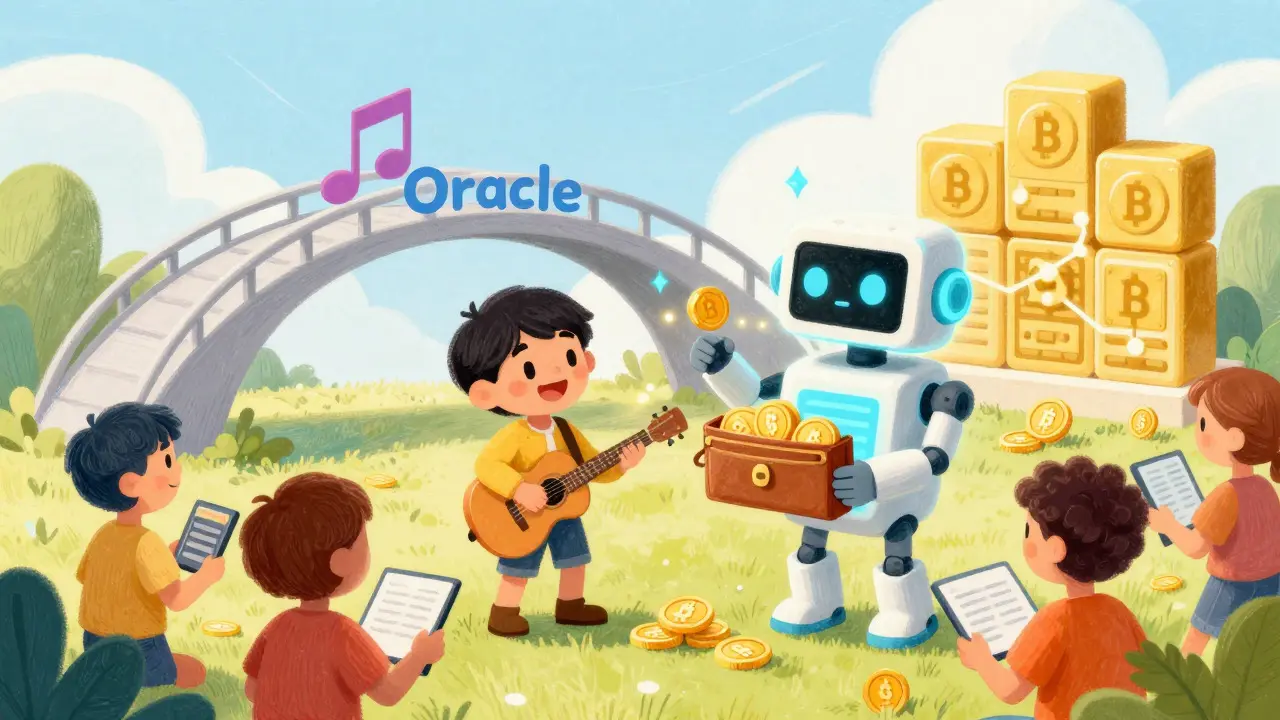
- Data Ingestion via Oracles: This is the critical bridge between the physical world and the blockchain. Oracles such as Chainlink fetch real-world data-like stream counts from a DSP-and feed it securely onto the blockchain.
- Automated Execution: Once the oracle confirms a stream occurred, the smart contract calculates each party’s share based on the pre-set percentages and instantly distributes cryptocurrency (often stablecoins like USDC) to the connected wallets.
This process eliminates the need for monthly statements or annual audits. The Universal Business Council reported in June 2026 that these systems can reduce settlement times from 12-18 months to under 24 hours. That is a thirty-fold acceleration in payment speed, turning micropayments into immediate, usable income.
Key Technologies Powering the Shift
You cannot build this system on just any platform. The architecture requires specific tools to handle security, speed, and cost. Most current implementations rely on a layered approach:
| Layer Type | Example Technology | Role in Royalty System | Key Benefit |
|---|---|---|---|
| Base Layer | Ethereum | Stores core contract logic and NFTs | High security and decentralization |
| Scaling Layer | Polygon | Handles high-volume transactions | Low gas fees and fast confirmation |
| Oracle Network | Chainlink | Feeds external stream data to contracts | Ensures data accuracy and trustlessness |
| Storage | IPFS | Hosts audio files and metadata | Decentralized and censorship-resistant |
Why use Polygon instead of Ethereum mainnet? Because gas fees on Ethereum can exceed the value of a single stream. Polygon allows for thousands of transactions per second at a fraction of a cent, making micro-payments economically viable. Meanwhile, Chainlink oracles solve the "oracle problem"-the risk that bad data enters the blockchain. Without trusted oracles, a smart contract might pay out based on fake stream counts, ruining the system’s integrity.
Real-World Use Cases and Pilots
As of 2026, we are seeing move beyond theory into practice. Platforms like Nebula allow artists to tokenize fractional royalty rights, letting fans buy shares of a song’s future earnings. This creates a new funding model where listeners become investors. If the song performs well, both the artist and the fan profit automatically via smart contracts.
In India, regional analyses highlight how smart contracts could bypass fragmented licensing environments. Independent creators there often struggle with local PROs that lack transparency. By using a blockchain-based system, they can enforce international standard splits without relying on local bureaucratic hurdles. Similarly, audiovisual sectors are testing these models for movie soundtracks, ensuring composers get paid immediately upon broadcast rather than waiting for end-of-year reports.
A 2024 study published in ScitePress detailed a nine-step workflow for an Ethereum-based royalty platform. It showed how publishers could deposit funds into an escrow contract, artists could prove ownership via hash verification, and consumers could purchase tracks while triggering instant payouts. This level of granularity was previously impossible without massive legal overhead.

Challenges and Risks to Consider
Despite the hype, smart contracts are not a magic bullet. Several significant hurdles remain before they replace traditional PROs entirely.
Legal Enforceability: Code is not law. If a smart contract pays out incorrectly due to a bug, who is liable? Current copyright laws in the U.S. and EU do not explicitly recognize on-chain settlements as final legal accounts. Artists may still need human-readable contracts to back up their digital agreements. The SSRN article "Smart Royalties" argues for a three-pillar approach: MMA-specific blockchains, smart contracts, and NFTs working together under existing statutes, not replacing them.
Data Quality: Garbage in, garbage out. If the initial metadata uploaded to the blockchain is wrong-say, listing the wrong producer-the error becomes permanent. Changing it requires complex governance mechanisms or hard forks, which are difficult to coordinate. Roskilde University researchers warn that without rigorous rights-data governance, public blockchains could lock in incorrect splits forever.
Tax and Regulatory Complexity: Receiving payments in cryptocurrency triggers tax events in many jurisdictions. For an artist in Raleigh, North Carolina, receiving USDC payments daily means dealing with capital gains calculations for every tiny transaction. Until tax software integrates seamlessly with blockchain wallets, this administrative burden could outweigh the benefits for smaller creators.
The Future of Creator Economics
We are likely looking at a hybrid future over the next decade. Traditional PROs will not disappear overnight; they hold too much historical data and legal authority. However, they will increasingly interoperate with blockchain layers. Imagine a world where ASCAP verifies identity and legal standing, while a smart contract handles the actual distribution of funds. This reduces costs and increases speed without abandoning the safety nets of established institutions.
For creators, the advice is simple: start learning now. Understand how wallets work, how to manage private keys, and how to read basic smart contract terms. The transition won't happen all at once, but those who adopt these tools early will gain a competitive edge in transparency and cash flow control. The era of waiting six months for a check is ending. The era of real-time, programmable royalties has begun.
What is a smart contract in music royalties?
A smart contract is a self-executing digital agreement stored on a blockchain. In music, it automatically calculates and distributes royalty payments to artists, producers, and publishers whenever a song is streamed or sold, eliminating manual processing delays.
How do oracles help in royalty tracking?
Oracles like Chainlink act as bridges between off-chain data sources (such as Spotify or Apple Music) and the blockchain. They verify stream counts and sales data, then feed this information to the smart contract so it can trigger accurate payments.
Are smart contract payments legally binding?
Currently, they are technically binding but legally complex. While the code executes automatically, most jurisdictions still require traditional contracts to resolve disputes. Experts recommend keeping human-readable agreements alongside smart contracts for legal protection.
Which blockchain is best for music royalties?
Polygon and Ethereum are the most common choices. Ethereum offers high security but higher fees, while Polygon provides faster transactions and lower costs, making it better suited for frequent micro-payments associated with streaming.
Can fans invest in songs using smart contracts?
Yes. Platforms like Nebula allow artists to mint NFTs representing fractional ownership of a song's royalties. Fans can buy these tokens and receive automatic proportional payments when the song generates revenue.