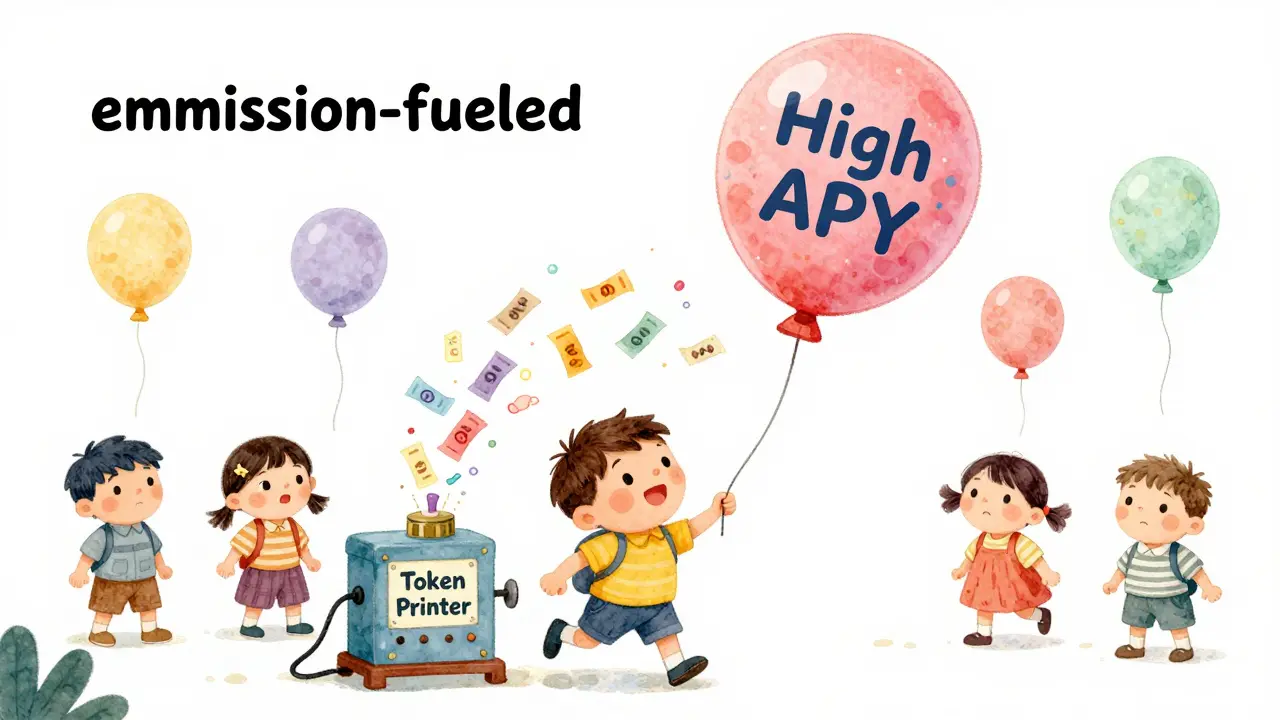
Remember the days when you could stake a governance token and watch your balance grow by 10,000% annually? Those numbers looked incredible on paper. But if you held onto those tokens for more than a few months, you likely noticed something strange: the value of your holdings didn’t actually go up. In fact, it probably went down. This was the era of "emission-fueled" yields, where protocols paid you with newly minted tokens that diluted everyone else’s share.
We have moved past that phase. The current standard in decentralized finance (DeFi) is real yield tokenomics. This model shifts the focus from printing new money to distributing actual cash flow generated by the protocol. It asks a simple but brutal question: Is this project making money, or is it just creating debt disguised as rewards?
What Is Real Yield?
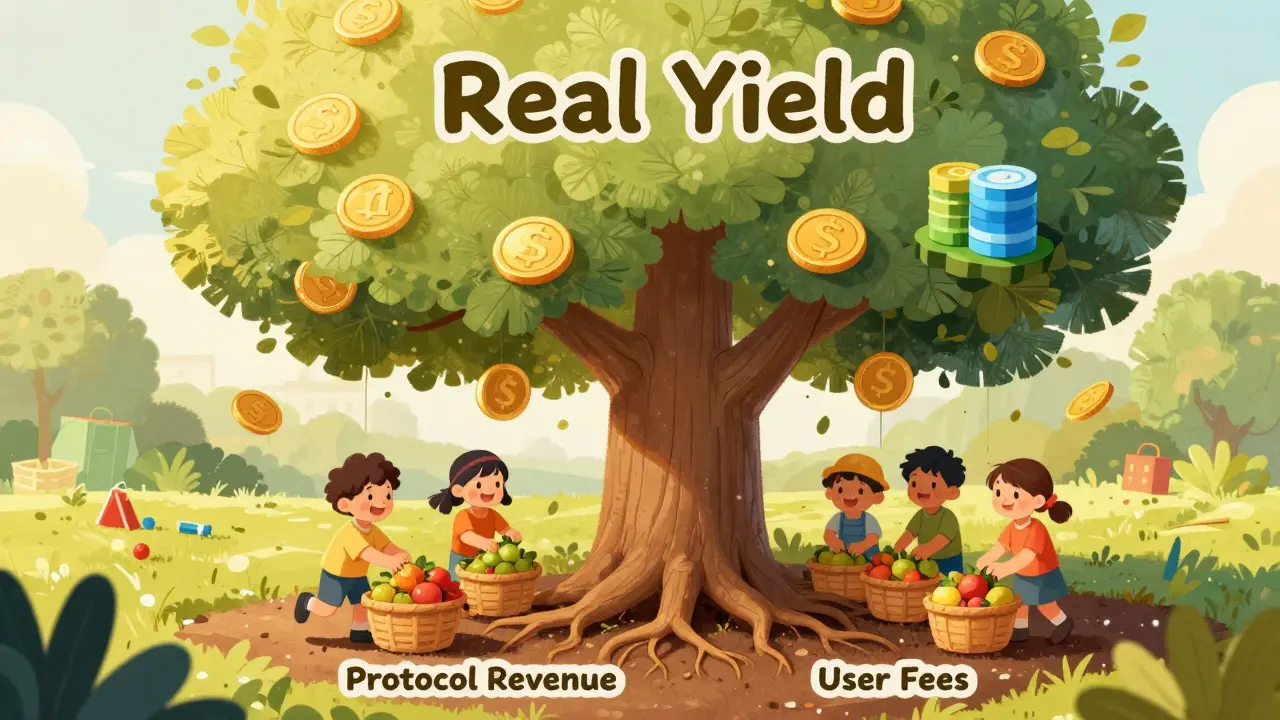
Real Yield is a DeFi design pattern where tokenholder returns are funded primarily from protocol revenue rather than inflationary token emissions. In simpler terms, it means the rewards you receive come from real economic activity-trading fees, interest payments, or borrowing costs-not from thin air.
To understand why this matters, look at how traditional businesses work. If you own stock in a company, you hope it pays dividends from its profits. If the company prints new shares to pay you, your ownership percentage shrinks, and the value of each share drops. That is dilution. In early DeFi, many projects operated like companies printing money to pay salaries. Today, the goal is to operate like a business paying dividends from net income.
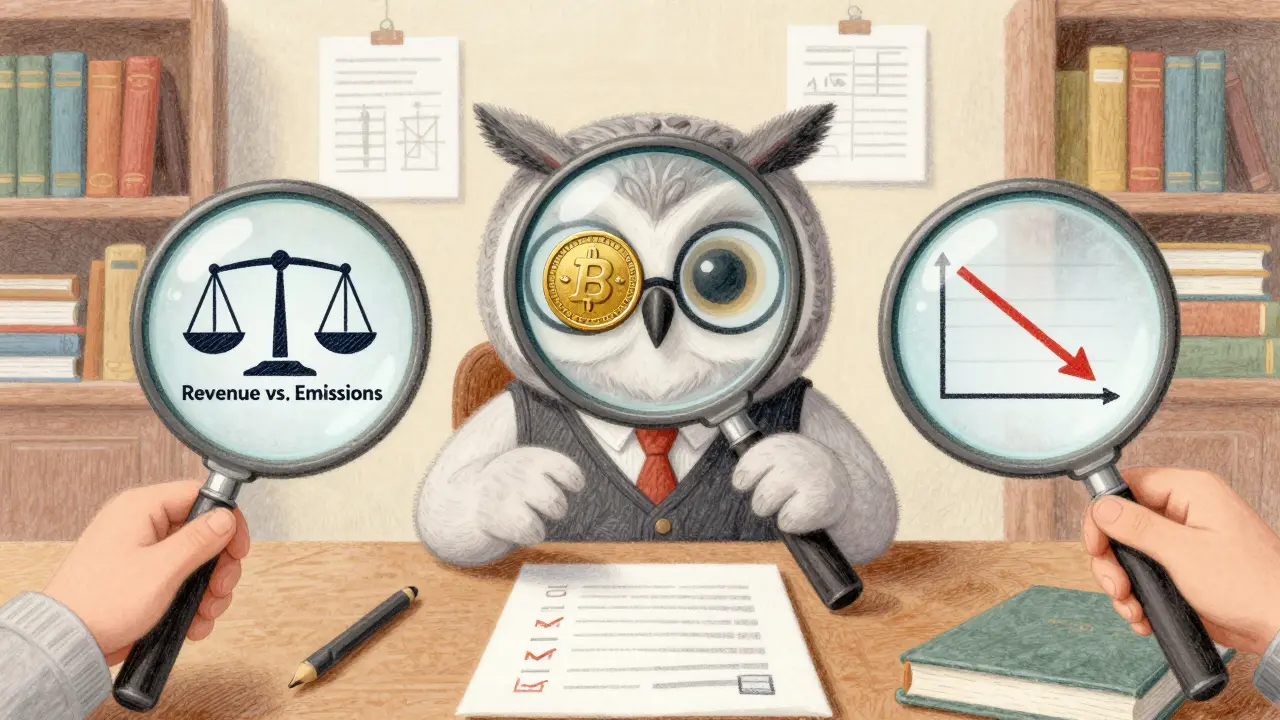
Binance Academy defines the metric clearly: compare a protocol’s total revenue over a set period (like 30 days) against the value of new tokens emitted as rewards during that same time. If revenue equals or exceeds emissions, you have real yield. If emissions are higher, you have dilutionary yield.
The Three Tests for Real Yield
Not every project claiming "real yield" is telling the truth. Some use marketing language to hide heavy inflation behind small fee distributions. To separate the genuine revenue-sharing models from the hype, you need to run three specific checks. These tests help you verify if the math actually works out.
- The Revenue-to-Distribution Ratio: Pull data from analytics platforms like DeFiLlama Fees or Token Terminal. Look at the last 30 or 90 days. Did the protocol generate $1 million in fees? If so, did they distribute $700,000 of that back to stakers? If yes, that is real yield. If they distributed $700,000 worth of their own token while only earning $100,000 in fees, the gap comes from new supply. That is inflation.
- The Asset-Type Check: What currency are you being paid in? Real yield is typically paid in non-inflationary assets like ETH, USDC, or other stablecoins. These are assets the protocol actually earns from users. If you are being paid solely in the protocol’s native governance token, ask yourself: is that token appreciating, or is its price dropping because millions of new tokens are hitting the market every day?
- The Tokenomics Floor Check: Examine the emission schedule. Does the protocol have a hard cap on inflation? Or does it rely on governance votes to keep printing tokens? A true real-yield model minimizes reliance on new supply. Even if a protocol distributes some fees, hidden inflation in the background can erase your gains. You want to see a downward trend in annual inflation rates over time.
Revenue Over Emissions: How It Works
The core philosophy behind this shift is reversing the cash flow direction. In the 2020-2021 bull market, the logic was: "Print tokens to attract users, hope volume grows, then maybe we’ll make money later." This created a reflexive bubble. Users stayed only as long as the high APYs lasted. When new buyers stopped entering, the token price collapsed, and the yield vanished.
In a revenue-over-emissions model, the sequence is different:
- Users pay fees to use the service (e.g., swapping tokens, borrowing funds).
- The protocol collects these fees in a treasury or smart contract.
- A portion of that collected revenue is streamed back to tokenholders or liquidity providers.
- No new tokens are minted to fund this reward.
This structure aligns incentives. The protocol only pays you if it provides value to users. If no one uses the platform, there are no fees, and therefore no yield. This sounds less exciting than guaranteed 500% APY, but it is sustainable. It turns the token into an asset that generates cash flow, similar to a bond or a dividend-paying stock.
Case Study: Astar Network’s Dynamic Adjustment
You don’t have to take my word for it; look at how established networks are adjusting their parameters. Astar Network is a blockchain platform that recently updated its tokenomics to prioritize sustainability over aggressive growth incentives. They implemented a "Dynamic Tokenomics" update that serves as a perfect example of tuning emissions toward reality.
Astar reduced the base reward allocated to stakers from 25% of emissions to just 10%. Simultaneously, they increased the share routed through usage-based rewards (like dApp staking) from 40% to 55%. They also lowered their annual inflation rate from 4.86% to 4.32%. While Astar still uses some emissions to secure the network, this quantitative rebalancing shows a clear intent: reduce passive dilution and reward active participation that drives value.
This approach acknowledges that pure fee distribution isn’t always possible immediately. However, by capping inflation and tying rewards to Total Value Locked (TVL) and activity, they move closer to a real-yield model. The key takeaway is transparency. They published the numbers. They showed the reduction in dilution. Investors can calculate the net impact.
| Feature | Emission-Fueled Yield | Real Yield |
|---|---|---|
| Source of Rewards | Newly minted tokens | Protocol fees & revenue |
| Asset Type | Native governance token | ETH, Stablecoins, or Native Token |
| Sustainability | Low (relies on new buyers) | High (relies on user activity) |
| Impact on Supply | High inflation / Dilution | Neutral or Deflationary |
| Typical APY | Very High (100% - 1000%+) | Moderate (5% - 20%) |
Why Investors Are Shifting
The shift toward real yield is driven by experience. After the collapses of several high-profile projects in 2022 and 2023, investors became skeptical of narrative-driven tokens. Professional DeFi investors now view uncapped emissions as a marketing cost, not a source of value. They treat high emissions in the first 6-12 months as acceptable for bootstrapping, provided there is a clear roadmap to transition to fee-sharing.
Findas.org reports that experienced investors now ask three questions before allocating capital: 1. How much revenue did you generate in the last 30 days? 2. What percentage of that revenue goes to holders? 3. How does that compare to your daily token emissions?
If the answer to the third question reveals that emissions dwarf revenue, the project is flagged as risky. This scrutiny has forced protocols to be more honest. Platforms like Tokenomics.com now rank tokens by "holder earnings from revenue sharing," creating a leaderboard for sustainable projects. This data availability empowers users to choose assets that behave like equity rather than lottery tickets.
Risks and Trade-Offs
Real yield is not without its drawbacks. The most obvious trade-off is lower absolute returns. Because real yield is capped by actual usage, you will rarely see triple-digit APRs. If a protocol earns $100,000 a day, it cannot distribute $1 million a day in real yield. For speculative traders seeking quick flips, this lack of explosive growth can be unappealing.
Additionally, revenue is cyclical. During bear markets, trading volumes drop, fees decrease, and real yield payouts shrink. In contrast, emission-funded yields remain constant regardless of market conditions (until the token runs out). Therefore, real-yield tokens are more sensitive to macroeconomic trends and user adoption cycles. You are betting on the utility of the product, not just the promise of future growth.
There is also the risk of "blended" models. Many protocols claim real yield but mix it with modest emissions. Without careful analysis using the three tests above, it is easy to misinterpret a blended model as purely revenue-backed. Always check the coverage ratio. If revenue covers only 50% of rewards, the other 50% is still dilution.
How to Evaluate Your Portfolio
If you hold DeFi assets, audit them today. Do not trust the APY displayed on the dashboard. Go to DeFiLlama or Token Terminal. Find the protocol’s fee revenue chart. Compare it to their emission schedule. Calculate the net return after accounting for inflation.
Look for protocols that publish transparent dashboards showing fee-to-emission ratios. Favor projects that pay rewards in external assets like ETH or stablecoins. Avoid projects with open-ended emission schedules and no clear path to fee accrual. The future of DeFi belongs to protocols that prove their value through usage, not promises.
Is real yield better than high APY emissions?
For long-term investors, yes. Real yield is sustainable because it comes from actual profit. High APY emissions often lead to massive dilution, meaning the token price drops faster than your rewards accumulate, resulting in a net loss of purchasing power.
How do I calculate if a yield is "real"?
Compare the protocol's total fee revenue over a specific period (e.g., 30 days) to the total value of tokens distributed as rewards in that same period. If revenue equals or exceeds the value of rewards, it is real yield. If emissions exceed revenue, it is dilutionary.
What assets are considered "real yield"?
Real yield is typically paid in non-inflationary assets such as Ethereum (ETH), stablecoins (USDC, DAI), or other major cryptocurrencies that the protocol earns through fees. Rewards paid solely in the protocol's own newly minted governance token are usually not considered real yield unless accompanied by significant buybacks.
Can a protocol have both real yield and emissions?
Yes, many protocols use a blended model. They may distribute 70% of rewards from fees and 30% from emissions. However, investors should scrutinize the ratio. A high percentage of emissions still indicates dilution, even if some portion is revenue-backed.
Why did the industry shift away from emission-heavy models?
The 2022-2023 bear market exposed the unsustainability of funding yields through infinite token printing. As new buyer inflows slowed, token prices collapsed, and nominal high APYs turned into negative real returns. Investors demanded transparency and sustainability, leading to the rise of revenue-sharing models.