Imagine trying to send a package from a house in New York to one in London, but you can only use mail services that don't talk to each other. You’d need a dozen different couriers, each with their own rules and fees, just to get the item across borders. For years, that was exactly how blockchains worked. Bitcoin couldn’t talk to Ethereum, and Ethereum struggled to communicate with newer networks. This fragmentation made building complex applications slow, expensive, and risky.
Enter Polkadot, a blockchain protocol designed specifically to solve this problem. Instead of forcing every application onto a single chain, Polkadot allows multiple specialized blockchains-called parachains-to connect securely. It acts as a central hub where these chains can exchange data and value instantly. If you are looking to understand why developers and investors are paying attention to the DOT token in 2026, you need to look past the price charts and understand the architecture underneath.
How Polkadot Actually Works: The Relay Chain and Parachains
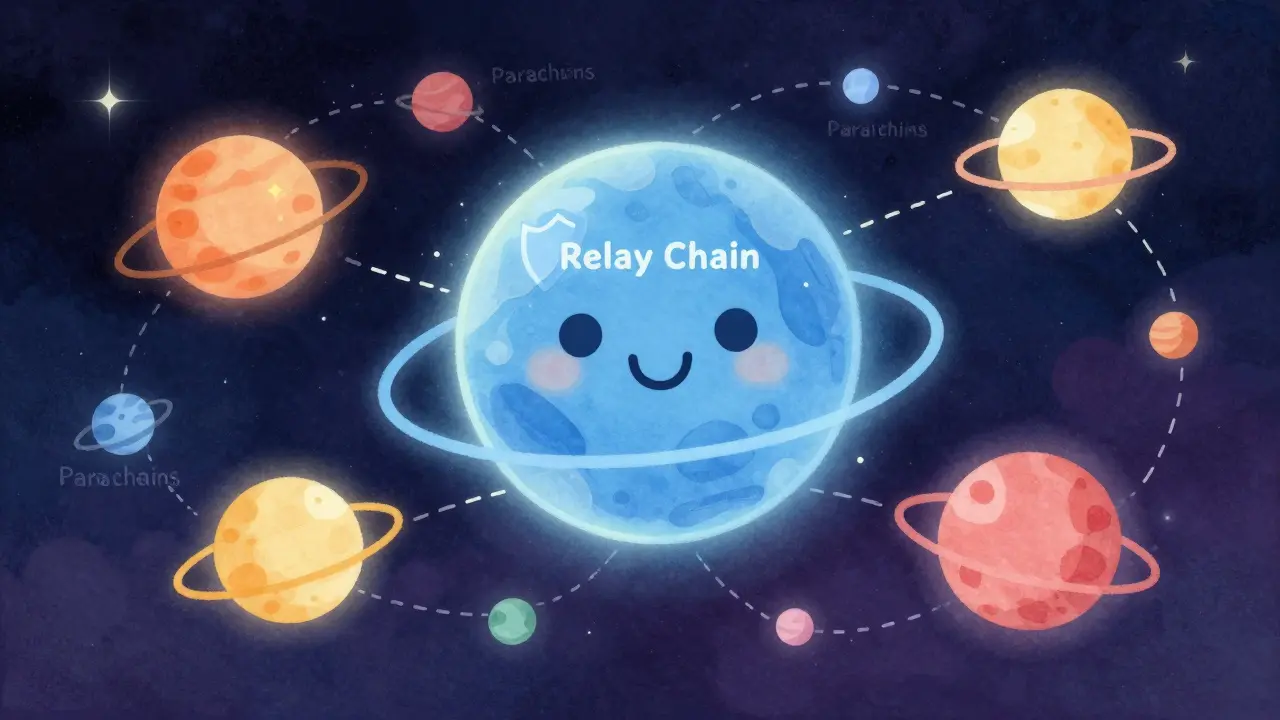
To grasp Polkadot, you have to forget the traditional idea of a single blockchain. Think of it more like a solar system. At the center is the Relay Chainthe core blockchain of the Polkadot network that coordinates consensus and security for all connected chains. Its only job is to handle security and consensus. It doesn’t run smart contracts or host apps directly. That’s where the orbiting planets come in: the parachains.
Parachains are independent blockchains that lease space on the Polkadot network. They benefit from the Relay Chain’s shared security without having to build their own validator networks from scratch. This is a huge deal because securing a new blockchain is incredibly hard and expensive. By plugging into Polkadot, a new project gets instant security guarantees. Plus, because they are all connected to the same hub, a parachain handling gaming assets can easily trade with a parachain focused on decentralized finance (DeFi). No bridges needed. No third-party intermediaries. Just native cross-chain communication.
There is also a third component called parathreads. These are like parachains but operate on a pay-as-you-go basis. If your project isn’t ready to commit to a long-term slot rental, you can use a parathread to test the waters. This flexibility lowers the barrier to entry for smaller developers who want to experiment with Polkadot’s infrastructure without locking up massive amounts of capital.
The Role of the DOT Token: Governance, Staking, and Bonding
You can’t talk about Polkadot without talking about its native cryptocurrency, DOTthe utility token used for governance, staking, and bonding within the Polkadot network. Unlike many tokens that exist primarily for speculation, DOT has three concrete functions that keep the network running.
- Governance: DOT holders vote on changes to the protocol. Want to adjust transaction fees? Change the number of parachains? It goes through an on-chain referendum. This means the community controls the roadmap, not a central corporation.
- Staking: To secure the network, users lock up their DOTs to become validators or nominators. Validators process transactions and produce blocks. Nominators back these validators with their stake, earning rewards if the validators perform well and losing money if they act maliciously. This Nominated Proof-of-Stake (NPoS) model ensures that bad actors have a high financial incentive to behave.
- Bonding: This is unique to Polkadot. To get a spot as a parachain, projects must bond (lock) DOT tokens. In the early days, this happened through competitive auctions where communities raised millions of dollars to win slots. While the mechanism has evolved with upgrades like Aggregated Chains, bonding remains the economic anchor that ties projects to the health of the main network.
If you hold DOT, you aren’t just holding a speculative asset; you’re participating in the operational mechanics of a global computing platform. As of late 2025, the DOT market cap hovered around $6.2 billion, reflecting steady institutional interest despite broader crypto volatility.
Why Developers Choose Substrate Over Other Frameworks
Building a blockchain from scratch is a nightmare. You have to worry about cryptography, networking, consensus algorithms, and storage. Most teams don’t have the expertise to do all that while focusing on their actual product. That’s why Polkadot offers Substratea modular framework for building custom blockchains that are compatible with the Polkadot network.
Substrate is a toolkit written in Rust. It provides pre-built modules for common tasks like account management and transaction verification. Developers can mix and match these modules to create a blockchain tailored to their specific needs. Want a chain optimized for high-frequency trading? Build it. Need one focused on identity verification? Done.
The learning curve is steep, though. According to the Web3 Foundation, developers typically spend 80-100 hours getting proficient with Substrate. But once you’re over that hump, the speed of development is unmatched. A 2024 ConsenSys case study found that experienced teams could deploy enterprise-grade Polkadot solutions in 6-12 weeks. Compare that to months or years spent wrestling with legacy codebases on older platforms, and the efficiency gain is clear.
Moreover, Substrate isn’t locked into Polkadot. You can use it to build standalone blockchains. However, connecting to Polkadot unlocks the real magic: interoperability. Your custom chain can suddenly talk to hundreds of other networks, accessing liquidity and data sources it never had before.

Polkadot vs. Cosmos: Shared Security vs. Sovereignty
When people ask about multi-chain interoperability, Polkadot and Cosmos are usually mentioned in the same breath. Both aim to connect blockchains, but they take fundamentally different approaches.
| Feature | Polkadot | Cosmos |
|---|---|---|
| Security Model | Shared security via Relay Chain | Each chain secures itself independently |
| Interoperability Protocol | XCM (Cross-Consensus Messaging) | IBC (Inter-Blockchain Communication) |
| Governance | Centralized on-chain voting via DOT | Decentralized per-chain governance |
| Best For | Projects needing strong security guarantees | Projects prioritizing full sovereignty and customization |
Cosmos uses the Inter-Blockchain Communication (IBC) protocol. It allows chains to talk to each other, but each chain is responsible for its own security. This gives projects maximum freedom-they can choose their own consensus mechanisms and upgrade schedules. But it also means smaller chains are vulnerable to attacks if they don’t attract enough validators.
Polkadot flips this model. All parachains share the security of the Relay Chain. If someone wants to attack a small DeFi parachain, they have to attack the entire Polkadot network, which is economically unfeasible. For many enterprises and serious DeFi protocols, this shared security is a non-negotiable requirement. It reduces risk significantly, especially for projects that don’t have the budget to maintain a massive validator set.
However, this comes at a cost. Polkadot’s governance is slower. Because changes affect the whole network, decisions require broad consensus. Cosmos chains can move fast and break things. Polkadot moves deliberately. Which approach is better depends entirely on your priorities: speed and sovereignty, or security and integration.
Real-World Performance and Recent Upgrades
Let’s talk numbers. First-generation blockchains like Bitcoin handle about 7 transactions per second (TPS). Ethereum manages around 20-30 TPS. Polkadot, by design, processes over 1,000 TPS across its parachains. But the story in 2025 and 2026 is about scaling even further.
In Q2 2025, Polkadot launched a major upgrade called Asynchronous Backing. This technical shift reduced block production time from 6 seconds to just 0.5 seconds. More importantly, it increased the potential capacity from 100 parachains to nearly 1,000. This isn’t just theoretical. With 112 active parachains processing $4.7 billion in quarterly volume by late 2025, the network is already handling significant load.
The roadmap for 2026 focuses on Elastic Scaling and Aggregated Chains. Elastic Scaling allows parachains to dynamically request more resources during peak times and release them when demand drops. This makes the network more efficient and cheaper to use. Aggregated Chains improve composability, making it easier for apps to span multiple chains seamlessly.
Gavin Wood, Polkadot’s founder and co-founder of Ethereum, stated in November 2025 that these upgrades position Polkadot to handle one million TPS in enterprise configurations. Whether that figure becomes reality depends on hardware advancements and continued developer adoption, but the trajectory is clearly upward.

Challenges and Criticisms
No technology is perfect, and Polkadot faces valid criticisms. One major issue is the complexity of entering the ecosystem. The old parachain auction system required projects to raise hundreds of millions of dollars in crowdloans to win a slot. While the new bonding mechanisms are more accessible, the barrier to entry remains higher than on simpler platforms like Polygon or Binance Smart Chain.
Some critics, including blockchain researcher Dr. David Schwartz, have argued that the capital requirements for parachain slots concentrate power among well-funded entities. This could undermine the decentralization ethos of blockchain. If only big players can afford to participate, does it really serve the community?
Additionally, the user experience for average consumers is still clunky. Managing DOT wallets, understanding staking periods, and navigating cross-chain transfers requires more technical knowledge than using a centralized exchange. Trustpilot reviews from 2025 show that while developers praise the documentation, 42% of users cite a steep learning curve. Until the interface layer improves, mass adoption will remain limited to tech-savvy users and institutions.
Who Should Use Polkadot?
Polkadot isn’t for everyone. If you are building a simple NFT marketplace or a basic token swap, lighter solutions might be faster and cheaper to implement. But if you are working on complex, cross-chain applications, Polkadot shines.
- DeFi Protocols: Projects that need to access liquidity from multiple chains without relying on risky bridges.
- Enterprise Solutions: Companies like Deutsche Telekom and SAP use Polkadot for supply chain tracking and identity management because of its robust security and privacy features.
- New Blockchain Startups: Teams that want to launch a custom chain but lack the resources to secure it independently.
For investors, DOT represents a bet on the future of interconnected blockchains. As more industries realize that siloed data is inefficient, the demand for interoperable infrastructure will likely grow. Gartner’s 2025 report gave Polkadot a 78% probability of remaining a top-10 blockchain platform through 2030, citing its unique governance and security model.
Is Polkadot safe to use?
Yes, Polkadot is considered highly secure due to its shared security model. All parachains benefit from the protection of the main Relay Chain, which is secured by thousands of validators. Additionally, the Nominated Proof-of-Stake consensus mechanism penalizes malicious behavior financially, incentivizing honest participation.
What is the difference between a parachain and a parathread?
A parachain leases a permanent slot on the Polkadot network, providing continuous availability and shared security. A parathread operates on a pay-as-you-go basis, allowing projects to access the network temporarily without committing to a long-term lease. Parathreads are ideal for testing or low-volume applications.
How does Polkadot compare to Ethereum?
Ethereum is a single-chain platform that relies on Layer 2 solutions for scalability. Polkadot is a multi-chain network designed for interoperability from the ground up. While Ethereum has a larger developer ecosystem, Polkadot offers faster finality (around 12 seconds) and native cross-chain communication without complex bridging mechanisms.
Can I earn passive income with DOT?
Yes, you can earn rewards by staking your DOT tokens. You can either run a validator node (which requires significant technical expertise and capital) or nominate existing validators. Nominators earn a portion of the rewards generated by the validators they support, minus any slashing penalties if those validators misbehave.
What is Kusama?
Kusama is often described as Polkadot’s “canary network.” It is a sister network that runs the same codebase but with lower barriers to entry. Developers use Kusama to test new features and upgrades before deploying them on Polkadot. About 87% of Polkadot’s major updates are first validated on Kusama to ensure stability.