You minted your digital art. You sold it for a nice price. Then you watched as that same piece changed hands three more times, each time for significantly more money than you originally received. In the early days of NFTs, this was supposed to be a win-win: every resale triggered an automatic payment back to you, the creator. That promise is what drew many artists into the space.
But if you are checking your wallet today, you might notice those payments have slowed down-or stopped entirely. The landscape of NFT royalties is recurring payments to creators from secondary market transactions has shifted dramatically since 2023. The guaranteed income stream many relied on has largely been replaced by optional tips, leaving artists to navigate a complex web of marketplace policies and smart contract standards.
The Promise vs. The Reality of Secondary Sales
To understand where we stand in 2026, we need to look at how the system was designed versus how it actually works now. Originally, NFTs were marketed with a compelling economic model: unlike traditional art, where the artist sees no benefit after the first sale, digital art could provide perpetual revenue through resale fees. This concept aligned perfectly with the ethos of decentralized ownership.
However, the technical implementation never matched the marketing hype. While the code existed to signal who should get paid, the enforcement relied entirely on marketplaces choosing to honor those signals. When competition heated up between platforms like OpenSea is the largest NFT marketplace that shifted from mandatory to optional royalties and trader-focused hubs like Blur is a high-volume NFT trading platform known for low fees and optional royalties, the focus shifted from supporting creators to attracting liquidity. Traders wanted lower costs; marketplaces responded by making royalties voluntary.
How Royalties Work Technically: The ERC-2981 Standard
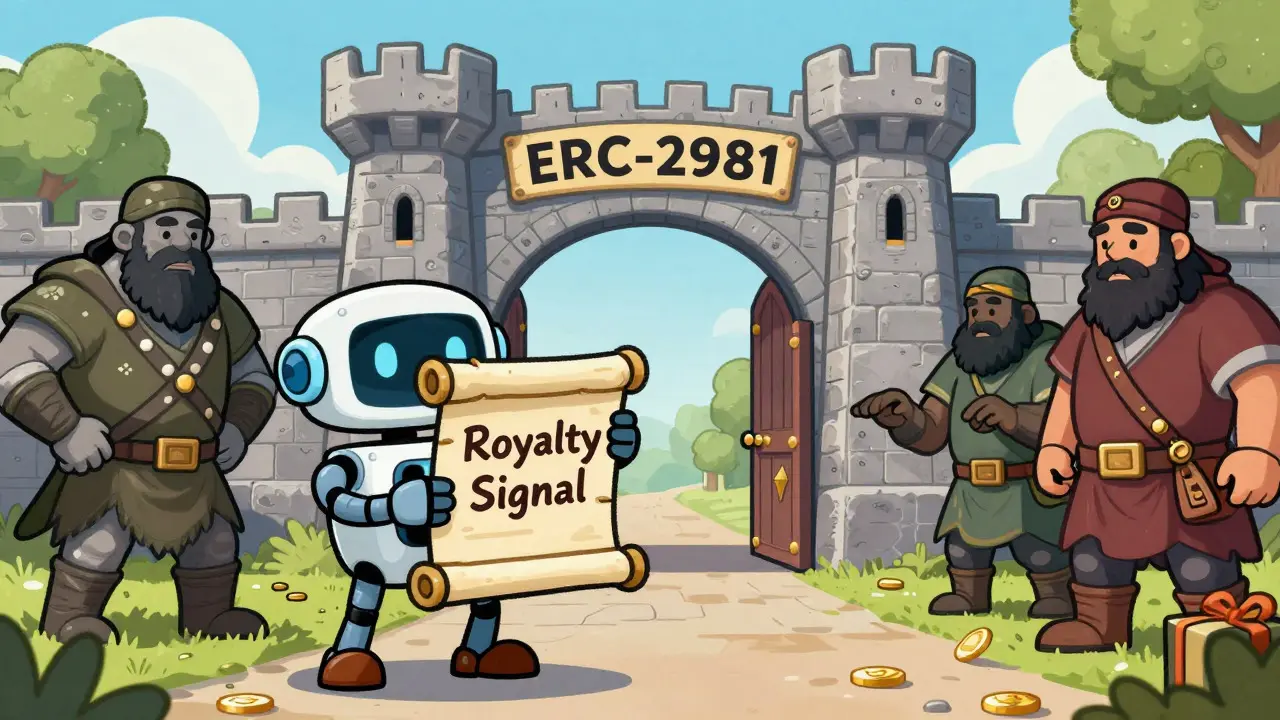
If you are an artist or developer, understanding the underlying technology is crucial. The backbone of royalty signaling is ERC-2981 is an Ethereum standard for signaling royalty information on NFTs. Proposed in September 2020 by Zach Burks, James Morgan, Blaine Malone, and James Seibel, this standard provides a simple interface for smart contracts to declare who gets paid and how much when a token is resold.
Here is how the process typically unfolds on-chain:
- Interface Check: When a trade occurs on a compliant marketplace, the platform checks if the NFT contract supports the ERC-2981 interface using the ERC-165 standard (interface ID
0x2a55205a). - Data Retrieval: If supported, the marketplace calls the
royaltyInfo(tokenId, salePrice)function. This returns two pieces of data: the receiver’s wallet address and the calculated royalty amount based on the sale price. - Settlement: The marketplace then distributes the funds. Part goes to the seller, part to the platform fee, and ideally, part to the creator as defined by the royalty rate.
The critical flaw? ERC-2981 is advisory. It tells the marketplace *what* the royalty should be, but it cannot force the marketplace to pay it. As noted in technical documentation from Fullstack Development, if a marketplace chooses to ignore the standard, no funds are transferred to the creator. The smart contract itself does not enforce payment; it only signals intent.
The Shift to Optional Royalties
The period between 2020 and early 2022 saw robust enforcement. Major platforms enforced rates typically between 2.5% and 10%. But the "royalty wars" began in earnest in February 2023. OpenSea dropped its marketplace fee to 0% and made royalties optional, enforcing only a minimum of 0.5% if buyers refused to pay more. By August 2023, OpenSea announced it would end mandatory resale royalties entirely, sunsetting its Operator Filter tool-a feature that allowed creators to block trades on non-compliant platforms-by March 2024.
This shift wasn’t just about one platform. Blur, launched in October 2022, positioned itself as a pro-trader hub with minimal friction. While Blur enforces a minimum royalty of 0.5% for collections with royalties across markets, the effective average rate often hovers around 0.4%. Traders can set royalties as low as 0%, prioritizing speed and cost over creator support.
Other platforms have adopted varied approaches. Magic Eden is a multi-chain NFT marketplace that enforces royalties on Solana but makes them optional on Ethereum enforces royalties on Solana collections (often 5-10%) but treats Ethereum royalties as optional. X2Y2 is an NFT marketplace with optional royalty defaults around 5% lists a typical default of 5%, but again, enforcement is discretionary.
Marketplace Comparison: Where Do You Stand?
| Marketplace | Royalty Enforcement | Typical Rate Range | Key Policy Detail |
|---|---|---|---|
| OpenSea | Optional | 0% - 10% | Ended mandatory enforcement in Feb 2024; royalties now function as tips. |
| Blur | Optional (Min 0.5%) | 0% - 5% | Effective average ~0.4%; allows 0% royalties to attract traders. |
| Magic Eden | Chain-Specific | 5% - 10% (Solana) | Enforces on Solana; optional on Ethereum. |
| X2Y2 | Optional | ~5% Default | Treats royalties as optional with a mid-single-digit convention. |

Strategies for Artists in 2026
If you are creating digital art today, relying solely on secondary sales for income is risky. Here are practical steps to maximize your earnings:
- Diversify Revenue Streams: Don’t bet everything on royalties. Consider primary sales, physical merchandise, or licensing deals. A 2024 study in ScienceDirect notes that while royalties align incentives, they are not a substitute for diverse business models.
- Choose Your Chain Wisely: If consistent royalties are a priority, consider launching on chains where marketplaces still enforce them. Magic Eden’s approach on Solana shows that chain-specific norms can preserve higher payout rates.
- Engage Your Community: Since royalties are now social norms rather than technical guarantees, community pressure matters. Educate your holders about why paying royalties supports future creation. Some projects have seen success by framing royalty payments as direct support for the artist’s next project.
- Monitor Platform Policies: Policies change frequently. Stay updated on announcements from OpenSea, Blur, and others. Tools like Onchain Diary track these shifts, helping you adjust your strategy as needed.
- Consider Blocklisting (With Caution): Some creators choose to blocklist marketplaces that don’t honor royalties. However, this can reduce liquidity. As reported by CoinDesk in 2023, creators faced difficult choices between blocking OpenSea to protect Blur royalties or vice versa. Weigh the loss of potential sales against the gain in per-sale revenue.
The Future of Creator Payments
The industry is not standing still. Efforts to "fix" royalties continue. In October 2023, Yuga Labs (creators of Bored Ape Yacht Club) partnered with Magic Eden to experiment with new royalty-preserving models. These initiatives aim to restore trust without sacrificing liquidity.
Academic analysis suggests that the long-term viability of NFT royalties depends less on protocol-level enforcement and more on a combination of factors: marketplace competition, regulatory developments, and social norms among traders. As Bankless noted in their 2023 analysis, optional royalties reflect a strategic response to trader demand for lower fees. Creators must adapt by building value beyond the token itself.
For now, the era of guaranteed, automated passive income from secondary sales is largely over. But that doesn’t mean NFTs aren’t valuable. It means the relationship between artist and collector has become more direct-and more dependent on mutual respect and community engagement.
Are NFT royalties still enforced in 2026?
Most major marketplaces like OpenSea and Blur treat royalties as optional. Enforcement varies by platform and blockchain. For example, Magic Eden enforces royalties on Solana but makes them optional on Ethereum. Always check the specific policy of the marketplace where your work is traded.
What is the ERC-2981 standard?
ERC-2981 is an Ethereum standard that allows NFT contracts to signal royalty information. It defines who should receive royalties and how much, based on the sale price. However, it is advisory; marketplaces must choose to honor it.
Why did OpenSea make royalties optional?
OpenSea shifted to optional royalties due to competitive pressure from platforms like Blur, which offered lower fees. To attract traders and maintain liquidity, OpenSea ended mandatory enforcement in early 2024, turning royalties into voluntary tips.
Can I set my own royalty rate?
Yes, you can set a desired royalty rate in your smart contract or marketplace dashboard. However, whether that rate is enforced depends on the marketplace. On platforms with optional royalties, buyers or sellers decide whether to pay the suggested amount.
Which blockchain has the best royalty enforcement?
As of 2026, Solana-based marketplaces like Magic Eden tend to enforce royalties more strictly (often 5-10%) compared to Ethereum-based platforms, where royalties are largely optional. Always verify current policies before launching a collection.