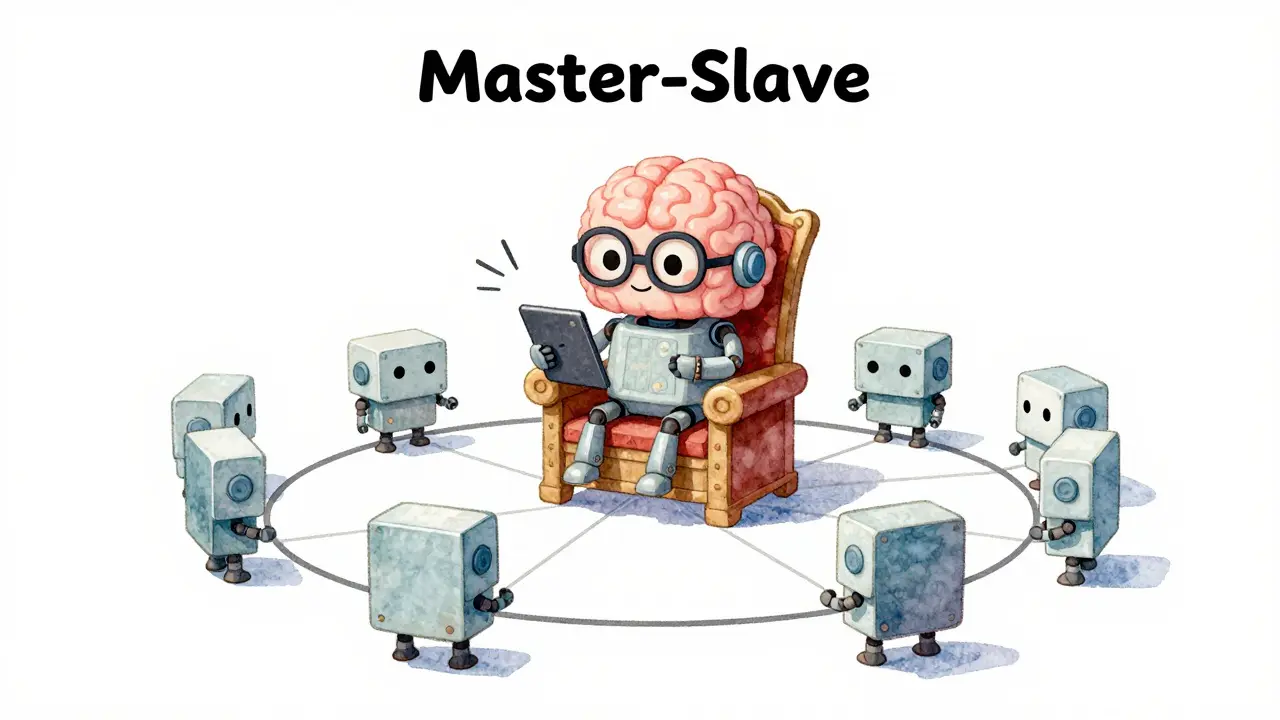
Most people assume that if you want to run Voice over IP (VoIP), you need SIP. It’s everywhere. But there is another beast in the machine room, one that doesn’t shout across the network like a peer-to-peer protocol but instead waits quietly for orders from a central brain. This is the Media Gateway Control Protocol (MGCP), a master-slave signaling standard defined in RFC 3435.
While SIP treats every phone and gateway as an independent decision-maker, MGCP flips the script. It turns your hardware into "dumb" endpoints that do exactly what they are told by a centralized controller. If you are managing a large enterprise network or dealing with legacy PSTN connections, understanding this alternative approach isn't just academic-it’s often the key to stability.
The Core Concept: Dumb Gateways, Smart Controllers
To understand why MGCP exists, you have to look at how it splits responsibilities. In a typical SIP setup, your IP phone knows how to register, how to find a proxy server, and how to negotiate codecs. It carries state. With MGCP, none of that happens at the edge.
Instead, you have two main players:
- The Media Gateway Controller (MGC): Also called the Call Agent. This is the brain. It handles call routing, policy enforcement, address resolution, and billing logic. In a Cisco environment, this is usually Cisco Unified Communications Manager (CUCM).
- The Media Gateway (MG): This is the muscle. It sits between the digital voice world (RTP streams) and the analog or TDM world (PSTN lines, T1/E1 trunks). It has no opinion on where a call should go. It simply executes commands like "connect this port to that IP address" or "play a busy tone."
This architecture is called "decomposed" or "split." The intelligence is centralized. The hardware is simplified. For a carrier managing thousands of trunk lines, this means you can update call logic on the controller without touching the physical gateways installed in remote closets.
How MGCP Actually Works: The Command Set
MGCP is a text-based protocol, similar in syntax to HTTP or SIP, which makes it relatively easy to debug compared to binary protocols. It runs primarily over UDP on port 2427 (for the gateway listening) and 2727 (for the controller sending), though TCP port 2428 is often used for backhauling ISDN signaling.
The communication revolves around nine core commands. You don't need to memorize them all, but knowing the big three helps demystify the process:
- CRCX (CreateConnection): The controller tells the gateway, "Set up a media path between this endpoint and this IP/port."
- MDCX (ModifyConnection): Used to change parameters mid-call, like switching codecs or adjusting volume.
- DLCX (DeleteConnection): Tears down the media stream when the call ends.
There are also audit commands (AUEP and AUCX) that allow the controller to ask, "What is the current status of this port?" This gives the administrator precise visibility into every single line, a feature highly valued in large-scale deployments.
| Feature | MGCP | SIP | H.323 |
|---|---|---|---|
| Architecture | Centralized (Master-Slave) | Distributed (Peer-to-Peer) | Distributed (Gatekeeper-controlled) |
| Endpoint Intelligence | Low ("Dumb" Gateway) | High (Smart Endpoint) | Medium/High |
| Primary Use Case | PSTN Interworking, Carrier Networks | Enterprise PBX, UC, WebRTC | Legacy Video Conferencing, Early VoIP |
| Security | None built-in (relies on IPsec) | TLS/SRTP supported natively | Limited native support |
| Standardization | RFC 3435 (2003) | RFC 3261 (2002+) | ITU-T H.323 Suite |
Why Choose MGCP Over SIP?
If SIP is the industry standard for new IP phones, why does MGCP still exist? The answer lies in control and simplicity.
In a SIP network, if a phone misbehaves or tries to route a call incorrectly, it can cause issues. In an MGCP network, the gateway cannot make a routing decision on its own. It physically cannot. This eliminates a whole class of configuration errors at the edge. For service providers who need deterministic behavior across tens of thousands of ports, this rigidity is a feature, not a bug.
Furthermore, MGCP excels at handling complex legacy signaling. When you connect a modern IP network to old-fashioned T1 or E1 trunks, you deal with things like CAS (Channel Associated Signaling) or PRI (ISDN). MGCP allows these low-level signaling events (like off-hook, digits dialed, or ringback tones) to be "backhauled" to the central controller. The controller then decides how to handle them. This keeps the gateway hardware cheap and simple, as it doesn't need powerful processors to interpret complex dial plans.
The Downside: Single Points of Failure
Every architectural choice has a trade-off. The biggest weakness of MGCP is its dependency on the controller. Because the gateway is "dumb," it relies entirely on the MGC for instructions. If the connection between the gateway and the controller drops, the gateway can often still pass existing voice traffic (media flows independently via RTP), but it cannot set up new calls.
In contrast, a SIP phone might be able to fall back to a local registrar or use cached credentials to place emergency calls even if the central server is unreachable. MGCP requires careful high-availability planning. You typically deploy redundant controllers in active/standby modes so that if one fails, the gateways can failover to the secondary without dropping service.
Another limitation is security. RFC 3435 explicitly states that MGCP does not provide end-to-end security. It doesn't have built-in TLS encryption like SIP does. To secure MGCP traffic, you must rely on network-level protections like IPsec tunnels or isolated VLANs. In today's threat landscape, this adds an extra layer of complexity to your infrastructure design.
MGCP vs. H.248/MEGACO: The Successor
You will sometimes hear MGCP confused with H.248 or MEGACO. They are cousins, but not twins. H.248 was developed jointly by the IETF and ITU-T to address some of MGCP's limitations, particularly regarding scalability and multimedia services beyond voice.
While MGCP uses a simpler package system for defining events (like "off-hook"), H.248 introduced a more flexible structure with "terminations" and "contexts," allowing for more complex media manipulations. Many carriers that started with MGCP migrated to H.248 in the mid-2000s. However, MGCP remains widely supported, especially in Cisco ecosystems, because it is sufficient for pure voice interworking.
Real-World Deployment: A Cisco Example
Let’s look at how this plays out in a real configuration. Imagine you have a Cisco VG320 analog gateway connecting 32 desk phones to your CUCM server. You don't configure each phone individually on the gateway. Instead, you tell the gateway who its boss is.
The configuration on the gateway looks something like this:
mgcp call-agent 192.168.1.10 2427 service-type mgcp version 0.1
ccm-manager config server 192.168.1.10
ccm-manager config
ccm-manager mgcp
mgcp
Once this is done, the gateway sends a RSIP (Restart In Progress) message to the CUCM. The CUCM responds by auditing the endpoints (AUEP) and requesting notifications for specific events (RQNT), such as when a user picks up the phone (off-hook). From that point on, the CUCM controls the destiny of every call on those 32 lines. If you want to add a new extension, you do it in CUCM, not on the gateway.
Is MGCP Dead?
Not quite, but it is no longer growing. The era of massive greenfield MGCP deployments ended around 2010. Today, new IP phones are almost exclusively SIP-based. Cloud PBX providers offer SIP trunks. Even many modern softswitches prefer SIP for their northbound interfaces.
However, MGCP lives on in the "brownfield" world. Thousands of enterprises and carriers still have robust MGCP-based infrastructures running smoothly. Replacing them is expensive and risky. As long as TDM PSTN networks exist, MGCP will remain the bridge that connects the old world to the new. For network engineers, understanding MGCP is essential for maintaining these critical links, even if you never build a new one from scratch.
What is the main difference between MGCP and SIP?
The main difference is architecture. SIP is a distributed, peer-to-peer protocol where endpoints (phones/gateways) hold intelligence and make routing decisions. MGCP is a centralized, master-slave protocol where a controller (Call Agent) makes all decisions, and the gateways act as simple execution devices.
Which port does MGCP use?
MGCP typically uses UDP port 2427 for command messages from the controller to the gateway. It may also use TCP port 2428 for backhauling ISDN/Q.931 signaling data.
Is MGCP secure?
MGCP itself does not include native encryption or authentication mechanisms. Security must be implemented at the network layer, typically using IPsec tunnels or by isolating MGCP traffic on dedicated, secured VLANs.
Why would a company choose MGCP over SIP?
Companies choose MGCP for centralized control, simplified gateway hardware, and easier management of large numbers of PSTN trunks. It reduces configuration complexity at the edge and ensures consistent policy enforcement from a single controller.
What happens if the MGCP controller goes down?
If the controller fails, existing calls usually continue because media (RTP) flows directly between endpoints. However, new calls cannot be established until the controller is restored or the gateway fails over to a redundant backup controller.