Imagine working a full-time job for six months, only to watch your paycheck lose 97% of its value overnight. That’s exactly what happened to thousands of STEPN users when their GMT tokens collapsed in 2023. It wasn’t bad luck; it was bad math. Most metaverse projects fail not because the graphics are ugly or the gameplay is boring, but because their economic models are broken. They print money faster than they can burn it.
If you’re building a virtual world or just trying to understand why some digital economies thrive while others crash, you need to grasp three core mechanics: inflation control, effective sinks, and balanced rewards. This isn’t just about crypto hype anymore. With the metaverse sector projected to hit $1.3 trillion by 2030, getting these numbers right is the difference between a sustainable ecosystem and a graveyard of worthless NFTs.
Why Virtual Economies Break (And How to Fix Them)
Traditional games like Fortnite avoid inflation because Epic Games controls the faucet-they decide exactly how many V-Bucks enter the system. But in blockchain-based worlds, players own the assets. If everyone mines tokens simultaneously, supply explodes, and prices plummet. K33 Research notes that "one of the basic laws of economics is the principle that an increasing money supply causes inflation," and virtual worlds are no exception.
The goal isn't to stop growth; it's to balance circulation. You want 60-70% of tokens circulating in the market while 30-40% are locked away or destroyed. If you miss this ratio, you get hyperinflation. Look at Axie Infinity. Its Smooth Love Potion (SLP) token dropped from $0.30 to $0.003 in six months because there were too many sellers and not enough reasons to spend the tokens. Players felt progression was impossible, so they quit.
The Dual-Token Model: A Necessary Evil?
Most successful platforms use two types of currency. One is a utility token for daily transactions, and the other is a governance token for long-term holding. Think of The Sandbox's SAND versus its LAND parcels, or Decentraland's MANA. Utility tokens move fast; governance tokens move slow.
| Token Type | Primary Function | Inflation Risk | Example Platform |
|---|---|---|---|
| Utility Token | Paying for items, crafting, entry fees | High (if mined excessively) | SAND (The Sandbox) |
| Governance Token | Voting rights, staking, prestige | Low (supply often capped) | MANA (Decentraland) |
| Stablecoin | Store of value, price stability | Negligible | USDC (Various integrations) |
This separation helps stabilize the economy. When the utility token inflates, players can still hold governance tokens as a store of value. However, don't make the mistake of making both tokens interchangeable. If users can swap them instantly without friction, you’ve just created one big inflationary mess.
Designing Effective Sinks: Where Does the Money Go?
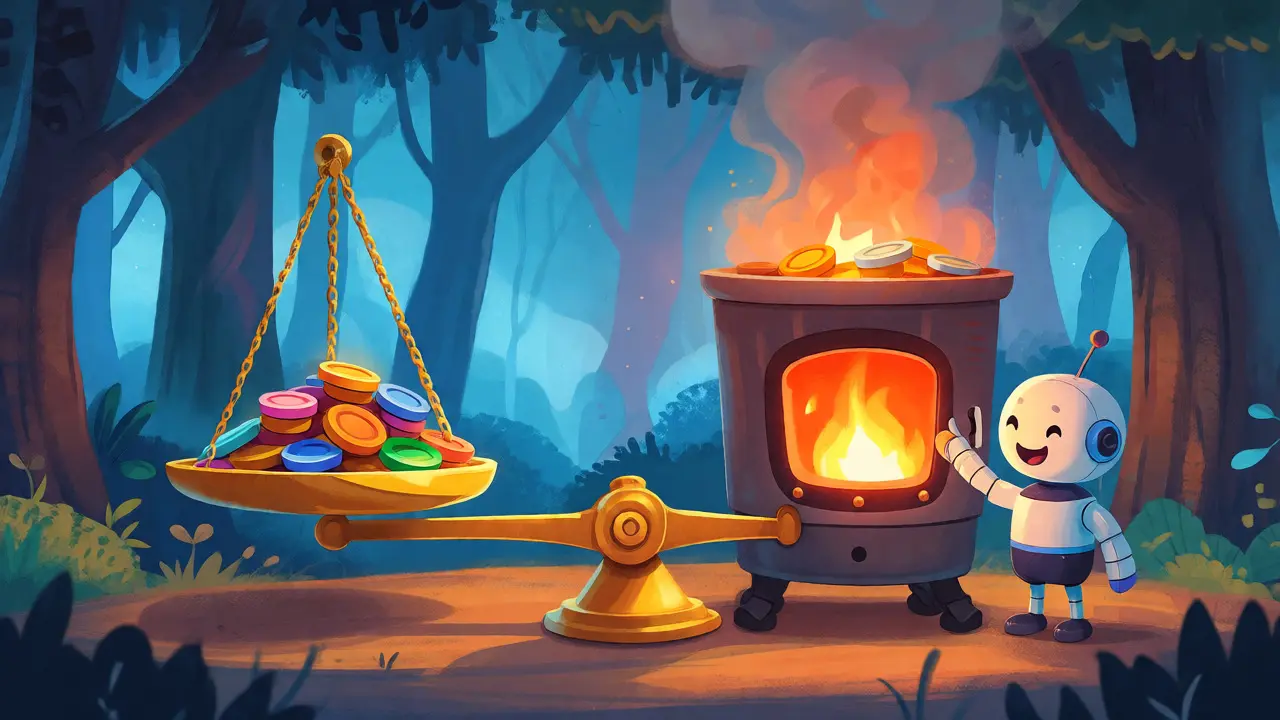
A "sink" is any mechanism that removes tokens from circulation. Without sinks, every reward is just delayed inflation. Yu-kai Chou of Octalysis Group argues that effective economies need "a range of sinks and faucets to help balance the economy." Here are the most proven methods:
- Cosmetic Customization: Sell avatars, skins, and mounts. These should cost 50-500 tokens per item. Since cosmetics don't affect gameplay stats, players buy them for status, not efficiency.
- Transaction Taxes: Charge 2.5% to 10% on land trades or item sales. This fee should be burned (destroyed), not sent to a treasury wallet. Burning creates deflationary pressure.
- Crafting & Upgrading: Allow players to combine low-level items into high-level ones, consuming 20-100% of the component value. This encourages spending rather than hoarding.
- Rare Collectibles: Introduce items with 0.1%-1% drop rates. High demand for scarce items drives up the price floor for common currencies.
Don't forget dynamic sinks. Static taxes won't work if user activity spikes. Decentraland’s "Economic 2.0" update introduced crafting systems that consume 35% of circulating tokens monthly. If activity drops, the sink rate should adjust automatically to prevent deflation.
Rewards: Pairing Extrinsic Cash with Intrinsic Fun
Purely financial rewards (extrinsic) create mercenaries. Players join for the payout and leave when the yield drops. To keep them, you need intrinsic rewards-fun, creativity, and social status. Dr. Jamie Wooders from 300mind Studio warns that "preventing deflation is as critical as controlling inflation." If players lose resources too quickly, they feel stuck.
Use the "8 Core Drives" framework. Empowerment of Creativity (Core Drive 3) is powerful. Let users build things that others pay to use. In The Sandbox, builders earn royalties when others visit their lands. This creates a secondary economy where creators are rewarded for quality, not just time spent grinding.
Also, consider non-monetary progression paths. Give players badges, titles, or access to exclusive areas. These cost nothing to mint but have high perceived value. Splinterlands managed to keep its token volatility within 15% for 18 months partly by offering such perks alongside its 5% trade tax.
Implementation Roadmap: From Whitepaper to Reality
You can't just copy-paste another project's tokenomics. Riseup Labs suggests scaling your testing based on complexity:
- Small Economies (5-10 items): Take 2-3 months to balance. Focus on simple loops: Earn -> Spend -> Burn.
- Medium Economies (20-50 items): Require 6-9 months. Add crafting tiers and guild systems.
- Large Economies (100+ items): Need 12+ months. Implement AI-driven pricing and real-time analytics.
Use simulation tools like AnyLogic to model player behavior before launching. Monitor the velocity of money (target 0.5-2.0 transactions per token per day). If velocity is too low, people are hoarding; if too high, speculation is dominating. Adjust your sinks accordingly.
The Future: Regulation and Real-World Assets
The EU’s MiCA legislation now requires transparent disclosure of tokenomics. No more hiding behind vague whitepapers. Investors and regulators want to see exactly how many tokens exist and how they’re distributed. Additionally, major platforms are planning to integrate tokenized real-world assets (RWAs) by 2025. Imagine buying a digital shirt in the metaverse that also gives you a discount on a physical Nike hoodie.
But beware: K33 Research warns that RWAs could amplify systemic risks. If the real-world asset loses value, does the virtual one follow? You need clear separation between virtual and physical value propositions.
What is the biggest cause of failure in metaverse economies?
The primary cause is over-rewarding without adequate sinks. When projects distribute too many tokens through mining or staking rewards and fail to provide compelling reasons for players to spend or burn those tokens, hyperinflation occurs, destroying the value of the native currency.
How do dual-token systems help prevent inflation?
Dual-token systems separate transactional currency (utility) from investment currency (governance). This allows the utility token to fluctuate with game activity while the governance token remains stable for long-term holders. It prevents speculative dumping from crashing the daily trading economy.
What is a 'token sink' in gaming?
A token sink is any mechanism that permanently removes tokens from circulation. Examples include burning transaction fees, costing tokens to craft items, or paying entry fees for events. Sinks counteract the inflation caused by token faucets (rewards).
Can AI help manage metaverse economies?
Yes. Platforms like Meta’s Horizon Worlds use AI to tailor in-game store offerings and pricing based on user behavior. Dynamic sinks adjusted by AI can respond to real-time economic metrics, preventing both inflation and deflation more effectively than static rules.
How important is transparency in tokenomics?
Transparency is critical for trust. Regulations like the EU's MiCA require clear disclosure of token distribution and emission schedules. Projects with opaque models face higher skepticism and lower adoption, as seen in the 73% failure rate of poorly documented play-to-earn games.