
You just sent some Bitcoin or Ether. The wallet says "Broadcasted." You refresh the block explorer. It says "0 confirmations." And then... nothing happens for ten minutes. Twenty. An hour. Did your money vanish? Did the network reject it? Or is it just sitting there, waiting its turn?
That waiting room has a name: the mempool, short for memory pool. It is not a single global line where everyone queues up politely. It is a chaotic, distributed collection of pending transactions held by thousands of independent computers around the world. Understanding how this works saves you from panic when fees spike and helps you avoid overpaying when the network is quiet.
The Myth of the Single Queue
Most people imagine the mempool as one giant list that every miner checks. That’s wrong. There is no central server holding your transaction. Instead, each node running software like Bitcoin Core or Geth maintains its own local copy of pending transactions. When you broadcast a transaction, it hops from peer to peer. Node A might have it. Node B might not see it yet. Node C might have rejected it because their fee policy is stricter than yours.
This means two different miners can look at their mempools and see completely different sets of transactions. One miner might prioritize high-fee trades on Ethereum, while another focuses on long chains of dependent Bitcoin transactions. Your transaction isn't in "the" mempool; it's in a mempool. If it doesn't get picked up quickly, it might be because the specific nodes with your transaction haven't gossiped it to a miner who currently has spare block space.
How Transactions Enter and Leave
A transaction enters the mempool only after passing strict validation checks. The node verifies the digital signature, ensures the inputs aren't already spent (double-spending), and checks if the fee meets the node’s minimum relay rate. In Bitcoin, this default minimum is often around 1 satoshi per virtual byte (sat/vB), but many nodes set higher thresholds to prevent spam.
Once inside, the transaction waits. But it doesn't wait forever. Bitcoin Core nodes typically hold unconfirmed transactions for 336 hours-about 14 days. After that, they drop them from their local pool. This doesn't mean the transaction is dead; it just means those specific nodes forget about it. If other nodes still have it, it can reappear later. However, if all nodes evict it, your transaction effectively disappears until you rebroadcast it.
Leaving the mempool usually happens in one of three ways:
- Confirmation: A miner includes it in a new block. This is the goal.
- Replacement: You send a new transaction with the same inputs but a higher fee, replacing the old one (Replace-by-Fee).
- Eviction: The mempool gets too full, and the node drops the lowest-fee-rate transactions to make room for better-paying ones.
Bitcoin vs. Ethereum: Different Rules, Same Problem
While the concept is similar, Bitcoin and Ethereum handle their pools differently due to their underlying architectures. In Bitcoin, selection is primarily driven by fee rate-the amount of satoshis paid per unit of data size (virtual bytes). Miners want to maximize revenue per block, so they sort transactions by this metric.
Ethereum uses a more complex system involving nonces and gas prices. Ethereum clients like Geth split their mempool into "pending" and "queued" transactions. Pending transactions are ready to go because their nonce (a counter ensuring order) matches the account's current state. Queued transactions are valid but blocked because they have a future nonce or insufficient funds right now. If you try to send two transactions with the same nonce, the second one must offer a higher fee to replace the first. If it doesn't, the node keeps both in the queue, potentially causing confusion.
| Feature | Bitcoin MemPool | Ethereum TxPool |
|---|---|---|
| Primary Selection Metric | Fee Rate (sat/vB) | Priority Fee & Nonce Sequence |
| Default Expiry Time | ~14 days (336 hours) | ~3 hours (for queued/non-executable) |
| State Dependency | Low (inputs either exist or don't) | High (depends on account balance/nonce) |
| Common Stuck Cause | Low fee rate during congestion | Nonce gap or low priority fee |

Why Your Transaction Gets Stuck
Stuck transactions are rarely a bug; they’re a feature of economic competition. If you pay 10 sat/vB on Bitcoin when the market average is 50 sat/vB, your transaction sits at the bottom of the pile. Miners will pick everything else first. On Ethereum, if you underestimate the base fee or tip, validators ignore you in favor of users offering higher incentives.
There’s also the issue of "package" limits. In Bitcoin, transactions often depend on other unconfirmed transactions (parents). If a parent has a low fee, the child might be stuck even if the child pays well. Recent updates to Bitcoin Core introduced cluster limits to manage these dependencies better, allowing up to 64 connected transactions to be considered together. But if the whole package doesn’t meet the fee threshold, the entire chain stalls.
Fixing a Stuck Transaction
If your transaction is hanging out in the mempool, you have options depending on the blockchain and your wallet’s capabilities.
For Bitcoin, check if your original transaction signaled "Replace-by-Fee" (RBF). Most modern wallets enable this by default. If it did, you can simply create a new transaction spending the same coins with a higher fee. The network will discard the old one and process the new one. If RBF wasn't enabled, you can use Child-Pays-For-Parent (CPFP). This involves sending a new transaction (the child) that spends an output from your stuck transaction (the parent) and attaches a very high fee. Miners see the combined package fee and include both to claim the reward.
On Ethereum, the fix is usually simpler: resend the transaction with the same nonce but a higher gas price. If you used a hardware wallet or a service that locks the nonce, you might need to cancel the pending transaction by sending a zero-value transaction to yourself with the same nonce and a higher fee. This clears the slot, allowing subsequent transactions to proceed.
The Privacy Trade-Off
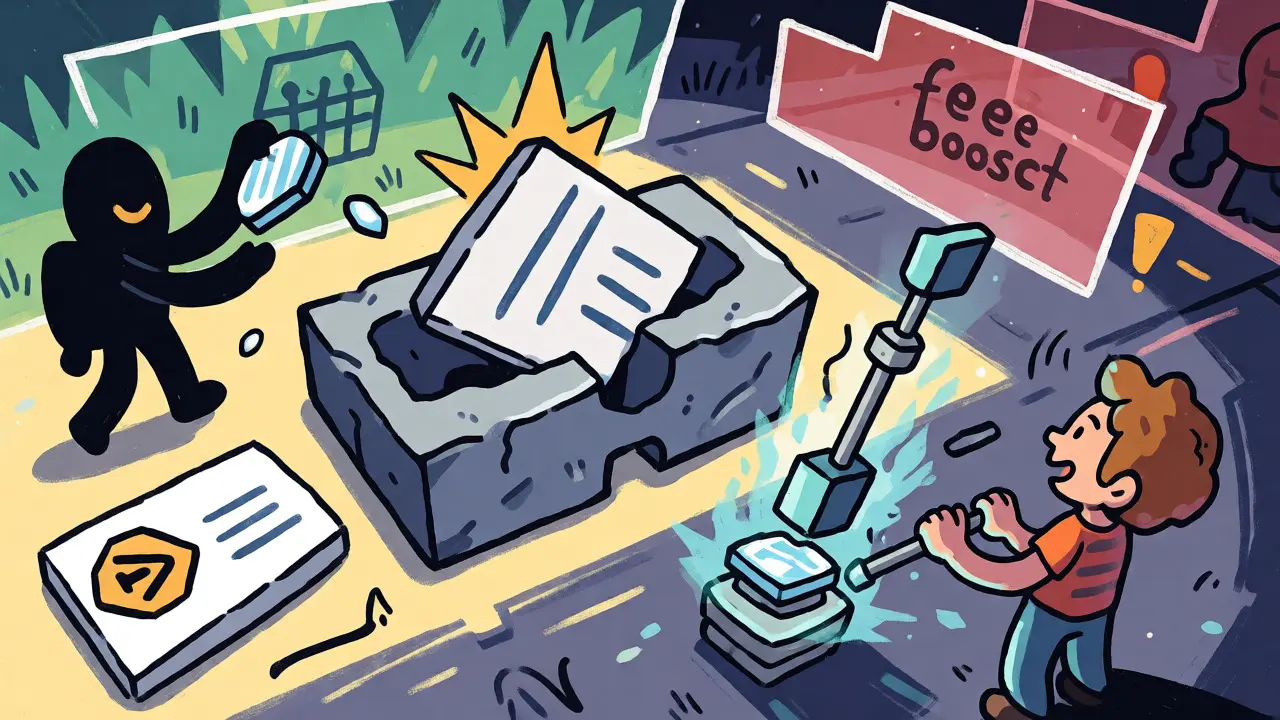
Public mempools are great for transparency but terrible for privacy. Anyone can watch your pending transactions. On Ethereum, this leads to "front-running" or "sandwich attacks," where bots see your large trade in the mempool, buy the asset before you, and sell it back to you at a higher price within the same block.
To combat this, services like Flashbots Protect route your transactions through a private mempool. These transactions bypass the public view and go directly to block builders. You gain protection from MEV (Maximal Extractable Value) extraction, but you rely on trusted infrastructure. It’s a trade-off: you keep more of your value, but you lose the pure decentralization of broadcasting to everyone equally.
Monitoring Tools and Practical Tips
You don’t need to run a node to understand what’s happening. Block explorers like Mempool.space or Etherscan provide real-time views of the public mempool. They show estimated confirmation times based on current fee markets. Use these tools before sending large amounts. If the recommended fee is 20 sat/vB, paying 15 might leave you waiting hours. Paying 25 ensures quick inclusion.
Developers should remember that acceptance by one node does not equal confirmation. Your app should listen for events across multiple providers if reliability matters. Also, never assume a transaction is lost just because it’s unconfirmed. Check the status via API. If it’s been dropped, rebroadcast it. If it’s replaced, update your UI accordingly.
Does my money disappear if a transaction stays in the mempool?
No. The coins are locked in your wallet as "unconfirmed" or "pending." They are not gone. If the transaction is eventually dropped from the mempool without being confirmed, the coins become spendable again, though you may need to rebroadcast them.
Is there one global mempool for all Bitcoin nodes?
No. Each node maintains its own local mempool. While they gossip transactions to peers, differences in configuration, bandwidth, and timing mean that no two nodes necessarily have identical pools at any given moment.
How long can a transaction stay in the mempool?
In Bitcoin, the default expiration is roughly 14 days (336 hours) for most nodes. On Ethereum, queued transactions may expire after a few hours (e.g., 3 hours in Geth defaults). However, if the network remains congested, low-fee transactions are often evicted much sooner to make room for higher-fee ones.
What is Replace-by-Fee (RBF)?
RBF is a Bitcoin protocol feature that allows you to replace an unconfirmed transaction with a new one that pays a higher fee. This is useful if you underestimated the fee during network congestion. Not all transactions signal RBF, so check your wallet settings before relying on it.
Why do miners choose some transactions over others?
Miners generally select transactions that offer the highest fee per unit of block space (fee rate). This maximizes their profit since block space is limited. Other factors can include transaction standardness, dependency chains, and private order flow arrangements.