
What Is Liquidity Mining and Why Does It Matter?
Imagine you own a small coffee shop. You want customers to line up, but the street is empty. What do you do? You hand out free cookies or offer a 'buy one, get one' deal. In the world of decentralized finance (DeFi), a financial system built on blockchain technology that operates without central intermediaries like banks, protocols face a similar problem. They need people to provide funds-called liquidity-so traders can buy and sell tokens instantly. To attract these providers, projects use a strategy called liquidity mining, an incentive mechanism where protocols distribute additional tokens to users who supply assets to liquidity pools.
Liquidity mining is essentially a reward system. When you deposit your crypto into a pool, you don't just earn trading fees; you also get extra tokens from the project itself. These are often governance tokens, which give you a say in how the protocol runs. This method became famous during the "DeFi summer" of 2020, when platforms like Compound started handing out their native tokens to anyone who supplied capital. Today, it remains a core part of tokenomics, the economic model of a cryptocurrency project, including its supply, distribution, and incentives.
But here’s the catch: it’s not free money. While the rewards can be juicy, there are real risks involved, especially something called impermanent loss. If you’re looking to understand how this works, whether it’s worth your time, or how projects design these programs, you’ve come to the right place.
How Liquidity Mining Works Step-by-Step
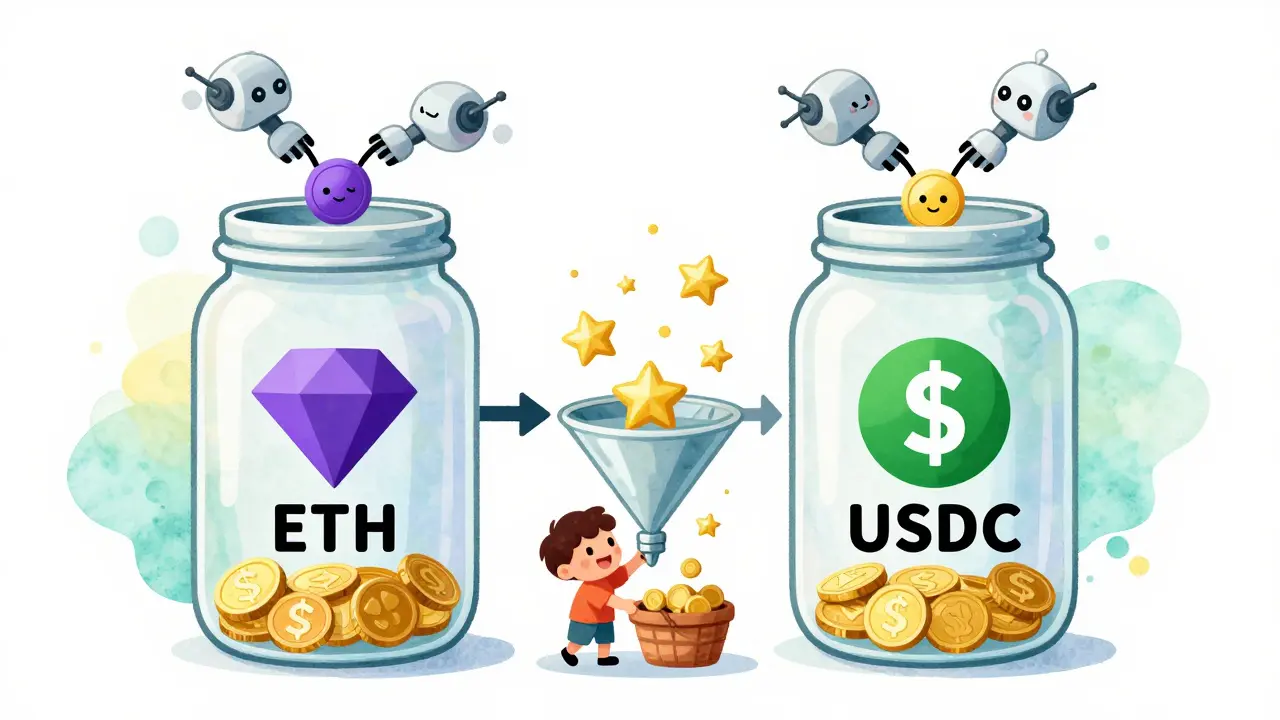
To grasp liquidity mining, you first need to understand automated market makers (AMMs), smart contracts that allow users to trade tokens directly with a pool of funds rather than matching buyers and sellers. Unlike traditional stock exchanges that use order books, AMMs rely on liquidity pools. These are smart contracts holding pairs of tokens, like ETH and USDC.
Here is how the process typically unfolds for a participant:
- Choose a Pool: You pick a pair on a decentralized exchange (DEX) like Uniswap or Curve. Let’s say you choose an ETH-USDC pool.
- Deposit Equal Value: You must deposit both tokens in equal value. If ETH is $3,000, you might deposit 1 ETH ($3,000) and 3,000 USDC. The total deposit is $6,000.
- Receive LP Tokens: The protocol gives you Liquidity Provider (LP) tokens. These represent your share of the pool. If the pool has $6 million total, your $6,000 means you own 0.1% of it.
- Earn Fees and Rewards: As traders swap tokens, they pay a fee (usually 0.25% to 0.3%). This fee is added to the pool, increasing the value of your LP tokens. On top of that, the protocol distributes its native reward tokens to all LPs based on their share.
- Claim and Withdraw: You can claim your reward tokens at any time. When you’re done, you burn your LP tokens to get your original deposits back, plus any accrued fees.
The magic happens in step four. Without the extra token rewards, earning only 0.3% in fees might not justify the risk. But if the protocol adds a 20% annual percentage yield (APY) in bonus tokens, the math changes dramatically. This is why liquidity mining is so powerful-it artificially boosts returns to attract capital quickly.
The Hidden Cost: Impermanent Loss Explained
If liquidity mining were perfect, everyone would do it. But there’s a significant downside known as impermanent loss, a temporary reduction in value experienced by liquidity providers when the price of deposited assets changes relative to each other. It sounds scary, but it’s just math.
Let’s look at a concrete example. Suppose you deposit 1 ETH and 3,000 USDC into a pool when ETH is priced at $3,000. Your total value is $6,000. Now, imagine ETH’s price doubles to $6,000. Because the AMM maintains a constant product formula, arbitrage bots will buy ETH from the pool and sell USDC into it until the ratio balances out. The pool now holds less ETH and more USDC than it did before.
When you withdraw, you’ll have fewer ETH tokens but more USDC. However, because ETH went up so much, the total value of your withdrawal might be less than if you had simply held 1 ETH and 3,000 USDC in your wallet. That difference is impermanent loss. It’s "impermanent" because if ETH prices return to $3,000, the loss disappears. But if ETH keeps rising, the loss grows.
So, how do you decide if it’s worth it? You compare the impermanent loss against the rewards. If the protocol pays out enough bonus tokens to cover the loss and then some, you profit. If not, you’d have been better off just holding your bags. This calculation is crucial for any serious provider.
Why Projects Use Liquidity Mining
From the project’s side, liquidity mining is a marketing and growth tool. New tokens have no liquidity. Without liquidity, you can’t trade them. Slippage would be huge, and spreads would be wide. No one wants to buy a token where selling it immediately loses you 10% of its value.
By offering token rewards, projects can bootstrap liquidity rapidly. Instead of waiting months for organic growth, they can fill pools in days. This creates a virtuous cycle: deeper liquidity attracts more traders, higher volume generates more fees, and more fees make the pool even more attractive. Additionally, distributing governance tokens to providers decentralizes ownership. It turns users into stakeholders who care about the protocol’s success because they have a vote in its future.
However, this approach isn’t without flaws. Many projects struggle with sustainability. Once the initial hype fades and token emissions slow down, the "mercenary capital" leaves. These are providers who chase high yields and jump ship the moment a better offer appears elsewhere. This leads to volatile liquidity levels and can crash the price of the reward token due to massive sell pressure.
Risks Beyond Impermanent Loss
Impermanent loss is the most discussed risk, but it’s not the only one. Here are other dangers you need to watch out for:
- Smart Contract Risk: Liquidity pools are code. If there’s a bug or a vulnerability, hackers can drain the entire pool. Always check if the protocol has been audited by reputable firms.
- Token Volatility: The reward tokens themselves can lose value. If you earn 100% APY in a token that drops 90% in price, you’ve actually lost money.
- Wash Trading: Some actors fake trading volume to farm rewards. This inflates the apparent health of a pool without adding real economic value. If you’re relying on fee income, wash trading dilutes your earnings.
- Regulatory Uncertainty: As governments clarify rules around securities and DeFi, some liquidity mining programs could be deemed illegal securities offerings, leading to delistings or bans.
These risks mean you shouldn’t just look at the APY number. A 1,000% APY on a new, unaudited protocol is far riskier than a 5% APY on a established platform like Aave or Uniswap.

Best Practices for Participants
If you’re ready to try liquidity mining, start small. Treat your first few deposits as tuition fees. Learn how the interface works, how to claim rewards, and how withdrawals behave under different market conditions.
Focus on stablecoin pairs or correlated assets if you want to minimize impermanent loss. For example, providing liquidity for USDC-USDT carries very little impermanent loss risk because both peg to the US dollar. The rewards might be lower, but your principal is safer.
Diversify your exposure. Don’t put all your capital into one protocol. Spread it across several reputable platforms. Also, keep an eye on the token emission schedule. If a project plans to halve rewards every three months, calculate whether the declining yield will still offset impermanent loss after the cut.
Finally, engage with the community. Join Discord servers and read governance proposals. Understanding the team’s vision and their plan for long-term sustainability can help you avoid projects that are likely to rug pull or fail.
The Future of Liquidity Incentives
The industry is evolving. Early liquidity mining was blunt and inefficient-just throw tokens at the problem. Now, we’re seeing more sophisticated approaches. Concepts like "liquidity targeting" suggest paying providers only for the liquidity that actually reduces slippage for typical trade sizes, rather than rewarding dead capital sitting at the bottom of deep pools.
We’re also seeing hybrid models. Some projects combine professional market makers for core pairs with liquidity mining for long-tail assets. This provides stability while still encouraging community participation. As DeFi matures, expect to see more data-driven incentive structures that prioritize efficiency over raw TVL (Total Value Locked).
For now, liquidity mining remains a double-edged sword. It democratizes access to market making and offers high yields, but it demands careful management and risk awareness. By understanding the mechanics and watching for red flags, you can navigate this space with confidence.
Is liquidity mining safe?
Liquidity mining involves significant risks, including impermanent loss, smart contract vulnerabilities, and token volatility. While it is not inherently unsafe, it requires thorough research into the protocol's audit status, tokenomics, and historical performance. Never invest more than you can afford to lose.
What is the difference between yield farming and liquidity mining?
The terms are often used interchangeably, but there is a subtle distinction. Liquidity mining specifically refers to providing liquidity to a pool to earn rewards. Yield farming is a broader term that includes liquidity mining but also encompasses staking tokens in lending protocols or complex strategies involving multiple DeFi platforms to maximize returns.
How do I calculate impermanent loss?
Impermanent loss depends on the price change of the assets in the pool. You can use online calculators available on sites like Beefy Finance or Yearn Finance. Generally, the greater the divergence in price between the two tokens, the higher the impermanent loss. Stablecoin pairs have near-zero impermanent loss.
Can I withdraw my funds anytime?
Yes, most liquidity pools allow you to withdraw your liquidity at any time by burning your LP tokens. However, doing so frequently incurs gas fees on networks like Ethereum. Additionally, withdrawing early means you may realize the impermanent loss if prices have moved significantly.
Which tokens are best for liquidity mining?
For beginners, stablecoin pairs (e.g., USDC/USDT) are the safest due to low impermanent loss. For higher risk tolerance, pairs involving major assets like ETH or BTC with stablecoins offer a balance of liquidity depth and potential rewards. Avoid obscure, low-volume tokens unless you fully understand the project and its tokenomics.