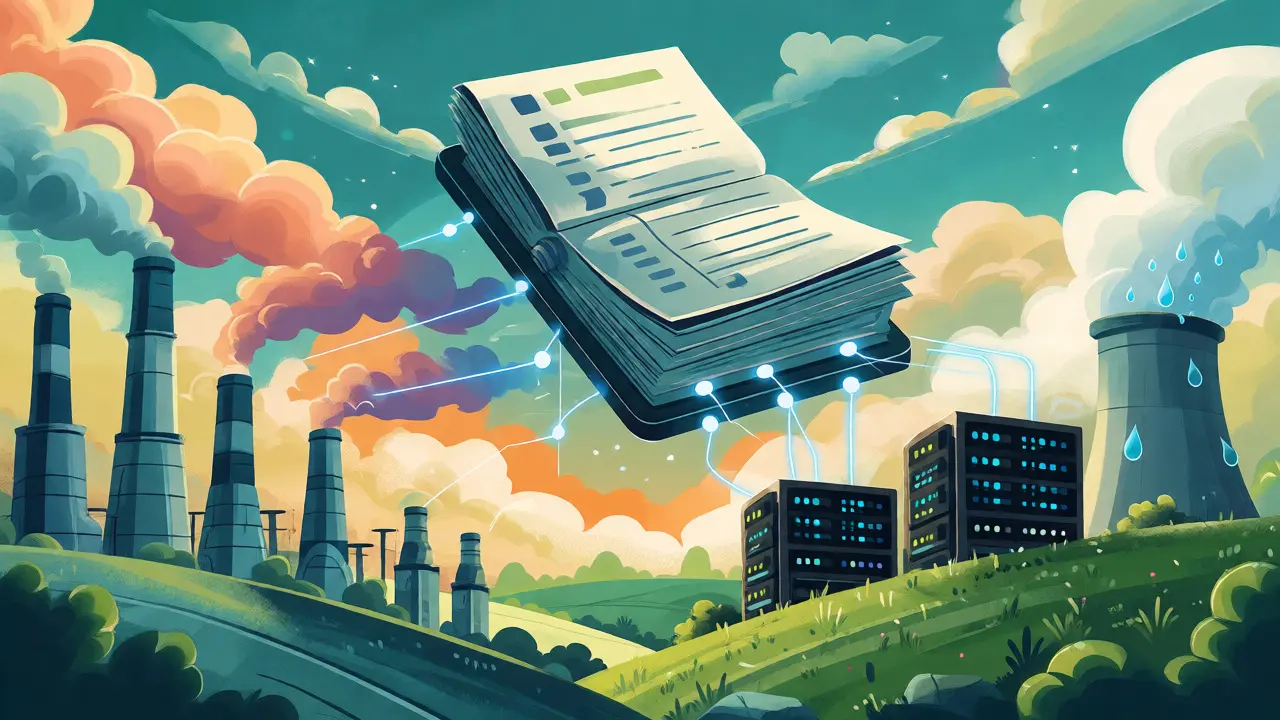
Think your digital transactions are invisible to the planet? Think again. While you might not see smokestacks when you send a Bitcoin or mint an NFT, the Life Cycle Assessment (LCA) of blockchain systems reveals a heavy physical footprint hidden behind the code. It’s not just about electricity bills; it’s about the mining rigs that burn out in months, the water used for cooling, and the land occupied by massive data centers. If you’re wondering whether crypto is a green technology or an environmental burden, standard LCA methods like ISO 14040 provide the hard numbers we need to stop guessing and start measuring.
What Is Life Cycle Assessment in the Context of Crypto?
Life Cycle Assessment is a standardized method that quantifies environmental impacts from raw material extraction through production, use, and disposal. In traditional manufacturing, this means tracking a car from steel mill to scrapyard. For blockchain, it’s trickier because the "product" is a digital ledger, but the infrastructure is very real. We have to look at three main phases: hardware production, operational energy use, and end-of-life waste management.
The International Organization for Standardization (ISO) sets the rules here with standards ISO 14040 and ISO 14044. These frameworks force researchers to define system boundaries clearly. Are we counting just the electricity used by a miner today? Or are we also counting the coal burned to build the GPU that runs the miner? Recent studies show that ignoring hardware production can skew results significantly, especially as energy grids get cleaner.
- Goal and Scope: Defining what you are measuring (e.g., one Bitcoin transaction vs. the whole network).
- Inventory Analysis: Listing all inputs (energy, materials) and outputs (emissions, heat).
- Impact Assessment: Converting those lists into indicators like global warming potential.
- Interpretation: Making sense of the data to guide policy or tech choices.
Bitcoin’s Environmental Footprint: More Than Just Electricity
Bitcoin gets the most attention, and for good reason. A landmark study from Aalborg University estimated that in 2018, the Bitcoin network consumed 31.29 TWh of electricity, resulting in a carbon footprint of 17.29 MtCO₂-eq. To put that in perspective, that’s comparable to the annual emissions of some mid-sized countries. But here’s where it gets complicated: newer research suggests that looking only at electricity misses half the story.
A 2024 preprint on arXiv found that when miners use low-carbon electricity, the production of Application-Specific Integrated Circuits (ASICs) can account for up to 80% of total life cycle impacts. Why? Because ASICs are power-hungry and become obsolete quickly. They contain rare metals and require energy-intensive manufacturing processes. If your grid is already green, the dirty part of Bitcoin isn’t the plug-it’s the factory.
| Impact Driver | Contribution Type | Key Metric | Mitigation Strategy |
|---|---|---|---|
| Operational Energy | Electricity consumption during mining | TWh per year | Shift to renewable energy sources |
| Hardware Production | Manufacturing of ASICs and GPUs | kg CO₂-eq per device | Improve device lifespan and recycling |
| Cooling Water | Water withdrawal for thermal management | Liters per kWh | Use dry cooling or waste heat recovery |
| E-Waste | Disposal of obsolete mining rigs | Tonnes of e-waste per year | Develop circular economy models |

The Ethereum Merge: A Case Study in Protocol Efficiency
If Bitcoin is the cautionary tale, Ethereum’s "Merge" in September 2022 is the success story. By switching from Proof-of-Work (PoW) to Proof-of-Stake (PoS), Ethereum slashed its energy consumption by roughly 99.95%. Before the transition, Ethereum used about 25.7 TWh per year-enough to power Ireland. After the switch, that dropped to negligible levels, around 7.87 GWh annually according to recent Cambridge Centre for Alternative Finance updates.
This wasn’t just a minor tweak; it was a fundamental redesign of how consensus is reached. PoW requires miners to solve complex puzzles using brute-force computing power. PoS relies on validators who stake their own coins, requiring far less computational work. The Stanford analysis highlighted that this single software update reduced global energy usage by 0.11%. That’s a massive win for sustainability advocates who argue that protocol design matters more than offsetting carbon credits.
Using Blockchain to Improve LCA Data
Here’s the twist: blockchain isn’t just the subject of LCA; it’s also a tool for doing better LCAs. Traditional supply chain data is often siloed, unreliable, or self-reported. Imagine trying to track the carbon footprint of a cotton shirt from farm to store. You rely on suppliers’ word, which can be shaky.
Blockchain-based LCA architectures use IoT sensors to record real-time data-like energy meters tracking kWh or flow meters tracking kg of material-and write that data to a permissioned ledger. Because the ledger is immutable, once the data is recorded, it can’t be quietly edited later. This creates a trusted trail for auditors and consumers. A 2024 review found that while only 13.6% of LCA papers currently use blockchain, adoption is growing as companies seek verifiable environmental claims.
However, this solution has its own costs. Running blockchain nodes consumes energy and resources. If you’re using a public, energy-intensive chain to track green data, you might be adding to the problem you’re trying to solve. Most successful implementations use private, permissioned chains with low-energy consensus mechanisms to keep the overhead minimal.

Methodological Pitfalls and Regional Variations
One size does not fit all in blockchain LCA. The environmental impact of mining depends heavily on where it happens. Mining in Iceland, powered by geothermal energy, looks very different from mining in Kazakhstan, where coal dominates the grid. Generic "average" numbers can be misleading if they don’t account for these geographic nuances.
Another common pitfall is the system boundary error. Should we count the electricity that *could* have been sent to the local grid if not used by miners? This concept, known as "opportunity cost," is critical in behind-the-meter mining scenarios. If a stranded gas flare is captured to power miners, the net impact might be positive compared to venting the gas directly into the atmosphere. But if miners compete with residential users for limited renewable capacity, the impact could be negative. Transparent assumptions about these boundaries are essential for credible results.
Water usage is another overlooked factor. A 2025 study in ACS Sustainable Chemistry & Engineering emphasized that cooling water withdrawals and land occupation by large facilities can strain local ecosystems even if carbon intensity is moderate. Ignoring water stress in arid regions paints an incomplete picture of sustainability.
Future Outlook: Circular Economy and Regulation
Where do we go from here? The industry is moving toward two main goals: decarbonizing energy sources and closing the loop on hardware. As grids get greener, the relative impact of hardware production grows. This puts pressure on manufacturers to design durable, repairable, and recyclable mining equipment. The current model of "use for 18 months, then discard" is unsustainable.
Regulators are paying attention too. New York State has scrutinized fossil-fuel-powered mining, and China’s previous ban reshaped the global hash rate distribution. Future regulations will likely lean on LCA data to set standards for what constitutes "green" crypto operations. Expect to see more mandates for transparent reporting, similar to financial disclosures.
For developers and investors, the takeaway is clear: efficiency is no longer optional. Whether you’re building a new blockchain or buying into an existing one, check the consensus mechanism and the energy mix. The days of ignoring the physical layer of digital assets are over.
Does blockchain always have a high environmental impact?
No. The impact depends entirely on the consensus mechanism and energy source. Proof-of-Work blockchains like Bitcoin consume significant energy, while Proof-of-Stake networks like Ethereum post-Merge use drastically less. Additionally, private blockchains optimized for enterprise use can have a near-zero operational footprint.
Why is hardware production important in blockchain LCA?
Mining hardware, such as ASICs, becomes obsolete quickly due to rising difficulty levels. Manufacturing these devices requires energy-intensive processes and rare materials. As electricity grids become cleaner, the embodied carbon in producing this hardware can become the dominant contributor to the total life cycle impact.
How does location affect the carbon footprint of mining?
Location determines the carbon intensity of the electricity used. Mining in regions with hydro, wind, or solar power has a much lower footprint than mining in areas reliant on coal or natural gas. Geographic resolution in LCA studies is crucial for accurate assessments.
Can blockchain help reduce the environmental impact of other industries?
Yes, by improving data traceability. Blockchain can verify supply chain data collected via IoT sensors, ensuring that environmental claims (like fair trade or low carbon) are tamper-proof. This helps companies optimize their own LCAs and reduces fraud in green certifications.
What is the difference between cradle-to-gate and cradle-to-grave LCA?
Cradle-to-gate covers the lifecycle from raw material extraction to the factory gate (production). Cradle-to-grave includes the use phase and end-of-life disposal or recycling. For blockchain, cradle-to-grave is preferred because it accounts for the long operational life and eventual e-waste generation of hardware.