
You see a 40% APY on a dashboard. It looks like free money. You deposit your ETH, borrow some USDC, swap it for more ETH, and redeposit. Suddenly, your capital is working twice as hard. But then the market dips 5%. Your position gets liquidated. You lose everything. This isn't a horror story; it's Tuesday in Leveraged Yield Farming within Decentralized Finance (DeFi).
Leveraged yield farming is the art of using borrowed money to amplify returns in DeFi protocols. It’s not a single product but a strategy loop: supply collateral, borrow assets, deploy them into yield-bearing pools, and repeat. The goal? To make your initial equity earn yield on a larger base than you actually own. While the upside can be juicy, the downside is brutal and fast. If you’re thinking about jumping in, you need to understand that advertised APYs are often mirages until you subtract debt costs, fees, and risk premiums.
How the Leverage Loop Actually Works
The mechanics are surprisingly simple, which is part of the danger. Imagine you have $1,000 worth of Ethereum (ETH). You deposit this into a lending protocol like Aave, a decentralized liquidity protocol where users can lend and borrow crypto assets. Aave might let you borrow up to 65% of that value in another asset, say USDC. You take that $650 in USDC, swap it for more ETH, and deposit that back into Aave. Now you have roughly $1,650 in collateral supporting a $650 debt. You can do this again. Each step increases your exposure.
In a simplified model with a constant Loan-to-Value (LTV) ratio, your effective leverage is calculated as 1 divided by (1 minus LTV). With a 65% LTV, your theoretical exposure is about 2.86x your original capital. That means if ETH goes up 10%, you gain nearly 28.6% on your equity. But flip that script: if ETH drops 10%, you lose nearly 28.6% of your equity before you even pay interest or fees. This "leveraging spiral" amplifies both gains and losses, turning small market moves into massive portfolio swings.
The Reward Structure: More Than Just Interest
Why do people do this? Because the rewards stack. In traditional finance, borrowing costs money. In DeFi, you often get paid to borrow-or at least, the cost is offset by multiple income streams. These include:
- Lending Interest: The baseline APR from supplying collateral.
- Borrowing Rebates: Sometimes negative rates mean you get paid to hold debt.
- Trading Fees: If you provide liquidity to an AMM like Uniswap, an automated market maker protocol that allows anyone to trade cryptocurrencies., you earn a cut of every swap.
- Token Emissions: Governance tokens like COMP or ARB distributed as incentives.
- Staking Rewards: Additional yields from locking tokens in other protocols.
However, these rewards are variable. They aren’t fixed contracts. When more capital floods into a pool, the share of rewards per dollar shrinks. When governance changes token emissions, your projected APY vanishes overnight. A nominal 30% APY can easily turn negative if the reward token loses half its value or if borrowing rates spike due to high utilization. Always calculate your net return on equity after subtracting the borrow APR and all transaction costs.

The Risk Landscape: Liquidation and Impermanent Loss
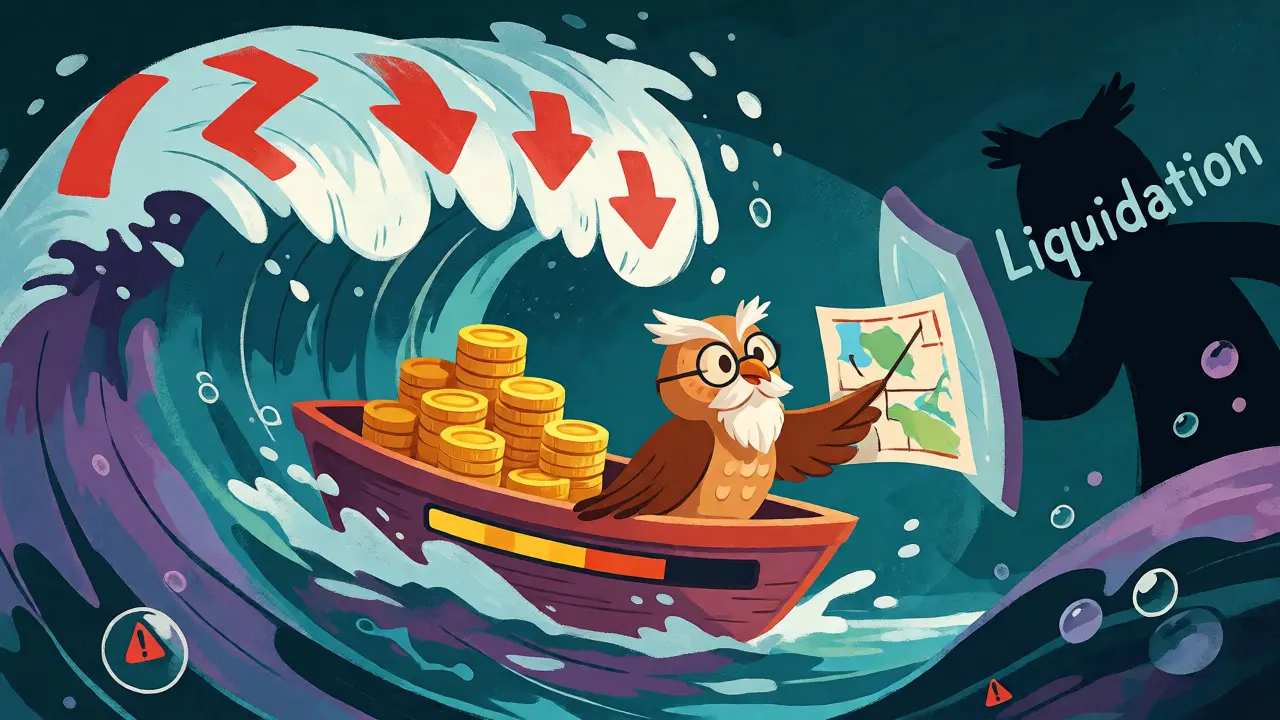
Risk in leveraged farming comes from two main directions: price volatility and protocol mechanics. The biggest threat is Liquidation, the forced sale of collateral when the health factor of a loan falls below a specific threshold. Protocols use a "Health Factor" to measure solvency. If your collateral value drops relative to your debt, your Health Factor decreases. Once it hits 1.0, liquidators swoop in, repay your debt, and take your collateral at a discount (often 5-10%). You lose the principal plus the penalty.
Then there’s Impermanent Loss, the opportunity cost incurred when providing liquidity to an AMM compared to simply holding the assets. If you’re farming on Uniswap V3, you’re exposed to this. Uniswap defines impermanent loss mathematically: a 2x price change results in about a 5.7% loss versus holding. Leverage magnifies this because you’re managing a larger position with borrowed funds. If the price moves out of your selected range in a concentrated liquidity position, you stop earning fees entirely while still paying interest on the debt.
| Strategy | Liquidation Risk | Impermanent Loss | Capital Efficiency | Complexity |
|---|---|---|---|---|
| Unleveraged LP | None | High | Low | Medium |
| Direct Lending | None (Supplier) | None | Low | Low |
| Leveraged Farming | High | Amplified | Very High | High |
| Staking | Slashing Risk | None | Medium | Low |
Hidden Costs and Market Dynamics
It’s not just about price charts. Borrowing rates on platforms like Aave are dynamic. They rise as more people borrow. During market stress, everyone wants to deleverage, causing rates to spike. Simultaneously, liquidity dries up. This creates a perfect storm: your collateral value drops, your interest payments skyrocket, and you can’t exit without massive slippage. Gas fees also eat into profits, especially on Ethereum mainnet. A failed transaction during a volatile moment can leave you stuck in a bad position while prices move against you.
Security is another layer. Smart contracts can have bugs. Oracles, which feed price data to the blockchain, can fail or be manipulated. In 2023, DeFi hacks resulted in significant losses, with yield-farming protocols and bridges being prime targets. Even if the code is audited, governance attacks or malicious upgrades can alter parameters unexpectedly. You are trusting complex software with your life savings, often across multiple chains via bridges, each adding its own failure point.
Practical Implementation: How to Not Get Wrecked
If you’re determined to try this, don’t go max leverage immediately. Start conservative. Calculate your position health under stress scenarios: what happens if your collateral drops 25%? What if borrow rates double? Use tools to simulate these outcomes. Maintain a Health Factor buffer well above 1.0-aim for 1.5 or higher-to give yourself room to breathe during volatility.
Choose your pairs wisely. Stablecoin pairs (like USDC/USDT) have minimal impermanent loss but lower yields. Volatile pairs offer higher potential returns but carry extreme IL risk. Diversify across protocols and chains to avoid single points of failure. Set up alerts for Health Factor drops. Automation tools can help manage rebalancing, but they add their own smart contract risk. Remember, no advertised APY is real until you’ve deducted interest, fees, and accounted for the probability of liquidation.
Frequently Asked Questions
Is leveraged yield farming safe?
No, it is inherently risky. While the underlying protocols may be audited, the strategy introduces liquidation risk, amplified impermanent loss, and exposure to oracle failures. It is suitable only for those who understand the mechanics and can tolerate total loss of capital.
What is the biggest risk in leveraged farming?
Liquidation is the primary risk. If the value of your collateral falls relative to your debt, the protocol automatically sells your assets to repay the loan, often at a discounted price, resulting in permanent capital loss.
Can I lose more than my initial investment?
Generally, no. Most overcollateralized DeFi protocols liquidate positions before the debt exceeds the collateral value. However, in extreme market gaps or oracle failures, slight over-losses are possible, though rare.
How does impermanent loss affect leveraged positions?
Leverage amplifies impermanent loss. Since you are managing a larger position size with borrowed funds, any divergence between the paired assets' prices results in a greater percentage loss on your equity compared to an unleveraged position.
Which protocols are best for leveraged farming?
Aave and Compound are leaders for lending-based leverage due to deep liquidity and robust security. For AMM-based leverage, platforms like Gearbox or specialized vaults on Yearn Finance offer integrated solutions. Always check current TVL and audit status.