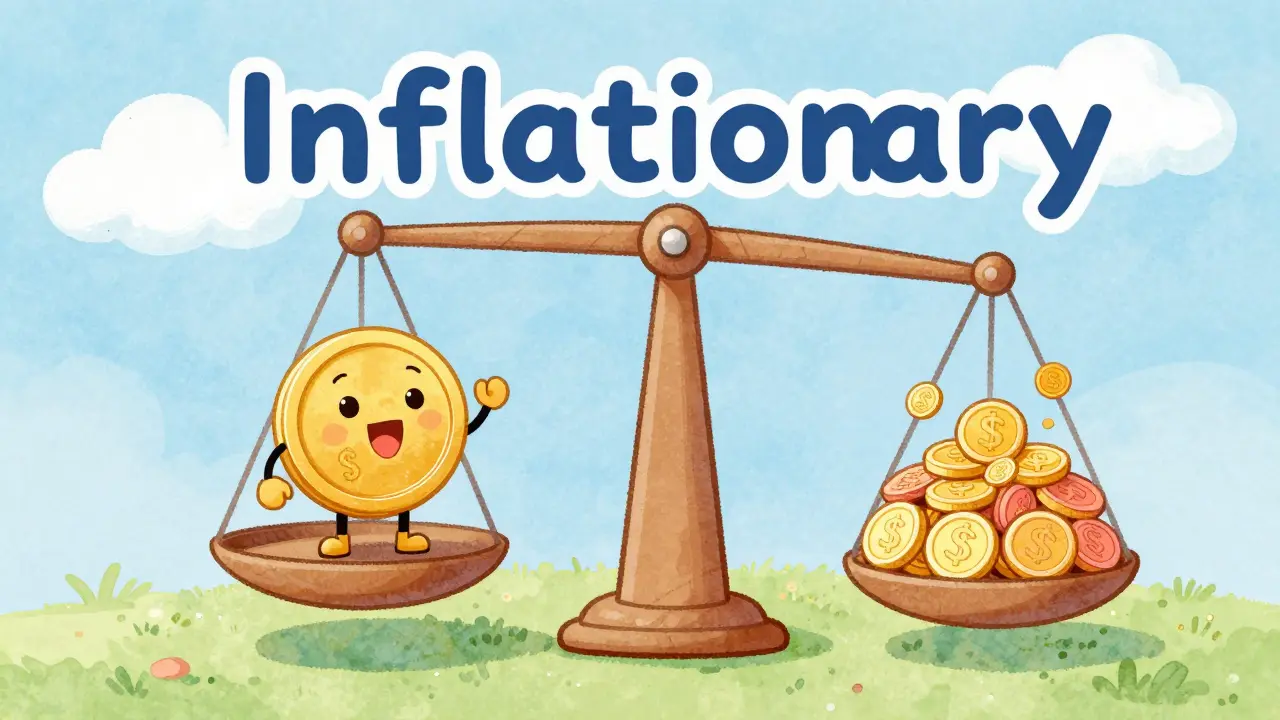
Imagine you’re holding a digital asset. You check the price today, and it’s $10. A year from now, is that same token worth more because there are fewer of them left? Or is it worth less because millions of new ones were printed out of thin air? This isn’t just a question about market sentiment or hype. It’s about the fundamental engine driving the value of the asset: token supply dynamics.
In the world of cryptocurrency, money doesn't behave like the cash in your wallet. There’s no central bank printing presses churning out bills based on economic data. Instead, code dictates whether a token’s supply grows (inflation) or shrinks (deflation). Understanding these mechanisms is crucial for anyone looking to invest, build, or simply hold crypto assets in 2026.
What is an Inflationary Token Model?
An inflationary token model is one where the circulating supply increases over time. New tokens are continuously created and added to the network, usually as rewards for miners, validators, or liquidity providers. Think of it like a company issuing new shares to pay employees; everyone gets paid, but existing shareholders own a slightly smaller percentage of the pie unless they buy more.
The Mechanics of Inflationary Tokens
When we talk about inflation in traditional economics, we often think of rising grocery prices. In tokenomics, inflation refers specifically to the increase in the number of tokens available. An inflationary token is a cryptocurrency designed with a supply schedule that adds new units to circulation at a predetermined rate.
Why would a project want this? The primary driver is incentive alignment. Blockchains need security. In Proof-of-Work systems like Bitcoin (early stages) or Litecoin, miners spend electricity to secure the network. They are paid in newly minted coins. In Proof-of-Stake networks like Ethereum or Cardano, validators lock up their stake to verify transactions and earn new tokens as a reward.
- Block Rewards: New tokens issued to miners or validators for processing blocks.
- Staking Yields: Tokens distributed to users who lock their assets to support network consensus.
- Liquidity Mining: Tokens given to users who provide liquidity to decentralized exchanges (DEXs).
This constant influx of new supply ensures that participants are motivated to keep the network running. Without these rewards, security could collapse. However, there’s a catch. If the supply grows faster than demand, the purchasing power of each individual token drops. This is dilution. If you hold 100 tokens and the total supply doubles while your holdings stay the same, your relative ownership is cut in half.
Understanding Deflationary Token Models
On the other side of the spectrum sits the deflationary model. Here, the goal is scarcity. A deflationary token is a cryptocurrency whose total supply decreases over time through mechanisms like burning or fee destruction.
The most common mechanism here is "burning." Burning means sending tokens to an address from which they can never be retrieved-effectively deleting them. Some projects burn a portion of every transaction fee. Others conduct periodic buyback-and-burn events using protocol revenue.
Take Binance Coin (BNB) as a prime example. For years, BNB has utilized an auto-burn mechanism tied to its price and total supply, aiming to reduce its maximum supply from 200 million to 100 million. As the supply shrinks, basic economic theory suggests that if demand remains steady or increases, the price per token should rise. This appeals heavily to long-term investors who view the token as a store of value, similar to gold.
However, deflation comes with its own set of challenges. If everyone believes the token will only go up in value, nobody wants to sell. This leads to hoarding. When tokens are hoarded, liquidity dries up. Liquidity is the ability to buy or sell an asset quickly without causing a massive price swing. A deflationary token with low liquidity can become a nightmare for traders trying to enter or exit positions.
Comparing Supply Schedules: A Practical Look
To really grasp the difference, let’s look at how these models play out in real-world scenarios. Not all tokens fit neatly into "inflationary" or "deflationary" boxes. Many exist in a hybrid state or transition between the two.
| Feature | Inflationary Model | Deflationary Model |
|---|---|---|
| Supply Trend | Increases over time | Decreases over time |
| Primary Mechanism | Block/Staking Rewards | Token Burns/Fee Destruction |
| Purchasing Power | Tends to decrease (dilution) | Tends to increase (scarcity) |
| Liquidity | Generally higher (more float) | Can be lower (hoarding risk) |
| Best Use Case | Medium of exchange, Gas fees | Store of value, Long-term investment |
| Example | Ethereum (ETH), Solana (SOL) | Binance Coin (BNB), Shiba Inu (SHIB)* |
*Note: SHIB employs burns, but its overall dynamics are complex due to initial distribution. BNB is a clearer example of systematic deflation via auto-burns.

Liquidity and Market Depth: The Hidden Factor
Most retail investors focus on price charts. But professional traders and protocol designers care deeply about liquidity. Liquidity depends on two things: the amount of tokens available for trade (float) and the willingness of holders to transact.
Inflationary tokens naturally maintain a healthy float. Because new tokens are constantly entering the market as rewards, there is always fresh supply available for trading. This makes them ideal for use as a medium of exchange. If you want to pay for a service or swap tokens on a decentralized exchange, you need liquidity. An inflationary design ensures that the token doesn’t disappear into cold wallets forever.
Conversely, deflationary tokens can suffer from liquidity crunches. If the narrative is "hold forever," then the order books on exchanges become thin. Thin order books mean high slippage. Slippage is the difference between the expected price of a trade and the price at which the trade is executed. High slippage eats into profits and discourages large institutional players from participating. This is why many successful ecosystems use a dual-token model: an inflationary utility token for daily operations and a deflationary governance token for value storage.
Security vs. Scarcity: The Trade-Off
Here is the core tension in tokenomics: How do you fund network security without destroying value through inflation? Or, how do you create scarcity without starving the network of incentives?
In Proof-of-Stake networks, inflation is essentially the salary for security. Validators take risks by locking up capital. If the inflation rate is too low, they might find better returns elsewhere, leaving the network vulnerable to attacks. If the inflation rate is too high, existing holders get diluted, leading to selling pressure that crashes the price. It’s a delicate balancing act.
Deflationary models solve the dilution problem but must find alternative ways to fund development and security. They often rely on transaction fees rather than new issuance. For example, after Ethereum’s "Merge" and subsequent upgrades, a significant portion of ETH issuance is burned via EIP-1559. During periods of high network activity, the burn rate exceeds the issuance rate, making Ethereum net-deflationary. This creates a dynamic where the token’s monetary policy adjusts automatically based on usage. High usage = high burns = deflation. Low usage = low burns = mild inflation. This is a sophisticated hybrid approach that aims to get the best of both worlds.

Real-World Examples and Lessons
Let’s look at how major protocols handle this. Bitcoin is often cited as the ultimate deflationary asset due to its hard cap of 21 million coins. However, until that cap is reached, Bitcoin is technically disinflationary. Its inflation rate halves approximately every four years. This predictable reduction in supply growth has created a powerful narrative of scarcity.
Solana (SOL), on the other hand, has a fixed annual inflation rate that gradually decreases to a terminal rate of 1.5%. This steady, predictable inflation funds its high-speed network and validator ecosystem. Investors accept the dilution because they believe the utility and adoption growth will outpace the supply increase.
Then there are meme coins or community-driven tokens that implement aggressive burns. These often see short-term price spikes due to FOMO (Fear Of Missing Out) driven by the scarcity narrative. But without underlying utility or consistent demand, the deflationary mechanic alone cannot sustain value. Price goes up not just because supply is down, but because demand is volatile. If demand vanishes, even a shrinking supply won’t save the price.
How to Evaluate Token Supply Before Investing
So, what should you look for when analyzing a new project? Don’t just read the whitepaper’s marketing fluff. Dig into the tokenomics dashboard.
- Check the Maximum Supply: Is there a hard cap? If yes, what is it? If no, what is the annual inflation rate?
- Analyze the Vesting Schedule: Even if a token is deflationary, if early investors have locked tokens that unlock in six months, you face massive sell pressure. Unlocking schedules often outweigh burn mechanics in the short term.
- Look at the Burn Mechanism: Is the burn automatic and tied to usage (like ETH or BNB)? Or is it discretionary, decided by a team vote? Automatic burns are more trustworthy because they are transparent and cannot be manipulated.
- Assess Utility Demand: Why do people need the token? If it’s only for speculation, deflation might help price but hurt liquidity. If it’s needed for gas, voting, or payments, inflation might be necessary to keep the ecosystem alive.
Remember, neither inflation nor deflation is inherently good or bad. They are tools. A hammer is great for nails but terrible for screws. Inflationary tokens are excellent for active, high-throughput networks that need to incentivize participation. Deflationary tokens excel as stores of value where scarcity drives long-term appreciation. The best projects often blend these approaches, adjusting their supply dynamics as they mature from early-stage growth to established stability.
Does a deflationary token guarantee price increases?
No. While deflation reduces supply, price is determined by both supply and demand. If demand for a token drops significantly, the price can fall even if the supply is shrinking. Deflation only supports price appreciation if demand remains stable or grows.
What is the difference between disinflation and deflation?
Disinflation means the rate of supply growth is slowing down, but the total supply is still increasing. Deflation means the total supply is actually decreasing. For example, if a token’s annual inflation drops from 5% to 2%, it is disinflating. If 1% of tokens are burned annually, it is deflating.
Why do some blockchains choose inflationary models?
Inflationary models are used to reward network participants (miners, validators, stakers) who secure the blockchain. Without new token issuance, there may not be enough incentive to maintain network security and decentralization. It also helps ensure sufficient liquidity for transactions.
How does token burning work?
Token burning involves sending tokens to a "burn address"-a public key that no one controls. Once sent there, the tokens are permanently removed from circulation. This can happen automatically via transaction fees or manually through buyback programs funded by the project.
Can a token switch from inflationary to deflationary?
Yes. Many tokens start with inflationary emissions to bootstrap security and liquidity. Later, they may introduce burn mechanisms or reduce issuance rates so much that burns exceed new creation, resulting in net deflation. Ethereum is a notable example of this dynamic shift.