
Ever wonder why your call connects instantly whether you're dialing a landline in a small town or a mobile phone across the ocean? It feels like magic, but it's actually a complex dance of data packets and digital handshakes. While old-school phones relied on physical copper wires and circuit switching, modern communication happens through VoIP is Voice over Internet Protocol, a technology that converts voice signals into digital data packets for transmission over IP networks . Instead of a dedicated line, your voice is chopped into tiny pieces and sent across the internet, similar to how an email is delivered.
The Digital Engine: How SIP Manages the Call
Before any audio is actually transmitted, the system needs to figure out where the call is going and if the other person is even available. This is where SIP (Session Initiation Protocol) comes in. Think of SIP as the digital operator. It doesn't carry the voice itself; instead, it handles the "signaling." It finds the recipient, rings their device, and establishes the connection.
When you hit dial, the VoIP device sends a request to a SIP Registrar, which acts like a phone book for the internet. The registrar checks where the target device is located on the network. If the system recognizes the number or device, it sends back the necessary packets to start the session. Once the "handshake" is complete, the system switches from SIP to TCP/IP to move the actual voice data efficiently.
Routing Paths: From IP to the Traditional Phone World
Not everyone is on a VoIP system. You might be using a high-tech office setup, but you're calling a grandmother who still uses a landline. This requires bridging two completely different worlds: the packet-switched internet and the PSTN (Public Switched Telephone Network), which is the legacy global network of copper wires.
To make this work, the system uses an IP-PSTN Gateway. This piece of hardware or software acts as a translator. It takes the digital packets from the internet and converts them into electrical signals that the traditional phone network can understand. Depending on who is calling whom, the route changes:
- VoIP-to-VoIP: The fastest and simplest path. The call stays on the internet from start to finish.
- VoIP-to-PSTN: Your call starts as data, hits a gateway, and then travels over traditional phone lines to the recipient.
- PSTN-to-VoIP: The reverse happens; a landline call is converted into data packets at a gateway before arriving at your VoIP phone.
- PSTN-to-PSTN: A traditional call that never touches the VoIP world, typically routed via SS7 (Signaling System No. 7), the global standard for landline signaling.
| Feature | VoIP Routing | PSTN Routing |
|---|---|---|
| Medium | Fiber/Broadband (IP Packets) | Copper Wires (Circuits) |
| Primary Protocol | SIP / TCP/IP | SS7 |
| Flexibility | High (Programmable rules) | Low (Fixed physical paths) |
| Cost Structure | Low (Uses existing data) | High (Dedicated line costs) |

Smart Routing: More Than Just Connecting A to B
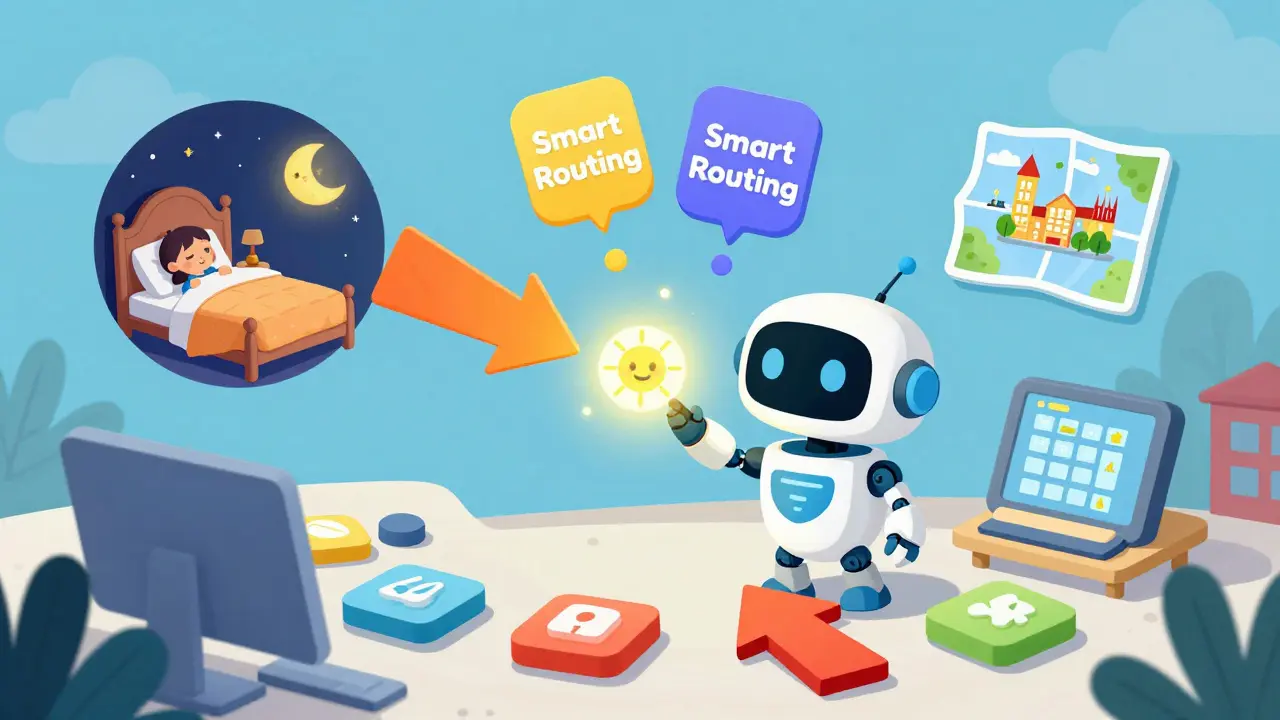
One of the biggest perks of VoIP call routing is that it's programmable. Unlike a landline, which just rings a bell, a VoIP system can analyze a call in real-time and make decisions. For example, a business can set rules based on the time of day. If a customer calls at 2:00 AM, the system knows to route the call to an overnight answering service instead of a sleeping employee.
Many companies use an IVR (Interactive Voice Response) system to manage this. You've experienced this when a recording says, "Press 1 for Sales, Press 2 for Support." This isn't just a menu; it's a routing instruction. The system takes the user's input and instantly redirects the data stream to a specific group of employees or a different office entirely.
Advanced setups also use location-based routing. If a caller has a UK area code, the system can automatically route them to a team member in the London office. This ensures the customer speaks to someone who understands their regional requirements without having to be manually transferred.
Handling the "Edge Cases": Adapters and Portability
What happens if you have an expensive old analog phone but want the benefits of VoIP? You don't have to throw the phone away. You can use an ATA (Analog Telephone Adapter). This small device plugs into your phone and your internet router, converting the analog signal of the old phone into the digital packets required by the network.
Another challenge is Mobile Number Portability (MNP). When people switch carriers but keep their phone numbers, the routing system has to know where that number actually lives. In some countries, there's a central database to check this. In others, like the UK, the VoIP system might need to query the mobile network directly to find the correct "home network" for the recipient to avoid a dead-end call.
Avoiding the "Dead-End" Call
The biggest nightmare for any business is the "dead-end"-where a customer calls and gets no answer, no voicemail, and no one to help. To prevent this, engineers build fallback options into the architecture. A typical fallback chain might look like this: Ring the primary agent → if no answer after 15 seconds, ring the team lead → if still no answer, send to a shared queue → finally, route to a recorded voicemail.
This logic is handled by the VoIP server's routing table. By setting these priorities, businesses ensure that every single call is captured, regardless of whether the primary recipient is on a coffee break or in a meeting.
Does VoIP require a special internet connection?
No, VoIP works on standard broadband internet. However, because voice calls happen in real-time, they are sensitive to "jitter" or lag. For the best experience, many people use Quality of Service (QoS) settings on their routers to prioritize voice traffic over other data, like Netflix or file downloads.
What is the difference between SIP and VoIP?
VoIP is the broad term for the entire technology of making voice calls over the internet. SIP is the specific protocol (the set of rules) used to start, manage, and end those calls. In simple terms, VoIP is the concept, and SIP is the tool that makes it happen.
Can I use my old analog phone with a VoIP system?
Yes, by using an Analog Telephone Adapter (ATA). The ATA converts the traditional analog signals from your old phone into digital packets that can travel over your internet connection.
How does a VoIP call reach a regular landline?
It uses an IP-PSTN gateway. This device acts as a bridge, translating the digital IP packets used by the VoIP system into the electrical signals used by the traditional Public Switched Telephone Network (PSTN).
Why do some VoIP calls have a slight delay?
This is called latency. Since voice is broken into packets and sent across various routers and servers on the internet, there can be a tiny delay in transmission. While usually unnoticeable, it can become apparent if the network is congested or the call is traveling across the globe.