
You hold cryptocurrency, but it just sits there in your wallet. Meanwhile, the blockchain networks you trust are working hard to secure transactions and validate blocks. Why not get paid for helping them? That is the core promise of crypto staking. It turns your idle digital assets into a source of passive income without needing expensive mining rigs or complex technical setups.
Staking has exploded in popularity since Ethereum shifted from energy-heavy mining to Proof-of-Stake (PoS) in September 2022. Today, over $145 billion is locked up in staking contracts across major platforms like Kraken, Coinbase, and Bitpanda. For beginners, this means you can start with as little as $10 and earn annual percentage rates (APR) ranging from 3% to 18%, depending on the coin. But how do you actually do it without losing money to fees or penalties?
What Is Crypto Staking and How Does It Work?
To understand staking, you first need to grasp how blockchains agree on the truth. Older systems like Bitcoin use Proof-of-Work (PoW), where miners compete to solve puzzles using massive amounts of electricity. PoS changes the game. Instead of competing hardware, validators lock up their own coins as collateral to prove they have skin in the game.
When you stake your crypto, you are essentially renting out your coins to help secure the network. In return, the network pays you interest. Think of it like a savings account, but instead of a bank holding your money, the decentralized network holds it. If a validator acts maliciously or goes offline, they face "slashing"-a penalty where part of their staked funds are burned or redistributed to honest participants. This keeps the network safe and efficient.
Is staking better than mining?
For most people, yes. Mining requires specialized hardware and high electricity bills. Staking only requires the cryptocurrency itself and an internet connection, making it accessible to retail investors with minimal capital.
Choosing Your Staking Method: Exchange vs. Direct vs. Pools
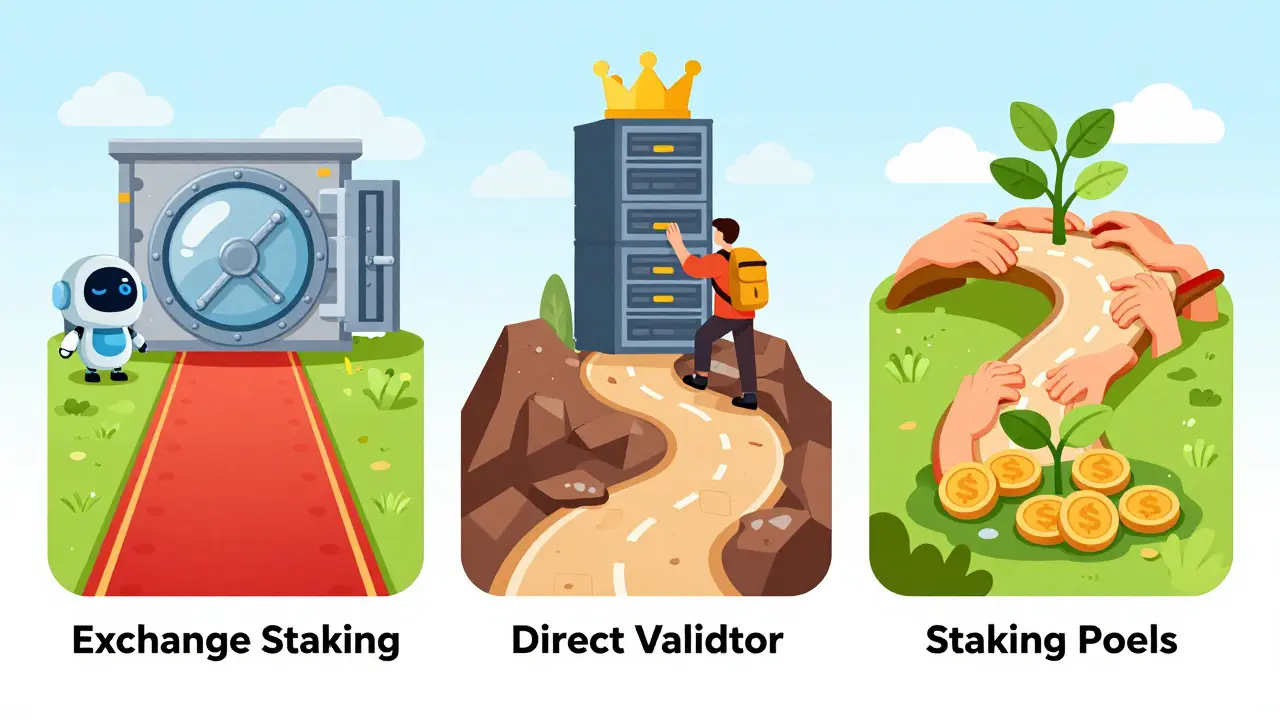
Not all staking is created equal. You have three main paths, each with different trade-offs between ease of use, control, and reward size. Understanding these options is crucial before you lock up any funds.
| Method | Minimum Stake | Technical Skill | Reward Fee | Control Level |
|---|---|---|---|---|
| Centralized Exchange Staking | $1 - $10 | Low (One-click) | 15% - 25% | Low (Exchange holds keys) |
| Direct Validator Node | $30,000+ (e.g., 32 ETH) | High (Linux/Server setup) | 0% (Network only) | High (Full custody) |
| Staking Pools | 0.01 - 1 ETH | Medium (Wallet interaction) | 5% - 10% | Medium (Shared custody) |
Centralized Exchange Staking: This is the easiest route. Platforms like Coinbase and Kraken handle the technical heavy lifting. You click a button, and they stake your coins. The downside? They take a cut. Coinbase, for instance, charges a 25% commission on Ethereum rewards. However, for a beginner who wants simplicity, this frictionless experience is hard to beat.
Direct Staking: If you want maximum control and rewards, you run your own validator node. This requires significant capital (32 ETH for Ethereum) and technical know-how. You manage the server, monitor uptime, and avoid slashing risks yourself. It’s not for the faint of heart, but you keep 100% of the rewards.
Staking Pools: Services like Lido or Rocket Pool let you combine funds with others to meet minimum requirements. You pay a smaller fee (5-10%) but retain more control than exchange staking. This is a great middle ground for those who don’t have $96,000 to spare but still want decentralization.
Step-by-Step Guide to Starting Your First Stake
Ready to earn? Here is a practical walkthrough to get your first stake active. We will focus on the most common path for beginners: using a reputable centralized exchange.
- Select Your Cryptocurrency: Not all coins can be staked. Stick to established Proof-of-Stake networks. Ethereum (ETH), Cardano (ADA), and Solana (SOL) dominate the market, comprising 78% of total staked value. Avoid obscure tokens with unproven track records.
- Acquire the Asset: Buy your chosen crypto on a platform that supports staking. Coinbase allows purchases starting at $2. Ensure you buy the native token, not a wrapped version, unless you understand the specific risks involved.
- Choose Your Platform: Compare exchanges based on APR and fees. As of late 2023, Ethereum staking yields 3.5-5.5% APR, while Solana offers 6-8%. Check if the exchange locks your funds or allows flexible unstaking.
- Set Up Your Wallet (Optional): If you prefer self-custody, set up a hardware wallet like Ledger or Trezor. These support 25+ staking coins. Software wallets like MetaMask work too but require careful security hygiene.
- Execute the Stake: Navigate to the "Earn" or "Staking" section of your exchange. Select the amount you wish to lock up. Confirm the transaction. Note that some networks have unbonding periods; for example, Solana takes 4-6 days to release funds after you unstake.
The entire process on an exchange takes about 15 minutes. Direct staking can take 2-5 hours of configuration. Be patient during the initial setup.
Understanding Risks: Slashing, Lock-ups, and Volatility
Staking isn't risk-free. While you won't lose your principal due to market crashes immediately, several factors can erode your returns.
Slashing Penalties: This is the biggest fear for validators. If your node misbehaves-by signing two blocks at once or going offline for too long-the protocol punishes you. On Ethereum, penalties range from 0.5% to 100% of your stake. Exchange staking mitigates this risk because the exchange manages the nodes professionally.
Lock-up Periods: Most staking involves a commitment period. During this time, you cannot sell your coins even if the market crashes. Solana’s unbonding period is 4-6 days. Ethereum’s exit queue can take weeks depending on network congestion. Plan your liquidity needs accordingly.
Market Volatility: If you stake $1,000 worth of ETH and earn 5% APR, but ETH drops 20% in value, you are still down overall. Staking rewards should be viewed as a hedge against inflation within the asset, not a guarantee of profit in fiat terms.

Tax Implications and Regulatory Landscape
Don't ignore the tax man. In many jurisdictions, including the US and UK, staking rewards are treated as taxable income when received, not when sold. This means every time your exchange credits your account with new tokens, you may owe taxes on the fair market value at that moment.
Regulatory clarity is improving. The EU's MiCA regulations, effective December 2024, provide clear guidelines for staking service providers. In the US, the SEC has been aggressive, classifying some staking services as securities offerings. Keep detailed records of all reward dates and values. Tools like CoinTracker can automate this, but 67% of users still report issues with accurate reporting.
Future Outlook: What’s Next for Staking?
The staking industry is projected to grow from $22.8 billion in 2023 to $56.4 billion by 2027. Institutional adoption is accelerating, with nearly 60% of top crypto hedge funds now using staking strategies. Technological upgrades, like Ethereum’s Dencun upgrade, are reducing hardware requirements and increasing efficiency.
As more participants enter the market, APRs will likely decline. Dr. Garrick Hileman notes that average APRs dropped from 14.2% in 2021 to 6.7% in 2023. However, staking remains significantly more profitable than traditional savings accounts, which average less than 1% APY. For long-term holders, staking is becoming a standard part of portfolio management.
Can I lose my staked crypto?
Yes. You can lose value through market volatility, slashing penalties if you run a validator incorrectly, or platform insolvency if you use a centralized exchange. Always diversify and research your platform.
Which coin is best for staking?
Ethereum is the safest bet for stability and liquidity. Solana and Cardano offer higher APRs but come with slightly higher technical risks. Choose based on your risk tolerance and belief in the underlying project.
Do I need to keep my computer on to stake?
Only if you are running a direct validator node. If you use exchange staking or a staking pool, the platform handles the infrastructure for you.
How often are staking rewards paid?
It varies by platform. Coinbase distributes Ethereum rewards daily. Kraken pays weekly. Some protocols distribute rewards continuously in real-time.
Is staking legal in the UK?
Yes, staking is legal in the UK. However, HMRC treats staking rewards as taxable income. You must declare them in your self-assessment tax return.