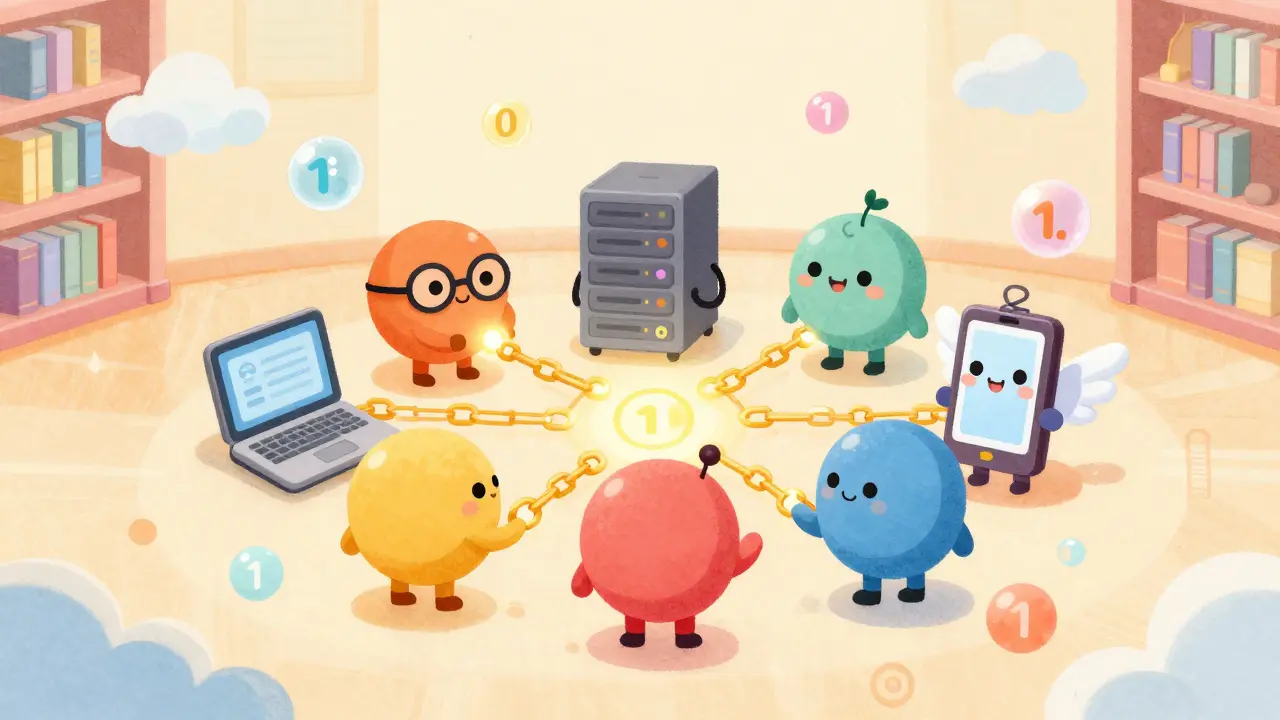
Imagine if every time you sent money, you had to trust a single bank server to record it correctly. If that server crashed, got hacked, or decided to change the rules, your money would be at risk. That is the reality of centralized systems. But in the world of cryptocurrency is a digital currency system that uses cryptography for security and operates on decentralized networks, there is no single boss. There is no central database. Instead, thousands of independent computers around the world work together to keep the ledger honest. These computers are called nodes is computers that participate in a blockchain network by storing, verifying, and propagating transaction data. They are the unsung heroes of digital finance, ensuring that Bitcoin, Ethereum, and other chains remain secure and truly decentralized is a network structure where control and authority are distributed among many participants rather than a single entity.
The Anatomy of a Blockchain Node
To understand how security works, we first need to know what a node actually does. In simple terms, a node is any device connected to the blockchain network. It could be a powerful server in a data center or a laptop running quietly in someone’s home office. Each node maintains a copy of the blockchain ledger is a distributed digital record of all transactions that have ever occurred on the network. When a new transaction happens, it doesn’t just go into one box. It gets broadcast to the network. The nodes pick it up, check it against the rules, and pass it along.
Not all nodes are created equal. There are different types, each playing a specific role:
- Full Nodes: These are the heavy lifters. They download the entire history of the blockchain from day one. They verify every single transaction and block against the protocol rules. If a block contains an error-like trying to spend coins that don’t exist-the full node rejects it. This independent verification is the bedrock of trust.
- Light Nodes (or Light Clients): These are smaller and faster. They don’t store the whole history. Instead, they download only the headers of blocks. They rely on full nodes for detailed data but still verify the integrity of the chain using cryptographic proofs. Most mobile wallets use light nodes because they can’t store terabytes of data.
- Validator or Miner Nodes: These nodes actively participate in creating new blocks. In Proof-of-Work systems like Bitcoin, these are miners who solve complex puzzles. In Proof-of-Stake systems like Ethereum, these are validators who lock up crypto assets as collateral. They propose new blocks, which are then verified by the rest of the network.
How Nodes Eliminate Single Points of Failure
In traditional banking, if the main server goes down, the whole system stops. You can’t buy coffee. You can’t pay rent. This is called a single point of failure. Blockchain nodes solve this through redundancy is the duplication of critical components or functions to increase reliability and availability. Because thousands of nodes hold copies of the same data, the network doesn’t care if one, ten, or even a hundred nodes go offline. The others keep running.
This resilience is not just about hardware failures. It’s also about censorship resistance. Imagine a government tries to shut down a cryptocurrency by blocking its servers. In a centralized model, that works. In a decentralized model, it fails. Why? Because the "servers" are people’s homes, small businesses, and universities across dozens of countries. To stop the network, an attacker would need to physically disconnect or seize thousands of independent machines simultaneously. That is practically impossible.
The peer-to-peer (P2P) architecture is a distributed application architecture that partitions tasks or workloads between peers without a central coordinator ensures that nodes talk directly to each other. They form a mesh network. If Node A loses connection to Node B, it instantly connects to Node C. Data flows around obstacles like water around rocks. This design makes the network incredibly robust against outages, natural disasters, and targeted attacks.

The Role of Consensus and Rule Enforcement
Decentralization isn’t just about having many computers; it’s about them agreeing on the truth. How do thousands of strangers agree on who owns what? They use consensus mechanisms is protocols that allow distributed nodes to agree on the state of the ledger despite potential faults or malicious actors. Whether it’s Proof-of-Work or Proof-of-Stake, the goal is the same: ensure that the majority of honest nodes accept the same version of the blockchain.
Here is where security gets interesting. Nodes don’t just blindly accept new blocks. They enforce strict rules. Every node checks:
- Are the digital signatures valid? (Did the sender really authorize this?)
- Is the sender spending coins they actually have? (No double-spending.)
- Does the block follow size and format limits?
- Does the transaction fee match the current market rate?
If a miner or validator tries to cheat-for example, by creating a block with extra coins out of thin air-the full nodes will reject it. The block won’t be added to their ledgers. It becomes orphaned and useless. For an attacker to succeed, they would need to control more than 51% of the network’s computing power (in PoW) or stake (in PoS) AND convince the honest nodes to accept invalid blocks. Since honest nodes are programmed to reject invalid data, the attacker would essentially be talking to themselves. The network remains secure because the code is law, and the nodes are the judges.
Cryptographic Security and Trustlessness
You might wonder, "Why should I trust a random computer on the internet?" The answer is: you don’t trust the computer. You trust the math. This concept is known as trustless verification is the ability to verify transactions and states without relying on the honesty of any intermediary party. Nodes use asymmetric cryptography is a cryptographic system that uses pairs of keys: public keys to encrypt messages and private keys to decrypt them to secure transactions. Your private key signs a transaction, proving you own the funds. The public key allows anyone to verify that signature. No password needed. No middleman needed.
When you run your own node, you are not trusting a third-party service like Coinbase or Binance to tell you your balance. You are calculating it yourself based on the raw data. This eliminates counterparty risk. Even if the exchange goes bankrupt, your node knows exactly how much crypto you own because it has seen every transaction since the beginning of time.
| Feature | Centralized Server | Decentralized Node Network |
|---|---|---|
| Data Storage | Single location | Distributed across thousands of devices |
| Control | One organization | Many independent participants |
| Failure Impact | Total system outage | Minimal disruption; network continues |
| Trust Model | Trust the provider | Verify independently (Trustless) |
| Censorship Resistance | Low (provider can block users) | High (hard to block all nodes) |

Client Diversity and Resilience
A hidden layer of security comes from software diversity. On networks like Ethereum, nodes can run different client software implementations (e.g., Geth, Nethermind, Besu). All these clients speak the same protocol language, but they are written in different programming languages by different teams. This is crucial. If a bug is found in one client, it doesn’t crash the whole network. Nodes running other clients continue to operate and validate blocks. This prevents a single software flaw from becoming a catastrophic failure point. It encourages a healthy ecosystem where developers compete to build better, safer tools.
Challenges to Node-Based Decentralization
While the theory is perfect, reality has challenges. Running a full node requires resources. As blockchains grow, so does the storage requirement. Bitcoin’s blockchain is now over 500 GB. Ethereum’s is larger. This means you need a fast SSD, plenty of RAM, and a stable high-speed internet connection. This barrier to entry can push individuals out and favor large corporations or cloud providers. If too many nodes are hosted on Amazon Web Services or Google Cloud, we risk a new kind of centralization-not in the code, but in the infrastructure. Additionally, attackers may target nodes with Denial-of-Service (DoS) attacks to disrupt connectivity. However, the community constantly evolves solutions, such as light clients and Layer-2 scaling, to keep participation accessible and resilient.
Can I run a blockchain node on my home computer?
Yes, for many cryptocurrencies. Bitcoin and Ethereum full nodes can run on consumer-grade PCs with sufficient storage (SSD recommended) and bandwidth. Light nodes require even less power and can often run on smartphones. Check the specific requirements for the network you want to join.
What happens if a node goes offline?
Nothing major. The network is designed for redundancy. Other nodes will fill the gap in validating and relaying transactions. When the offline node reconnects, it syncs up with the latest state of the ledger.
Do nodes make money?
Standard full nodes do not earn rewards directly; they contribute to security. However, if you run a validator node (in Proof-of-Stake) or a miner node (in Proof-of-Work), you can earn transaction fees and block rewards. This incentivizes people to keep their nodes online and honest.
Why is decentralization important for security?
Decentralization removes single points of failure. An attacker cannot hack the whole network by compromising one server. They would need to attack thousands of independent nodes simultaneously, which is economically and technically prohibitive.
What is the difference between a full node and a light node?
A full node downloads and verifies the entire blockchain history, providing maximum security and independence. A light node only downloads block headers and relies on full nodes for transaction details, making it faster and lighter on resources but slightly less independent.