
Imagine buying a share of a solar farm in Portugal or retiring a tonne of carbon from a reforestation project in Brazil, all with the same ease as sending an email. For decades, Green Finance has struggled with a stubborn problem: trust. Investors want to know their money actually helped the planet, but verifying that impact is slow, expensive, and often opaque. Enter Blockchain, not as a speculative bubble, but as a potential infrastructure upgrade for sustainability.
You might be skeptical. Haven't we heard this hype before? The difference now is that major institutions are testing it with real money. In 2023, the Hong Kong government issued HK$800 million in tokenised green bonds on a private blockchain. This wasn't a crypto experiment; it was a sovereign debt instrument settled digitally. So, does putting green projects on a ledger actually make them greener, or just more complicated? Let's look at how this technology intersects with climate goals, where it works well, and where it still stumbles.
The Core Problem Green Finance Faces
Before we talk about solutions, let's look at the friction. Traditional green finance relies heavily on paperwork and intermediaries. If you buy a Green Bond, you get a promise that the funds will go to environmentally beneficial projects. But proving that the money didn't leak into a coal plant requires audits, reports, and legal checks that can take months.
This creates three main issues:
- Information Asymmetry: Issuers know more about the project than investors do. This leads to "greenwashing," where companies claim environmental benefits they haven't fully delivered.
- High Transaction Costs: Reconciling records between banks, custodians, and regulators eats up capital that could otherwise fund clean energy.
- Lack of Liquidity: Many sustainable assets, like specific renewable energy installations, are illiquid. You can't easily sell your share of a wind turbine if you need cash quickly.
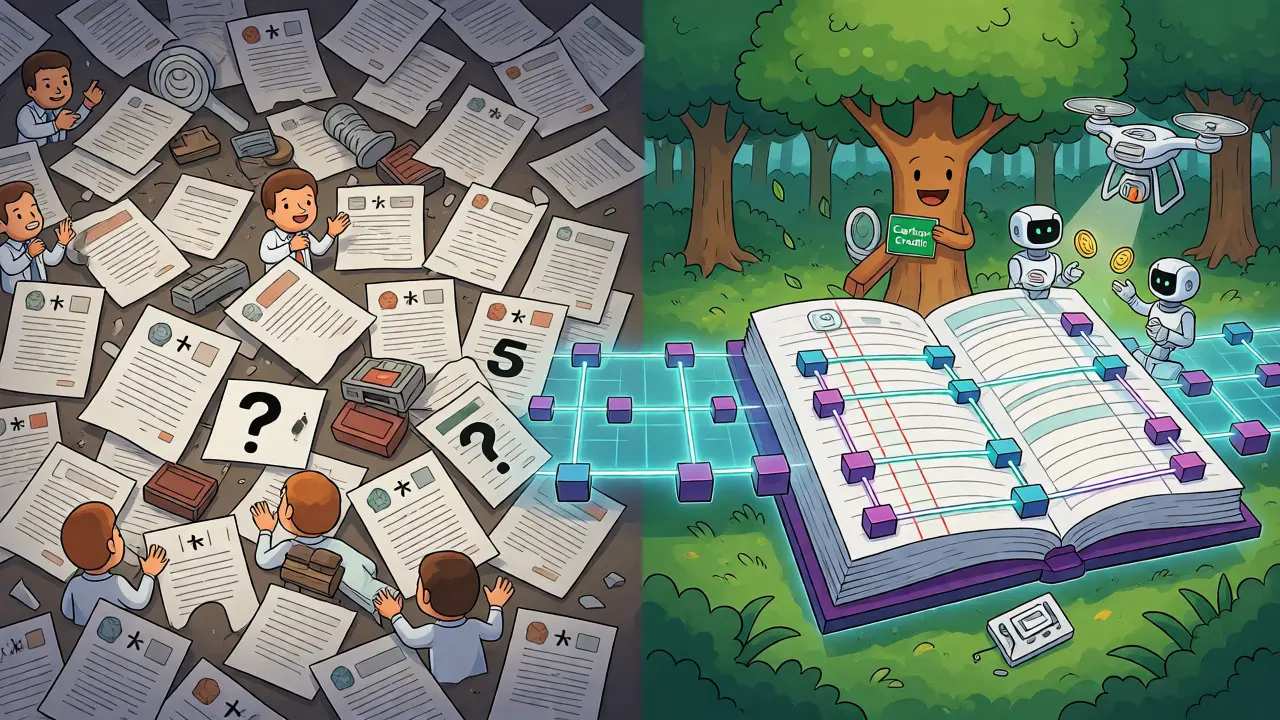
Blockchain acts as a shared, tamper-resistant database. It doesn't magically fix bad data, but it ensures that once a transaction is recorded, everyone sees the same version of the truth. This transparency is exactly what green finance needs to build investor confidence.
How Tokenisation Works in Practice
The most mature application here is Tokenisation. Think of it as turning a financial asset-like a bond or a carbon credit-into a digital token on a blockchain. Each token represents a fractional ownership or a claim on the underlying asset.
Consider the case of Project Evergreen by the Hong Kong Monetary Authority (HKMA). They didn't just create a crypto coin; they digitised the entire lifecycle of a government bond. Here’s how it worked:
- Issuance: The government created tokens representing the bond on a permissioned ledger (Hyperledger Besu).
- Settlement: Cash and securities were exchanged simultaneously using smart contracts, reducing settlement time from days to near-instantaneous.
- Coupon Payments: Interest payments were automated via code, eliminating manual processing errors.
- Redemption: At maturity, the principal was returned automatically.
This isn't just theoretical. By automating these steps, issuers reduce administrative overhead. More importantly, it creates an immutable audit trail. An investor can trace the flow of funds from issuance to specific project milestones without waiting for quarterly reports.
| Feature | Traditional Green Bond | Tokenised Green Bond |
|---|---|---|
| Settlement Time | T+2 or T+3 days | Near real-time (T+0) |
| Audit Trail | Fragmented across intermediaries | Unified, immutable ledger |
| Fractional Ownership | Limited by minimum denominations | Easily divisible into small units |
| Automation | Manual reconciliation required | Smart contracts automate payments |
Beyond Bonds: Carbon Credits and Renewable Energy
While bonds get the headlines, Carbon Markets are arguably where blockchain shines brightest. The voluntary carbon market has been plagued by double-counting-where two buyers think they own the same offset-and lack of transparency regarding the actual environmental impact.
Blockchain can assign a unique serial number to every single carbon credit. When a company buys a credit, the transaction is recorded on-chain. When they "retire" it (meaning they use it to offset their emissions), that retirement is also recorded. No one else can claim that same tonne of CO2 again. This solves the double-spending problem inherent in digital assets.
Moreover, new technologies like satellite imagery and IoT sensors can feed data directly onto the blockchain. Imagine a reforestation project in Kenya. Drones verify tree growth, satellites check canopy cover, and AI analyses the data. This verified information triggers smart contract payments to local farmers. This links financing directly to verifiable outcomes, rather than just promises.
Similarly, Renewable Energy Certificates (RECs) can be tokenised. Instead of buying a certificate that proves you used green electricity, you might trade micro-tokens representing kilowatt-hours generated by a specific solar panel. This allows for peer-to-peer energy trading, where households with solar panels can sell excess power directly to neighbours, bypassing traditional utility bottlenecks.
The Reality Check: Limitations and Risks
It would be dishonest to say blockchain fixes everything. In fact, it introduces its own set of problems. First, there's the "garbage in, garbage out" issue. If the initial data about a project's environmental benefit is wrong, the blockchain will permanently record that error. An immutable ledger preserves bad data forever.
Then there's the energy question. Early blockchains like Bitcoin used Proof-of-Work, which consumed massive amounts of electricity. However, modern networks used for finance, such as Ethereum post-Merge or permissioned ledgers like Hyperledger, use far less energy. Still, the environmental footprint of running data centres for these networks must be calculated against the efficiency gains they provide.
Regulatory uncertainty is another hurdle. Are these tokens securities? Commodities? Utilities? The answer varies by jurisdiction. In the EU, the MiCA Regulation (Markets in Crypto-Assets) came into full effect in late 2024, providing a framework for crypto-assets. However, tokenised securities often fall under existing banking and securities laws, creating a complex compliance landscape for issuers.
Finally, liquidity remains a challenge. Just because you can split a $10 million bond into 10 million tokens doesn't mean there are millions of buyers for those tokens. Secondary markets for tokenised assets are still thin compared to traditional stock exchanges. Without sufficient trading volume, the promised accessibility doesn't materialise.
Who Is Leading the Charge?
Don't assume this is only for tech startups. Major global institutions are driving adoption:
- Hong Kong Monetary Authority (HKMA): Has completed multiple real-money tokenised green bond issuances since 2023.
- European Investment Bank (EIB): Issued digital bonds on both public and private blockchains, partnering with Goldman Sachs and HSBC.
- World Economic Forum: Continues to publish frameworks for scaling climate action through digital tools.
- Climate Bonds Initiative: Tracks over USD6.8 trillion in cumulative labelled sustainable debt, increasingly looking at digital verification methods.
These players aren't replacing traditional finance; they're augmenting it. The goal is hybrid models where legacy systems coexist with distributed ledgers, leveraging the strengths of each.
Practical Steps for Investors and Projects
If you're an investor eyeing this space, or a project developer considering tokenisation, here’s a practical checklist:
For Investors:
- Verify the Oracle: Who provides the data confirming the environmental impact? Is it independent?
- Check Legal Finality: Does holding the token give you legally enforceable rights in your jurisdiction?
- Assess Liquidity: Can you actually sell the token when you want to exit?
- Understand the Ledger: Is it public (transparent but potentially slower/costlier) or permissioned (faster/private but centralised)?
For Project Developers:
- Start Small: Pilot a small tranche of debt or credits before committing to a full-scale tokenisation.
- Choose the Right Chain: Permissioned ledgers like Hyperledger or Corda offer better privacy and control for institutional deals.
- Integrate Existing Systems: Don't try to replace your bank or custodian immediately. Build APIs that connect your ledger to their systems.
- Focus on Data Quality: Invest in robust Measurement, Reporting, and Verification (MRV) systems. The blockchain is only as good as the data you feed it.
The Future Outlook
We are currently in the early operational phase. We have proof of concept and several successful live transactions, but we don't yet have mass-market adoption. The next few years will likely see more integration between Central Securities Depositories (CSDs) and blockchain platforms. This means tokenised assets will settle within the same regulatory frameworks as traditional stocks and bonds.
The ultimate test isn't whether an asset lives on a blockchain. It's whether this arrangement lowers costs, increases transparency, and ultimately directs more capital toward genuine sustainability projects. If it fails to deliver tangible environmental improvements alongside financial efficiency, it risks becoming just another layer of complexity.
For now, treat blockchain in green finance as a powerful tool in the toolkit, not a silver bullet. It offers unprecedented visibility and automation, but human oversight, rigorous auditing, and clear regulation remain essential to ensure that "green" really means green.
Does blockchain make green investments cheaper?
Potentially, yes. By automating settlements and reducing the need for multiple intermediaries, blockchain can lower transaction and administrative costs. However, initial setup costs for technology integration and compliance can be high, so savings may only appear at scale.
Is tokenised green finance regulated?
Yes, but the rules vary. In the EU, MiCA regulates crypto-assets, while tokenised securities often fall under existing securities laws like MiFID II. Most jurisdictions require strict KYC/AML compliance and investor protection standards similar to traditional finance.
Can retail investors participate in tokenised green bonds?
Technically, yes, due to fractional ownership. However, many current pilots are restricted to institutional investors due to regulatory hurdles and minimum investment requirements. Retail access is expected to grow as platforms mature and regulations clarify.
What is the biggest risk of using blockchain for carbon credits?
The "Oracle Problem." Blockchain ensures the record hasn't changed, but it cannot verify if the underlying data (e.g., that trees were actually planted) is accurate. If the input data is flawed or fraudulent, the blockchain immutably records that flaw.
Which blockchains are best for green finance?
Permissioned ledgers like Hyperledger Fabric, R3 Corda, and Quorum are popular for institutional use due to privacy and speed. Public chains like Ethereum (post-Merge) and Polygon are gaining traction for broader accessibility and composability, provided their energy consumption is low.