
Picture this: you have a remote office with five staff members who need to make calls simultaneously. Your internet connection is a modest 512 kbit/s link-typical for rural branches or older business setups. If you use the standard G.711 codec, you can only handle about six calls before the line chokes. But switch to G.729, and suddenly you can support up to twenty concurrent calls on that same pipe. That is the power of compression.
The G.729 codec is not just a technical specification; it is a lifeline for businesses operating on constrained networks. Approved by the ITU-T in March 1996, this narrowband speech codec was designed specifically to deliver toll-quality voice at an incredibly lean 8 kbit/s bit rate. For decades, it has been the go-to solution for remote offices, branch sites, and international links where every kilobit counts. While newer technologies like Opus are gaining ground, G.729 remains deeply embedded in enterprise infrastructure because it solves a very real problem: how do you keep people talking when bandwidth is expensive or scarce?
How G.729 Compresses Voice Without Breaking It
To understand why G.729 works so well, you need to look under the hood. The formal name is "Coding of speech at 8 kbit/s using conjugate-structure algebraic-code-excited linear prediction" (CS-ACELP). That mouthful describes a clever trick. Instead of sending raw audio data, which is heavy, G.729 models the human vocal tract.
It uses a 10th-order linear predictive coding (LPC) algorithm combined with an algebraic codebook. Think of it like sending a recipe rather than the cake itself. The codec sends instructions on how to reconstruct the sound waves at the other end, rather than the sound waves themselves. This happens in frames of 10 milliseconds, with a tiny 5 ms look-ahead buffer. The result? An algorithmic delay of just 15 ms. In the world of VoIP latency budgets, that is negligible.
Each 10 ms frame generates 80 bits (10 bytes). In practice, these are usually bundled into 20 ms packets (20 bytes) to reduce the overhead of IP headers. This efficiency is what allows G.729 to squeeze through tight network windows that would choke uncompressed audio.
The Real Cost of "8 kbit/s": Understanding Overhead
Here is where many administrators get tripped up. The spec says 8 kbit/s, but your network monitor will tell a different story. You cannot ignore the protocol layers wrapping your voice data.
When you send G.729 over Ethernet using RTP, you add IP, UDP, and RTP headers. On top of that, you have Layer 2 overhead from your switch or router. According to Cisco’s voice design guidelines, a single G.729 call with a 20 ms packetization interval actually consumes between 24 and 32 kbit/s of total link bandwidth.
| Codec | Payload Bit Rate | Total Network Usage (approx.) | Calls on 512 kbit/s Link |
|---|---|---|---|
| Uncompressed PCM | 64 kbit/s | 80-87 kbit/s | ~6 calls |
| Compressed CS-ACELP | 8 kbit/s | 24-32 kbit/s | ~16-20 calls |
See the difference? On a 512 kbit/s uplink, G.711 limits you to roughly six simultaneous calls. G.729 quadruples that capacity. For a small remote office, that margin between six and twenty calls is the difference between a functional phone system and one that constantly drops connections during busy hours.
Quality Trade-offs: What Does G.729 Sound Like?
You don’t get something for nothing. Compression costs quality. G.729 operates in the narrowband range, covering frequencies from 300 Hz to 3,400 Hz. This matches the traditional Public Switched Telephone Network (PSTN) standard. It sounds like a phone call-clear enough for conversation, but lacking the richness of modern HD voice.
In terms of Mean Opinion Score (MOS), G.729 typically scores around 4.0 out of 5. Compare that to G.711, which sits at 4.2, or wideband codecs like G.722, which hit 4.5. Most users find G.729 "acceptable" or "toll quality." However, you might notice artifacts if conditions aren’t perfect. Some speakers may sound slightly robotic, especially those with certain vocal tones or background noise. Pre-echo can occur, where a soft sound seems to start just before the actual word begins.
Crucially, G.729 is terrible for music. If you play music on hold over G.729, it will sound tinny and distorted. Best practice dictates switching to G.711 or a wideband codec for any non-speech audio. Similarly, fax machines and modems struggle with G.729. You should configure your PBX to force G.711 pass-through or use T.38 fax relay for those specific media types.

Licensing and the Patent Cliff
For years, G.729 came with a catch: patents. A consortium including France Télécom, NTT, and others managed royalties through Sipro Lab Telecom. If you ran an open-source PBX like Asterisk, you couldn’t just install G.729; you had to buy a license per concurrent channel. In the mid-2010s, Digium charged around US$10 per channel. This made many admins hesitant to use it unless absolutely necessary.
Then, around 2016-2017, the main patents expired. Today, G.729 is largely considered royalty-free for most commercial implementations. Providers like Telnyx now list it as free. This shift removed a major barrier to adoption, allowing smaller businesses to leverage its bandwidth savings without worrying about per-call licensing fees. However, always double-check local regulations, as some jurisdictions may still have lingering patent considerations, though this is increasingly rare.
G.729 vs. Modern Alternatives: Is It Still Relevant?
With the rise of high-speed fiber and 5G, is G.729 obsolete? Not entirely. Let’s compare it to its main competitors.
- G.711: Higher quality, zero compression artifacts, but eats bandwidth. Use this on LANs or high-capacity WANs.
- G.722: Wideband HD voice. Sounds great, but requires ~64 kbit/s payload. Too heavy for constrained links.
- Opus: The modern champion. Royalty-free, scalable from 6 to 510 kbit/s, and handles jitter/packet loss better than G.729. Many experts argue Opus is the superior choice for new deployments if endpoints support it.
So why stick with G.729? Compatibility. It is the "lowest common denominator" compressed codec. Virtually every IP phone (Cisco, Yealink, Poly, Grandstream) and every major PBX (Asterisk, 3CX, Avaya, Cisco CUCM) supports it out of the box. If you are connecting to a legacy carrier trunk or an old gateway that doesn’t speak Opus, G.729 is often your best bet for saving bandwidth while maintaining interoperability.
Deploying G.729 in Remote Offices: Practical Tips
If you decide to use G.729 for your remote site, follow these steps to ensure smooth operation:
- Configure Codec Preferences: Set your SIP trunks and extensions to prioritize G.729 for WAN legs, but prefer G.711 or G.722 for internal LAN calls. This saves bandwidth where it matters and preserves quality where it doesn’t cost anything.
- Avoid Transcoding: Transcoding (converting G.729 to G.711 and back) kills CPU performance and degrades audio. Try to ensure both ends of the call support G.729 so the stream passes through unchanged.
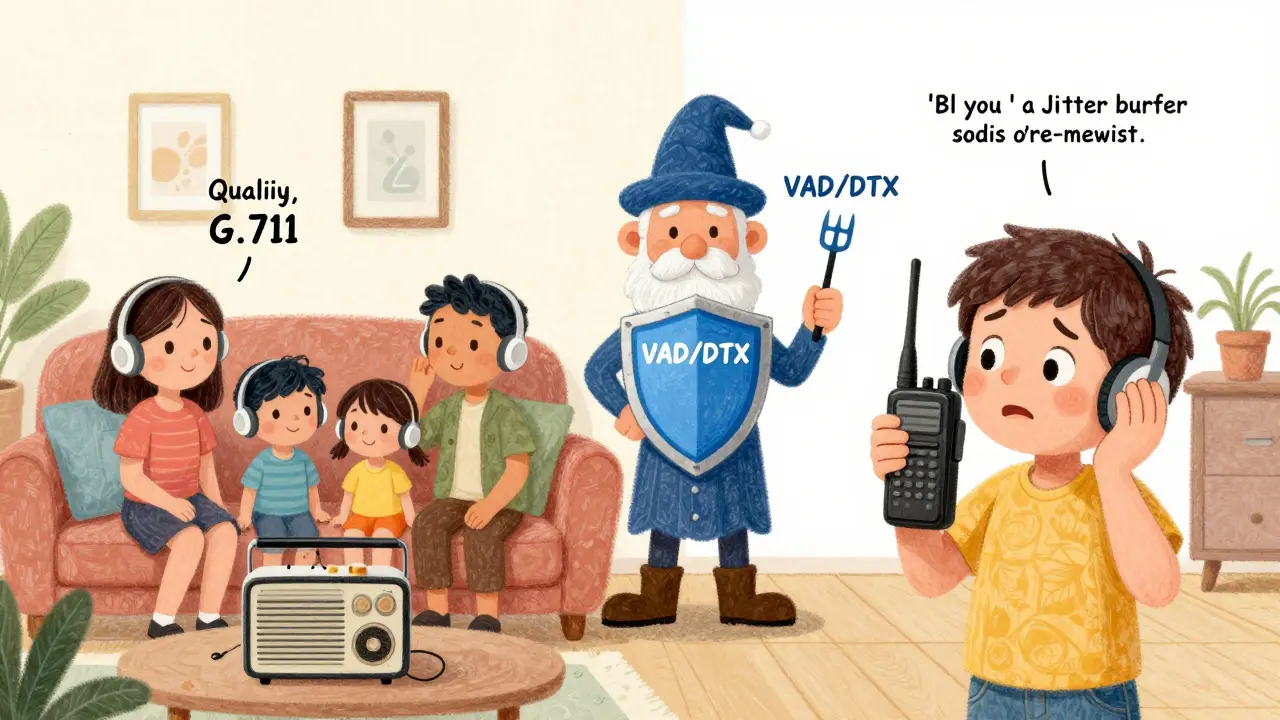
- Enable VAD/DTX: Turn on Voice Activity Detection and Discontinuous Transmission. This stops sending data during silence, replacing it with lightweight Silence Insertion Descriptors (SID). This can cut average bandwidth usage by another 20-30%.
- Tune Jitter Buffers: Because G.729 is sensitive to packet loss, enable adaptive jitter buffers on your endpoints. If audio sounds choppy, try increasing the packetization interval from 20 ms to 30 ms, which reduces header overhead further.
When to Avoid G.729
Don’t use G.729 if:
- You have plenty of bandwidth (e.g., dedicated 10 Mbit/s+ links).
- You need HD voice for executive calls or conference rooms.
- Your endpoints are low-end devices with limited DSP power (though Annex A helps here).
- You are transmitting faxes or music.
In these cases, G.711 or Opus will provide a better user experience without significant downside.
Is G.729 still relevant in 2026?
Yes, but its role has shifted. It is no longer the default for all VoIP. Instead, it is a specialized tool for bandwidth-constrained environments like rural remote offices, satellite links, or legacy carrier interconnections. For general use, Opus or G.711 are preferred due to better quality and robustness.
What is the difference between G.729 and G.729A?
G.729A is a reduced-complexity version of the original G.729 codec. It uses approximately half the computational power (MIPS) required by the standard, making it ideal for lower-cost IP phones and gateways. The trade-off is a slight reduction in subjective audio quality, though it remains bitstream compatible with standard G.729.
Can I use G.729 for fax transmissions?
No. G.729’s compression algorithms distort the signals used by fax machines and modems, leading to failed transmissions. You must configure your VoIP system to use G.711 (uncompressed) or T.38 fax relay for any fax traffic.
Why does my G.729 call sound robotic?
Robotic artifacts are common with G.729, especially if there is packet loss, jitter, or multiple transcoding steps involved. Ensure QoS is prioritized on your network, disable unnecessary transcoding, and consider increasing the packetization interval to 30 ms to improve resilience against minor network fluctuations.
Is G.729 royalty-free?
Most major patents for G.729 expired around 2017. Consequently, most providers and software vendors now treat it as royalty-free. However, always verify with your specific vendor or legal team, as residual patent claims can occasionally exist in specific jurisdictions.