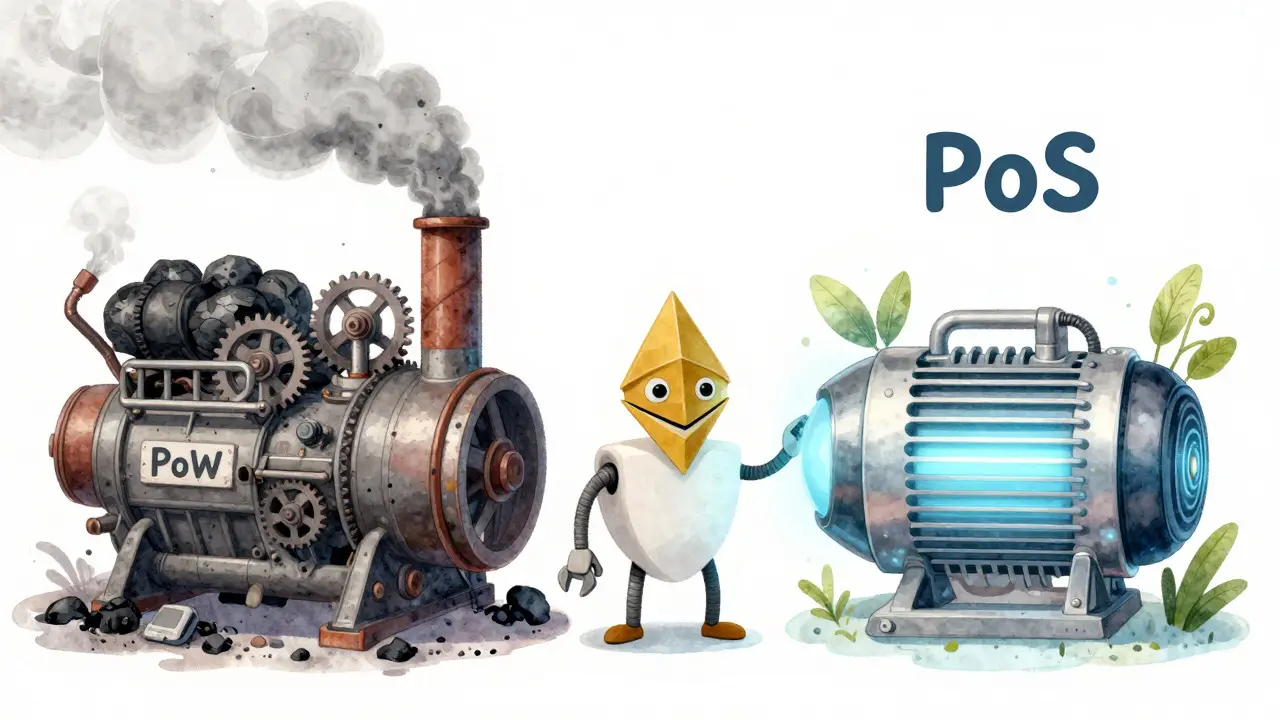
On September 15, 2022, something massive happened in the world of cryptocurrency that didn't look like much on the surface. No flashy graphics, no immediate price explosion. But behind the scenes, Ethereum switched its engine from a gas-guzzling combustion motor to an electric one. This event, known as "The Merge," replaced the network's old proof-of-work system with proof-of-stake (PoS). The result? A 99.98% drop in energy use. That is not a rounding error; it is a fundamental shift in how digital money works.
If you are running or planning a blockchain network today, you probably have questions. Can you switch consensus mechanisms without breaking your community? Will users lose their tokens? Is the security actually better? Ethereum’s journey offers a masterclass in high-stakes technical migration. Let’s break down exactly what went right, what risks remain, and what other networks can copy-or avoid-from this historic upgrade.
The Core Problem: Why Switch at All?
To understand the lesson, you first need to understand the problem Ethereum was trying to solve. Before the Merge, Ethereum relied on Proof-of-Work (PoW) a consensus mechanism where miners compete to solve cryptographic puzzles using specialized hardware.. Think of it like a global lottery where participants buy tickets by burning electricity. The more power you use, the more tickets you get. While this secured the network, it came with a huge environmental cost. Stanford researchers calculated that pre-Merge Ethereum consumed about 25.7 terawatt-hours of electricity per year. To put that in perspective, that is roughly equal to the entire annual energy consumption of Ireland.
Critics argued that blockchains were inherently wasteful. Proponents argued they were secure but inefficient. The Merge proved you could have both. By switching to Proof-of-Stake (PoS) a consensus model where validators lock up coins to secure the network instead of using computing power., Ethereum removed the need for competitive mining. Validators now secure the network by staking ETH, not by racing GPUs. For any network considering a similar move, the primary driver is usually sustainability, but the secondary benefits-like scalability potential-are equally compelling.
How It Worked: Merging Two Chains Into One
The technical execution of the Merge was complex, but the concept is straightforward. Imagine two separate systems working in parallel for years. On one side, you had the original Ethereum Mainnet, handling transactions since 2015. On the other, you had the Beacon Chain Ethereum's proof-of-stake consensus layer launched in December 2020., which had been running since December 2020, managing validator sets and rewards but not processing user transactions.
The Merge joined these two layers. The Mainnet became the execution layer, handling the logic of smart contracts and transfers. The Beacon Chain became the consensus layer, deciding which blocks were valid. This separation of duties is crucial. It allowed developers to upgrade the consensus rules without touching the execution code, and vice versa. For other networks, this architectural lesson is vital: decouple your execution from your consensus if you want future flexibility. The transition required node operators to run two pieces of software instead of one, a small friction point that prevented chaos.
| Feature | Pre-Merge (PoW) | Post-Merge (PoS) |
|---|---|---|
| Consensus Mechanism | Proof-of-Work (Mining) | Proof-of-Stake (Staking) |
| Energy Consumption | ~25.7 TWh/year | ~0.01 TWh/year (99.98% reduction) |
| Block Production | Competitive puzzle solving | Randomized validator selection |
| User Action Required | None | None |
| Asset Issuance | High inflation via block rewards | Lower issuance, yield-bearing asset |
The Environmental Impact: Hard Numbers
Let’s talk about the biggest headline: energy. The EU Blockchain Observatory confirmed that the Merge reduced Ethereum’s energy consumption by 99.98%. Visa echoed this, noting an estimated reduction of more than 99 percent. These aren’t marketing fluffs; they are measurable physical realities. The absolute reduction was 25.7 terawatt-hours per year. If you run a network that cares about its carbon footprint, this is the benchmark. It proves that blockchain technology does not have to be an environmental liability. It can be neutral, or even positive, if designed correctly. For networks facing regulatory pressure over energy use, the PoS transition is no longer just a technical choice-it’s a survival strategy.

User Experience: Zero Friction Transition
Here is the part that most people got wrong before the Merge. They thought users would need to swap their ETH for new "PoS ETH." They thought wallets would break. They thought smart contracts would vanish. None of that happened. The EU Blockchain Observatory explicitly stated that the Merge did not require users to exchange tokens. Contracts remained intact. No history was lost. This is a critical lesson for decentralized governance. When you change the underlying engine of a car, the passengers shouldn’t feel a bump. Ethereum achieved this by keeping the execution layer identical to what users interacted with. The backend changed, but the frontend stayed the same. If you are planning a protocol upgrade, prioritize user invisibility. If users have to do anything, you’ve already failed.
Risk Management and Governance Lessons
Changing a live, global financial network is risky. Built In identified four key lessons from Ethereum’s risk management strategy. First, risk is necessary. You cannot improve a system without taking chances. Second, change takes time. The Merge was discussed for years. Third, transparency is key. Developers communicated every step. Fourth, change creates winners and losers. Miners lost out; stakers gained. Acknowledging this redistribution of value helps manage community sentiment.
Technically, Ethereum used a clever trick called Terminal Total Difficulty (TTD). Instead of picking a specific date or block number for the Merge, they set a difficulty threshold. Once the network reached that cumulative difficulty, the Merge triggered automatically. This prevented "fast fork" attacks where bad actors might try to exploit uncertainty. Galaxy Digital noted that node operators could manually override the initial TTD value with a single line of code, reducing the burden of full software upgrades. This phased, transparent approach is a replicable model for any decentralized network. Don’t rely on fixed dates; rely on verifiable network conditions.
Scalability and Future Upgrades
The Merge wasn’t the end goal; it was a prerequisite. Holland & Knight pointed out that the improved block time consistency (averaging 12 seconds) set the stage for future scalability upgrades. Specifically, sharding. Sharding splits the database into smaller pieces to process them in parallel. Under PoW, sharding was nearly impossible due to security constraints. Under PoS, it’s feasible. Deutsche Bank noted that future upgrades aim to increase transaction processing from 15-20 TPS to potentially 100,000 TPS. That rivals traditional credit card rails. If your network wants to scale beyond niche use cases, PoS is likely the only path forward. The Merge cleared the runway for these high-throughput innovations.

The Centralization Trade-Off
No solution is perfect. Fidelity Digital Assets highlighted a major risk: centralization concerns. In PoW, anyone with enough hardware can mine. In PoS, you need enough coins to stake. This can lead to validator concentration, where large pools control disproportionate influence. While Ethereum has many small validators, the trend toward professional staking services is real. Other networks must design mechanisms to prevent this. Slashing penalties for bad behavior, distributed node incentives, and anti-delegation rules are essential tools. You cannot assume PoS is automatically decentralized. You have to engineer for it.
Key Takeaways for Network Builders
- Energy Reduction is Real: You can cut energy use by 99.98% without sacrificing security.
- User Invisibility Matters: Keep the execution layer stable so users don’t notice the backend changes.
- Decouple Execution and Consensus: This architecture allows for easier future upgrades.
- Use Verifiable Triggers: Mechanisms like TTD reduce coordination risks compared to fixed dates.
- Plan for Centralization: Actively design against validator concentration through economic incentives.
- Communicate Transparently: Years of preparation and open dialogue build the trust needed for major transitions.
Frequently Asked Questions
Did Ethereum users need to do anything during the Merge?
No. The Merge was completely seamless for end-users. Wallets, balances, and smart contracts remained unchanged. No token swaps or migrations were required.
How much energy did Ethereum save after the Merge?
Ethereum reduced its energy consumption by 99.98%, saving approximately 25.7 terawatt-hours per year. This is equivalent to the annual energy usage of Ireland.
Is Proof-of-Stake less secure than Proof-of-Work?
Not necessarily. While PoW relies on physical energy costs, PoS relies on economic stakes. Attacks on PoS are financially self-defeating because attackers risk losing their staked assets. However, PoS introduces different risks, such as validator centralization, which must be managed carefully.
What is the Beacon Chain?
The Beacon Chain is Ethereum’s proof-of-stake consensus layer. It was launched in December 2020 and ran in parallel to the main Ethereum network until the Merge in September 2022, when it became the core consensus mechanism for the entire network.
Will the Merge make Ethereum faster?
The Merge itself did not significantly increase transaction speed. Its primary goals were sustainability and stability. However, it laid the groundwork for future upgrades like sharding, which aim to drastically increase throughput to 100,000 transactions per second.