
Imagine if you could earn money just by leaving your computer on or placing a small device on your windowsill. For years, that sounded like a scam or a distant sci-fi dream. But as of May 2026, it is becoming a tangible reality through Decentralized Physical Infrastructure Networks, commonly known as DePIN. This model flips the traditional script on how we build and pay for the digital backbone of our world.
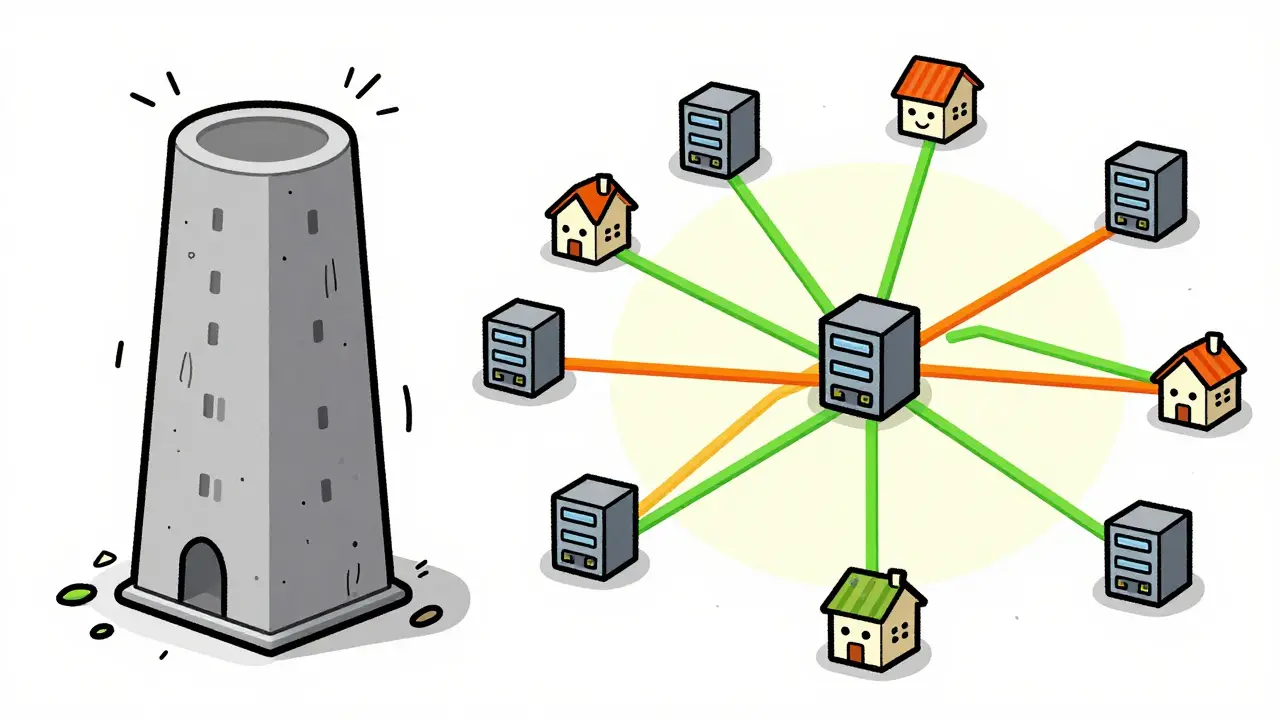
Traditionally, massive corporations spend billions to build data centers, wireless towers, and energy grids. You, the user, pay them for access. In a DePIN model, individuals like you provide the hardware-servers, sensors, hotspots-and get paid directly in cryptocurrency tokens for contributing resources like bandwidth, computing power, or storage. It is infrastructure built from the bottom up, not the top down.
What Exactly Is DePIN?
To understand why this matters, you have to look at the structure. DePIN is not just software; it is a hybrid system connecting the physical world with the digital ledger. According to frameworks established by industry analysts, these networks rely on three distinct layers working together.
- The Physical Layer: This is the hardware you own or install. It could be a GPU in your gaming PC, a sensor measuring air quality, or a 5G hotspot in your home office.
- The Blockchain Layer: This acts as the trusted record-keeper. It verifies that your hardware is actually providing value (like sending data or processing calculations) without a central company needing to audit every single transaction manually.
- The Token Incentive Layer: This is the economic engine. Smart contracts automatically reward you with tokens when you contribute resources. These tokens can often be traded, spent, or used to govern the network.
Think of it like a ride-sharing service for infrastructure. Instead of one company owning all the cars, everyone owns their car and gets paid per ride. The difference here is that the "rides" are essential services like internet connectivity or AI computation.
Why Traditional Infrastructure Is Failing Us
You might wonder, if big tech companies are already building data centers, why do we need DePIN? The answer lies in cost, speed, and resilience.
Centralized models are incredibly slow. When a telecom company wants to expand coverage to a rural area, they must run complex financial analyses, secure loans, and wait months or years for approval. If the projected return on investment isn't high enough, they simply don't build there. This leaves millions of people with poor connectivity or no access at all.
DePIN solves this by removing the capital bottleneck. Since individual users buy their own hardware, the network doesn't need upfront venture capital to expand. If you live in an underserved area and want better Wi-Fi, you can buy a hotspot, connect it to the network, and instantly improve coverage for your neighbors while earning rewards. The network grows organically where demand exists, rather than where corporate strategy dictates.
Furthermore, centralized systems have single points of failure. If a major cloud provider suffers a outage, entire sectors of the economy grind to a halt. Distributed networks are inherently more resilient. If one node goes offline, others pick up the slack. This decentralization creates a robust system that is harder to break and faster to repair.
Leading Projects Shaping the 2026 Landscape
While the concept is broad, several projects have emerged as leaders in the space by mid-2026. These are not theoretical experiments; they are active networks handling real-world workloads.
| Project | Token | Infrastructure Type | Primary Use Case |
|---|---|---|---|
| Render Network | $RNDR | GPU Computing | Distributed rendering for AI, VR, and film production |
| Helium | $HNT | Wireless Connectivity | Long-range IoT coverage and mobile hotspots |
| Akash Network | $AKT | Cloud Compute | Open-source cloud marketplace for developers |
Render Network has become critical for the exploding AI sector. As artificial intelligence models require immense graphical processing power, Render allows artists and developers to rent out idle GPU cycles globally. This reduces costs compared to renting from monolithic cloud providers like AWS or Azure.
Helium focuses on wireless infrastructure. By deploying LoRaWAN and 5G hotspots, users create a mesh network that provides coverage for Internet of Things (IoT) devices, such as smart meters and agricultural sensors. This is particularly valuable in regions where traditional cellular coverage is spotty.
Akash Network operates as a supercomputer marketplace. Developers can deploy applications across a decentralized network of servers, often achieving lower prices and higher transparency than traditional cloud hosting. It appeals heavily to Web3 developers who prioritize censorship resistance.
The Economic Engine: How Money Moves in DePIN
The sustainability of any DePIN project depends on its tokenomics. Early on, many networks relied on protocol subsidies-essentially printing new tokens to attract early adopters. While effective for growth, this is not sustainable long-term.
The mature model, which we are seeing solidify in 2026, shifts toward demand-driven revenue. Here is how the cycle works:
- Resource Contribution: You provide bandwidth or compute power.
- Service Consumption: An enterprise or developer pays for that resource using the network's token.
- Revenue Distribution: A portion of that payment goes to you, the provider. The rest may go to protocol development or treasury reserves.
This creates a circular economy. As more businesses use the network for AI training or data storage, the demand for tokens rises. This increases the value of the rewards you earn, incentivizing more people to join and provide hardware. The key metric to watch is the ratio of subsidized rewards versus real-user revenue. Networks with higher real-user revenue are generally more stable and less prone to price crashes.

Challenges and Risks to Consider
Despite the promise, DePIN is not without significant hurdles. The biggest challenge remains reliability. Centralized providers offer Service Level Agreements (SLAs) with guaranteed uptime. In a decentralized network, you are relying on volunteers or independent operators whose hardware might fail, lose power, or be disconnected.
For mission-critical applications, this variability can be a dealbreaker. However, protocols are improving. Advanced consensus mechanisms now verify proof-of-work more rigorously, ensuring that you only pay for resources that were actually delivered. If a node fails to respond, the network automatically reroutes the task and penalizes the inactive provider.
Another issue is interoperability. Currently, most DePIN networks operate in silos. A GPU rented on Render cannot easily be used on Akash. As standards mature, we expect to see cross-chain bridges and unified interfaces that allow resources to flow freely between different infrastructure types.
Future Outlook: Beyond Compute and Connect
By mid-2026, the conversation around DePIN is expanding beyond just IT infrastructure. We are seeing early pilots in decentralized energy grids, where homeowners sell excess solar power back to the grid via smart contracts. There are also emerging projects focused on environmental sensing, paying citizens to monitor air quality or noise pollution in urban areas.
As hardware becomes cheaper and more accessible, the barrier to entry continues to drop. The integration of DePIN with broader Web3 ecosystems means that infrastructure is becoming a fundamental layer of the digital economy, not just a niche experiment. Whether you are a developer looking for cheap compute or a homeowner wanting passive income, DePIN offers a compelling alternative to the centralized status quo.
Is DePIN safe for everyday users?
Generally, yes. Participating usually involves installing reputable hardware or running verified software on your existing devices. However, you should always research the specific project's security audits and reputation before investing money or connecting personal devices to unknown networks.
How much can I realistically earn from DePIN?
Earnings vary wildly depending on the resource you provide. High-end GPUs for AI rendering can generate significant returns, while simple wireless hotspots may only cover electricity costs. It is rarely a get-rich-quick scheme; think of it as optimizing underutilized assets.
What happens if my hardware breaks in a DePIN network?
You stop earning rewards until the hardware is fixed or replaced. Unlike employment, there is no salary guarantee. The network will detect the downtime and stop routing tasks to your node, ensuring users only pay for active resources.
Are DePIN tokens good investments?
They carry high risk and high reward. Many early tokens suffered from inflation due to heavy subsidization. Look for projects with growing real-world usage and revenue streams rather than those relying solely on speculative trading volume.
Can DePIN replace traditional cloud providers entirely?
Unlikely in the short term. Traditional providers offer unmatched consistency and support for enterprise-grade needs. DePIN is best suited for flexible, scalable workloads like AI training, storage redundancy, and IoT connectivity where slight latency variations are acceptable.