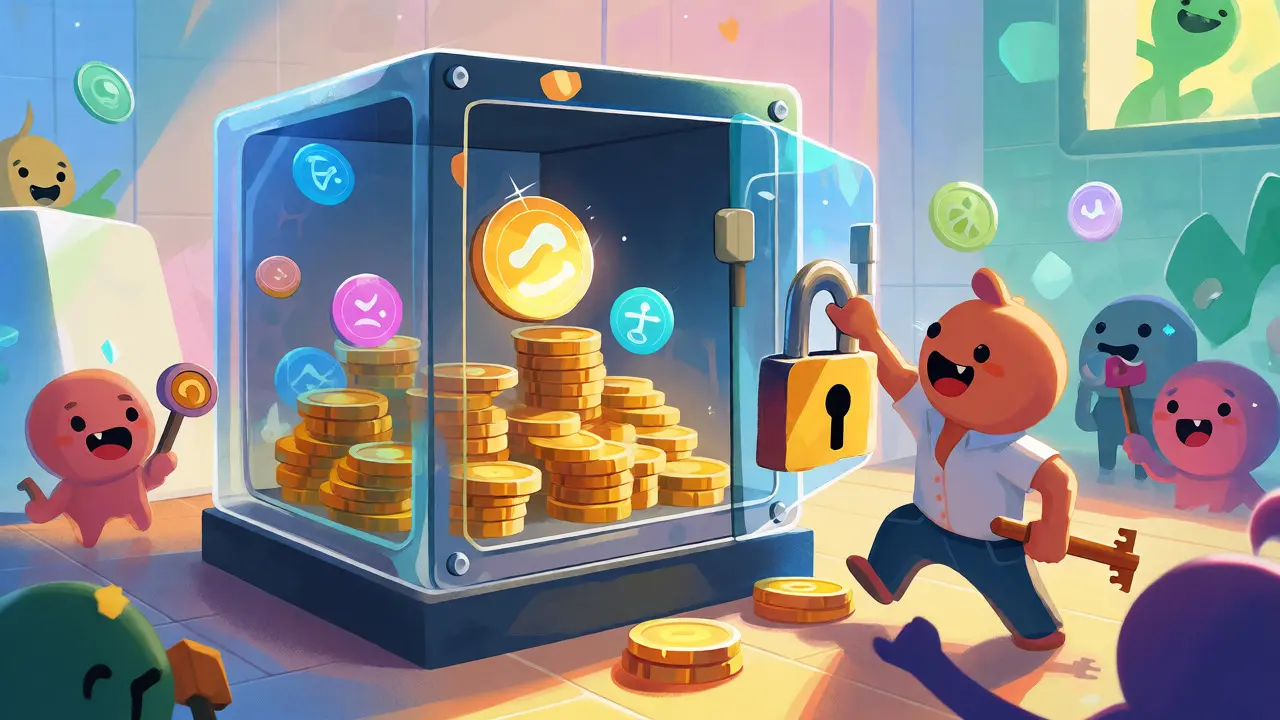
Imagine holding $25 billion in cash, but no single person can spend a dime of it without a vote. That is the reality for Decentralized Autonomous Organizations (DAOs) today. As of early 2026, these entities manage more than $25 billion across over 10,000 active projects. Yet, many still operate like startups with bad credit cards-holding all their money in one volatile asset and hoping for the best. If you are running a DAO or thinking about joining one, understanding how treasury management and on-chain governance models interact is not just academic; it determines whether your project survives the next market crash.
Why Traditional Corporate Treasuries Fail in Crypto
Traditional companies keep 5-10% in cash and diversify the rest. DAOs? They often do the opposite. A 2023 study showed that 85% of DAOs held their entire treasury in their own native token. This creates a dangerous feedback loop. When the token price drops, the DAO’s ability to pay contributors shrinks, which scares investors, which drops the price further. Vitalik Buterin called this "circular risk" in his 2025 keynote, and he was right. Holding 80% of your value in a governance token is like betting your rent money on a lottery ticket you printed yourself.
The solution isn't just holding stablecoins. It's about structural design. The most successful DAOs treat their treasury as an operating budget first and an investment portfolio second. They separate funds needed for immediate operations from long-term strategic reserves. Without this distinction, a simple 40% market correction can wipe out six months of operational runway.
The Technical Backbone: Multisigs and Smart Contracts
You cannot run a multi-billion dollar organization on trust alone. You need code. Most DAOs rely on Multisig Wallets, specifically tools like Safe (formerly Gnosis Safe), to secure funds. These wallets require multiple signatures to move money. A common setup is a 3-of-5 configuration, meaning three out of five designated signers must approve a transaction before it executes. This prevents any single individual from draining the treasury.
But multisigs are only half the story. Smart Contracts enforce the rules automatically. If a proposal passes voting, the smart contract executes the payment. There is no CEO to ignore the result. However, this automation brings risks. In 2016, The DAO lost $60 million because of a vulnerability in its code. Today, security protocols have improved, with timelocks (waiting periods) ranging from 24 hours to 7 days for large transfers. This gives the community time to spot errors or malicious moves before funds leave the wallet.
Governance Models: Who Actually Decides?
Not all votes are created equal. The simplest model is "one token, one vote." If you hold 1 UNI token, you get one vote. If you hold 1 million, you get a million votes. This favors whales. To combat plutocracy, some DAOs use quadratic voting, where the cost of each additional vote increases exponentially. This allows smaller holders to have a louder voice without needing massive capital.
Another emerging trend is delegation. Instead of every member voting on every minor expense, they delegate their voting power to trusted representatives. Aragon and Llama offer tools that make this easy. According to a 2024 survey, DAOs using delegated governance saw a 40% increase in voter participation because members felt their delegates were accountable. However, delegation concentrates power again. If your delegate goes rogue, you need a clear process to revoke their authority quickly.
| Model | How It Works | Best For | Risk Factor |
|---|---|---|---|
| Token Voting | Direct voting weighted by token holdings. | Large, liquid communities. | Wealth concentration (Whales dominate). |
| Quadratic Voting | Voting power grows slower than tokens spent. | Community-focused grants. | Complexity for new users. |
| Delegation | Members elect representatives to vote. | High-frequency decision making. | Delegate corruption or apathy. |
| Optimistic Governance | Proposals pass unless challenged within a window. | Technical upgrades. | Slow response to urgent issues. |

Treasury Diversification Strategies That Work
Let’s look at real-world examples. MakerDAO changed the game by allocating $3.5 billion to U.S. Treasury bonds and corporate securities. By December 2024, this strategy generated $127 million in stable yield. Why does this matter? Because it decouples the DAO’s income from crypto volatility. Even if ETH crashes, MakerDAO still earns interest from traditional finance instruments.
Uniswap takes a different approach. With $4.8 billion under management, they allocate 62% to UNI tokens, 25% to stablecoins, and 13% to ETH. Their focus is liquidity mining incentives. They don’t try to be an investment fund; they try to fuel the protocol. BitDAO (now Mantle) acts more like a venture capital firm, deploying $1.2 billion into 85+ DeFi projects. Each model fits a specific goal. Don’t copy Uniswap’s strategy if you’re a grant-making DAO, and don’t copy BitDAO’s if you need predictable payroll.
Practical Implementation: Tools and Pitfalls
Setting up a robust treasury isn't just about picking coins. It requires infrastructure. Request Finance processes billions in DAO transactions annually by integrating invoicing directly with multisig wallets. This reduces payment processing time from 72 hours to under 4 hours. Without such tools, paying contributors becomes a logistical nightmare.
One major pitfall is gas fee mismanagement. During peak congestion on Ethereum, a simple treasury operation can cost $50. Multiply that by hundreds of small payments, and you see why Layer 2 solutions like Arbitrum or Polygon are gaining traction. A November 2024 survey found that 63% of treasurers struggled with visibility across multiple chains. Using aggregated dashboards like Llama helps, but you still need to reconcile accounts manually if your tools aren't integrated.
- Key Management: Never store private keys on laptops. Use hardware wallets. 32% of incidents in 2024 came from compromised keys.
- Timelocks: Always implement a 24-72 hour delay for transactions over $50,000.
- Audit Trails: Ensure every transaction is tagged in your accounting software. Blockchain data is public, but interpreting it requires context.
Regulatory Landscape and Legal Wrappers
Here is the uncomfortable truth: most DAOs lack legal protection. A 2024 CoinCenter survey revealed that 68% of DAOs have no formal legal wrapper. This exposes members to personal liability. Wyoming was the first state to recognize DAO LLCs in 2021, followed by Tennessee. The EU’s MiCA regulations now include DAO provisions, adding another layer of complexity.
If you operate globally, you need a legal entity that matches your treasury structure. Some DAOs form foundations in Switzerland or Singapore to handle fiat conversions and tax reporting. Others remain purely on-chain, accepting higher regulatory risk for greater decentralization. There is no perfect answer, but ignoring the issue until a subpoena arrives is rarely a good strategy.
The Future of DAO Treasuries
The trend is clear: institutionalization. Fidelity and Coinbase launched DAO-specific custody products in 2025, signaling that big money wants in. Analysts predict that by 2027, top DAOs will hold 40% in stable assets, 30% in strategic crypto, and 30% in operational liquidity. This shift aims to reduce volatility by 60% compared to 2024 levels.
However, technology evolves faster than regulation. Smart contract vulnerabilities remain a threat. OpenZeppelin patched 17 critical treasury-related bugs in 2024 alone. Continuous auditing and bug bounty programs are non-negotiable for serious projects. The future belongs to DAOs that balance radical transparency with prudent financial hygiene.
What is the safest way to store DAO treasury funds?
The safest method is a multisig wallet like Safe, combined with hardware wallets for key storage. Funds should be diversified across stablecoins and major assets, with timelocks on large withdrawals to prevent flash loan attacks or social engineering hacks.
How do DAOs pay employees if they only have crypto?
Most DAOs convert a portion of their treasury to stablecoins (USDC/DAI) to cover payroll. Tools like Request Finance or Gitcoin allow automated invoicing and conversion. Some contributors prefer receiving native tokens for upside potential, while others demand stablecoins for stability.
Can a DAO go bankrupt?
Yes. If a DAO holds mostly its own volatile token and the price crashes, it may lack the funds to pay contributors or maintain infrastructure. This is why diversification into stable assets is critical for long-term survival.
What is a legal wrapper for a DAO?
A legal wrapper is a traditional corporate entity (like an LLC or Foundation) that interacts with the outside world on behalf of the DAO. It handles taxes, contracts, and liability, allowing the DAO to operate legally while maintaining on-chain governance.
How does quadratic voting help DAOs?
Quadratic voting prevents wealthy individuals from dominating decisions. It makes each additional vote more expensive, so a whale with 1,000 tokens doesn't necessarily have 1,000 times the influence of someone with 1 token. This promotes fairer community outcomes.